
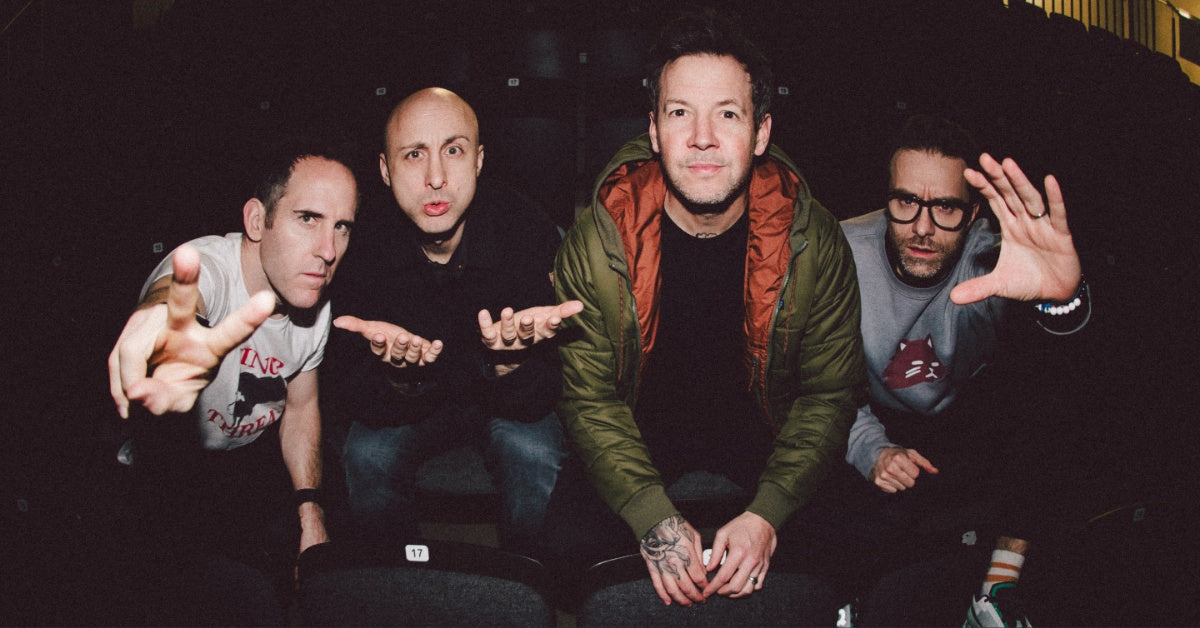
Simple Plan recently announced their new era-spanning documentary, The Kids In The Crowd, which features interviews with Mark Hoppus, Avril Lavigne, Fat Mike, and more. Ahead of its arrival on July 8 via Amazon Prime, we’re unveiling a section from our Simple Plan Collector’s Edition. Head to the AP Shop to grab yours.
The story of Simple Plan is an underdog story. From their teen years in Quebec, Canada, they became one of the noughties’ most important pop-punk bands, all while growing up in public and pushing back against the haters. Along the way, they cultivated a devoted, tight-knit fanbase that had them in constant demand on the Warped Tour circuit and beyond over the years.
Read more: 10 most criminally underrated Simple Plan songs
Theirs is also a story of endurance. As pop punk fell out of fashion, replaced on Top 40 radio by the shinier, synthier sounds of dance-pop, Simple Plan found a way to adapt while retaining their sense of identity. Almost two-and-a-half decades on from their formation, they’ve continued to find their way into the ears of a new, younger audience, opening the gates of alternative music to many. Today, they’ve got a new generation of fans filling the seats at their shows, a legion of emerging artists inspired by their music, and as such, they’re marching on to the next phase of their career, able to call themselves pop-punk legends.

Courtesy of Simple Plan
Simple Plan’s origin story is a rather humble one. Vocalist Pierre Bouvier and drummer Chuck Comeau had been making music together as far back as 1993, playing in Quebec punk band Reset while still in high school — but it seemed like Comeau was putting music behind him, when he quit the band in 1998 to attend college. However, he couldn’t stay away from the stage for too long, especially after reuniting with high school friend Jeff Stinco, who convinced him not to give up on music. Although Stinco was involved with another band at the time, the project that would become Simple Plan began taking shape in 1999, bouncing off the sounds of Bad Religion, NOFX, and Descendents but with a more innocent, melodic touch. In search of a second guitarist, they enlisted another high school friend, Sebastien Lefebvre, who still lived locally and admired Reset. All that was missing was a singer.
Happily, Comeau stumbled into the path of Bouvier for the first time in a significant while at a Sugar Ray concert. After reconnecting, Comeau suggested Bouvier could fill the vacant vocalist slot in the nascent band. Though he was still fronting Reset, Bouvier eventually pivoted to Simple Plan, and so began their mission for greatness. They set about writing music, honing their live show, and, most importantly, getting noticed by the wider industry.
Key to their success was Atlantic Records’ A&R manager Andy Karp. “One of the things I quickly learned about them is that they’re unbelievably hungry,” he recalls. “To this day, I’ve never worked with an artist that had a stronger work ethic than Simple Plan. They always did everything asked of them and more. They signed every autograph., They flew halfway around the world and back in 36 hours to take advantage of a promotional opportunity. They’re extremely nice, intelligent people. There was a mutual respect that remains to this day — that’s why I was able to maintain such a good relationship with them, even now.”

Courtesy of Simple Plan
Work soon began on the band’s debut album, No Pads, No Helmets…Just Balls, which would eventually hit shelves in 2002. Compared to their later output, their debut took a while to percolate. Over the course of a year, the band worked to shape future hits such as “I’m Just a Kid,” “I’d Do Anything,” “Addicted,” and “Perfect” under the industrious — and notoriously perfectionist — eye of producer Arnold Lanni. While the process might have been painstaking at times, it laid the groundwork for the band to properly explode.
“I would come up from New York every two to three weeks to hear the band perform the newest songs live off the floor,” Karp adds. “The band always sounded incredible. Tons of energy, perfect three-part harmonies. My favorite Simple Plan song is ‘Addicted’ — as I listened to them perform it for me, all I could think about was how many hooks were in that song. I had told the band from the very beginning that I wanted every song to have at least three hooks in it. ‘Addicted’ had four or five. I was ready to jump out of my chair.”

Courtesy of Simple Plan
While the critics weren’t entirely sold on No Pads…, it captured the attention of legions of fans across the world, propelling Simple Plan onto a relentless touring cycle to bring their hits to the masses. It brought them illustrious opening slots with pop-punk godfathers blink-182 and Green Day, Good Charlotte, Avril Lavigne, and a co-headlining tour with MxPx, as well as kickstarted their long-standing relationship with Warped Tour. Throughout the traveling punk tour’s lifetime, Simple Plan would appear 11 times.
They jumped from the tour bus to the studio to make follow-up album Still Not Getting Any…, continuing to ride the gold rush of success while pop punk still dominated the airwaves. They were young and victorious, yet metamorphosing into older, wiser human beings, with the album demonstrating an increasing maturity in both their more straight-up rock sound and their defiant lyrics, which even ventured into social commentary on fan-favorite ballad “Crazy.”

Courtesy of Simple Plan
While the band were already on their way to becoming a cornerstone of millions of kids’ coming of age, they also formed part of childhoods in a whole other way by performing the titular opening theme to What’s New Scooby-Doo? They would go on to develop a deeper connection with the animated show in the future by voicing themselves in the episode Simple Plan and the Invisible Madman, and their original music — including “I’d Do Anything,” “You Don’t Mean Anything,” and “The Worst Day Ever” — also cropped up in subsequent installments, as well as in the live-action motion pictures. The theme tune even remains a fixture of their live set to this day.
Subsequent years, however, would prove more challenging as Simple Plan set to work on their self-titled third album. As great as it might be to live the dream in a touring band, reality began to bite back when Bouvier’s brother Jay was diagnosed with cancer in 2006. It inspired the song “Save You,” as well as for Bouvier to shave his head in solidarity (though, fortunately, Jay was declared cancer-free the following year). Its poignant music video, meanwhile, brought together other Canadian musicians and music industry figures who had survived or were recovering from cancer.
The other major hurdle in their paths was rather different — they had to work out how they could continue to flourish when guitar music no longer had the same grip on the zeitgeist it did in the first half of the decade. In alternative music, pogoing was replaced by moshing as metalcore and post-hardcore became all the rage, while the mainstream was dominated by the shiny sounds of electropop. Indeed, for Simple Plan, they employed a strategy far more commonly relied on by pop stars, namely by working with three different producers, including renowned pop behemoth Max Martin.

Jo Hale/Getty Images
Nonetheless, it kept their heads above water. As a new decade began, however, they struck gold in a way bands rarely do when they’re a decade deep. Their fourth album, Get Your Heart On!, was packed with big-name collaborations, with everyone from Rivers Cuomo and Alex Gaskarth to Natasha Bedingfield, but a more left-field link-up with dancehall megastar Sean Paul on “Summer Paradise” massively refueled their engine, cinching them a place in the charts and becoming an unexpected crossover smash.
“It was a risk for us,” Comeau admits. “It was very different from what we’d usually do, but at the same time, we loved writing it. To see that risk pay off was amazing — our fans loved the song, and then on top of that, we were able to reach all these new people who had never heard of our band before. It was a home run for us later in our career, which is pretty rare. If you’d told me in 2002, ‘One day you will have a song with Sean Paul on your record,’ I would have laughed and said, ‘You’re out of your fucking mind.’”
While Simple Plan continued to prosper through times that saw rock bands consigned to more niche circles, which was bolstered by their 2016 album, Taking One for the Team, a new decade would herald yet another change in trends that weighed in their favor. As people turned to the comfort music of their youth to help them find joy within the seemingly ceaseless gloom of life in quarantine, pop punk from 20 years ago got to enjoy a second trip around the sun. The band were no exception to this, with their early hit “I’m Just a Kid” getting exposed to a whole new generation of listeners through a trend on TikTok during the pandemic. Even then, the band weren’t aware of it at first — it took a text from Bowling for Soup’s Jaret Reddick (who’s notably taken the platform in his stride) for them to see what had happened, but it made all the difference. The song’s popularity rebounded so strongly that they recorded a new version featuring LØLØ two years later.

Courtesy of Simple Plan
“That was another highlight of our career,” Bouvier explains. “A big challenge of being in a band is to remain relevant and remain in the spotlight. It was such an endearing viral moment, and it’s created a lot of cool memories for people. I feel very grateful that happened, because I can tell you that we had nothing to do with it. It really helped us connect with social media, and it’s really shifted our perspective on how important social media is. I think it’s helped us connect with our fanbase — it’s helped us connect with people that would have never heard of the band before. I think it’s great that we can play that song almost 25 years later, and people love it, and it’s created a new moment in our set.”
Two decades on from their formation, Simple Plan are thriving. Their most recent album, Harder Than It Looks, came out in 2022, and they’ve continued to prosper, remaining a constant of pop punk regardless of whatever’s in fashion. Their tank is far from empty, especially now that their crowds are filled with multiple generations of adoring fans.
“A friend from my childhood sent me a video, and he was at his office party, and they were doing these little performances. One of his colleagues, this young woman probably in her mid-20s, was singing ‘Welcome to My Life,’” Bouvier recalls. “I was like, ‘Oh, my God, this song probably came out when she wasn’t even listening to music, and now she’s singing it. It’s pretty cool.”