
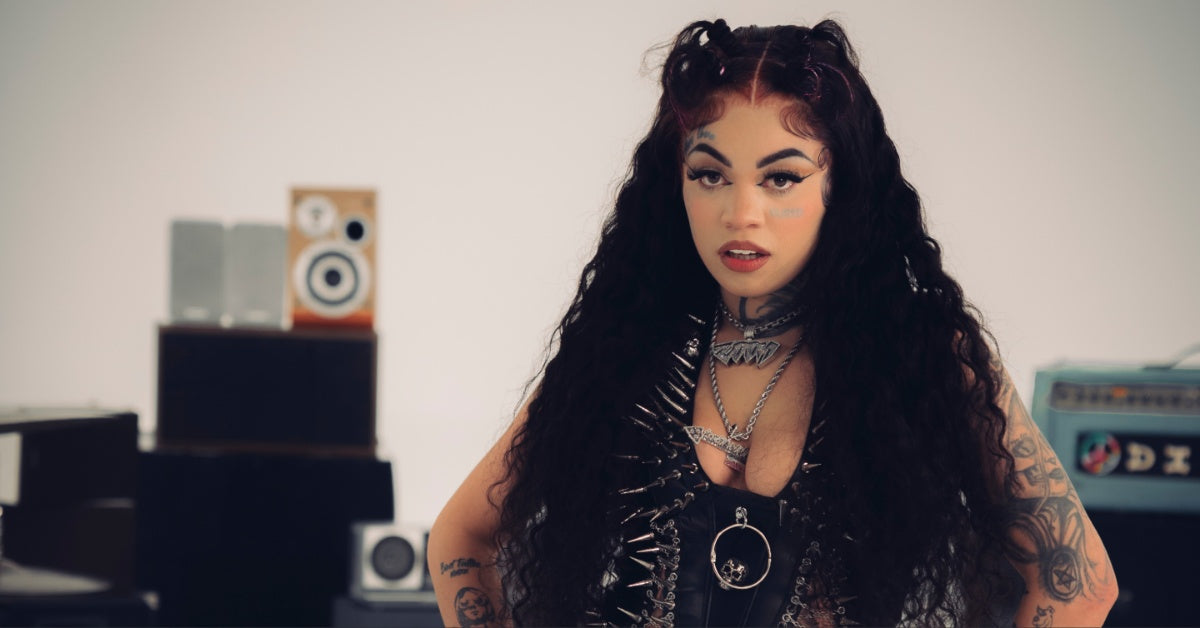
Rob Cavallo has produced the who’s who of generational, turn-of-the-millennium rock albums: American Idiot, The Black Parade, and Brand New Eyes, to name a few. But when he first met and recorded with Los Angeles-via-Pittsburgh vocalist Keyawna Nikole, an artist who grew up idolizing the projects Cavallo produced, it was a revitalization of his earlier work’s punk spirit and led Nikole to find her self-proclaimed “hood alt” sound. Those sorts of full-circle moments have been the throughline of Nikole’s blossoming career, whether it’s been extensively recording with Cavallo, working with Kellin Quinn on her 2023 single “Secrets,” or collaborating with Pierce The Veil’s Vic Fuentes, who told her in passing that she’d be a rock star when she was 10 year -old.
Now equipped with a project’s worth of material produced by Cavallo, Nikole is ready to tell her story. From sleeping in her car in a Denny’s parking lot after driving across the country to working with Wiz Khalifa-producer Ricky P and ascending the industry ranks, she’s met adversity in her adolescent and young adult years with an undeniable fervor.
Read more: Emo Nite remains a love letter to 2000s nostalgia
One of the standout moments from Nikole’s recordings with Cavallo is “Bleed,” a much-teased pop-punk triumph that marries an enduring chorus and heart-on-sleeve poetics with a feature from alt-rock experimenter and hip-hop legend Lil Wayne. The collaboration between the two came from a chance meeting over Instagram DMs and led to a single and video that crystallizes Nikole’s charisma as a nascent voice teeming with potential.

Mac Marshall
After weeks of hinting at “Bleed” through a variety of viral social media posts (which arrives this summer), Nikole’s first order of business is to reveal “Bury Me,” an earworm of a lead single that solidifies her artistic evolution since entering the studio with Cavallo. There’s an unmistakable alternative grit underlying the track, while Nikole’s vocals have a melodic sheen that peaks on the single’s snappy chorus.
Before the release of “Bury Me” and “Bleed,” Nikole and Cavallo sat down with Alternative Press to discuss their lightning-fast recording process, balancing the former’s fiery passion for music with the latter’s wisdom and experience, and Nikole’s unique perspective as a Black woman carving a path through the alternative scene for others to follow.
Who were some of your earliest musical influences? What inspired you to pursue alternative music as a solo artist?
KEYAWNA NIKOLE: My first concert ever, that was alternative-rock music, was My Chemical Romance. I remember being there and being like, “This is just the most incredible thing I’ve ever seen.” After that, in eighth grade for my 13th birthday, I got tickets to Pierce the Veil for the Collide With The Sky tour… I remember standing there and being like, “Oh, my God.” My whole life changed. At that moment, I was like, “This is exactly what I want to do.” Pierce the Veil, My Chemical Romance, Green Day, and Paramore [were my influences]. And ironically enough, Rob did almost all of them.
Rob, what is it like producing these records that were impacting young people on such a deep level?
ROB CAVALLO: It hit me in phases. When I was really young and I had done these records, we would get these letters from people. Back in the ’90s, there was America Online, and I had an email. This is at the beginning — there were barely cellphones. It would say, “You’ve got mail,” and all of a sudden I had 700,000 letters, and they were all basically the same. It was like, “Is this the Rob Cavallo that produced Green Day’s Dookie? Because we can’t find [you] anywhere else. So I just want you to know you made it so I got through high school,” or, “You saved my life. I was going to commit suicide.” I kid you not. There were so many of these. It just really warms your heart to know that you’ve had some kind of helpful or positive influence, in the sense that you know these records touch people’s hearts and minds. Still to this day, I pinch myself. It’s amazing.

Mac Marshall
Keyawna, I saw in a previous interview at that Pierce the Veil show, you ran into Vic, who you’ve now collaborated with. I imagine that was a full-circle moment.
NIKOLE: It’s so crazy that I have a scrapbook from that concert. That was the defining moment from when I was 12 that my life was going to change. At that show, we were so little. We were getting knocked over. The security guard noticed as people were exiting the building [and said], “Why don’t you guys walk out of the backstage door?” We got bumped into by Vic, and he’s like, “You’re gonna be a rock star one day.” Because all I could say was, “I’m gonna make music, too.” I was in shock. And it’s so funny to me that almost 10 years to that exact date of that show, I was doing a session with Vic, and we’re friends. We’re genuine friends.
What was it like for you moving to Los Angeles and diving into the industry?
NIKOLE: I was a freshman in college in Pennsylvania. I woke up one day, and I said, “I don’t want to live here anymore, and I want to make music.” There had been a lot of loss. My little sister, she’s going through a really rare genetic disease called Eagle-Barrett syndrome, so I was trying to be very close, just in case something happened. [But] I woke up one day, I got in my car, and I drove myself from Pittsburgh to Los Angeles in 74 hours. I got here and realized I didn’t know anybody. I didn’t know where to go. I had $1,203 to my name. I lived in the Denny’s parking lot in my Kia for the first week. I got on Instagram because Denny’s has Wi-Fi, [and] I ended up finding a position to be a studio runner and personal assistant for Ricky P, one of Wiz Khalifa’s producers and engineers. That’s how I was like, “OK, well, I’m gonna get into the industry. This is what I wanted to do. This is what I came here for.”
How was it making that jump from coming out to Los Angeles and living in your car to making these connections and integrating yourself into the scene?
NIKOLE: The first year, it was all happening simultaneously. I was in the worst position I’ve ever been in my life, but I was [also] in the best situations. I was at the best events. I was working with really great people. I was making my way into the industry. I would have rather lived in my car and been pursuing my dream than waking up in a pretty nice townhouse in Pennsylvania and looking at a cornfield. I started meeting people in the studio. I was taking cheaper payments in agreement to who I was working for, Ricky P, to produce and engineer for me at the end of my shift. It ended up going really well, [but] it was difficult. Homelessness sucks. That is probably the worst experience ever… but it’s honestly what made the story and made these records and made these connections happen. If I didn’t live that, I wouldn’t have the story to tell through the music we make.
Rob, when did you first meet Keyawana, and what were your first impressions of her and her music?
CAVALLO: We met at this little rock ’n’ roll house, like the proverbial rock ’n’ roll house, a bunch of dudes living together in the Valley. We go in there, and, for me, because of my punk-rock roots, I immediately feel comfortable. I go, “Fuck yeah, this is real rock ’n’ roll. It’s not some fancy schmancy, million-dollar studio, right?” I honestly can’t tell you what happened, other than I met Keyawna. She’s telling me all of the records that she likes. I’m like, “OK, I think she’s awesome.” Then literally 15 minutes later, we had the first song. We made it, bang, it’s called “Bury Me,” which is actually the first single that’s going to come out. Then half an hour later, boom, we did “Bleed,” which is the song that’s now got Lil Wayne on it… next thing you know, we had a body of work: 18 songs. Most of them were written within half an hour. It was one of those clicking, magicky kind of things.
NIKOLE: I’m honored that Rob took the time to breathe on my record. He’s become one of the most important people in my life. It’s a full-circle moment for me, too. I had these CD books, and I was highlighting who was making the music. Rob’s name was on 99% of the music. To actually become close with this person, then make a body of work that’s my most vulnerable body of work… because I’m really telling some dark shit. I’m talking about where I started. I’m talking about really deep loss… Rob was able to help me format that into an actual body of work that I’m proud of.
What lessons have you taken away from working with Rob?
NIKOLE: I’ve become an entirely different artist in the process of working with Rob. I found a confidence that I didn’t have before. I went from making records in the closet of hotel rooms that I was renting because I didn’t know where to live to making records with Rob Cavallo and just projecting my voice in a different way. The scenery is different. My feelings and where I’m at in life are so different from where I was when I was releasing my first records. I learned how to be confident… I’m so proud of these records that when people are like, “Oh, what’s your Spotify?” I’m like, “Nah, just wait till next month.” That was solely taught by Rob, and being around Rob, and just seeing Rob’s energy in the room and how excited he is for my records.

Mac Marshall
I’d love to talk about “Bleed” in particular and getting Lil Wayne on this track. Can you take me through the creative process of this one and what it was like getting Wayne involved?
NIKOLE: Every day I wake up, and I’m like, “How did I do that?” The whole time in “Bleed,” I’m really talking about surviving a couple intense situations. I was really specifically talking about a relationship I had survived that was very violent and unsafe for me to be in, and how you could love somebody so much that it makes you stop loving yourself, and it makes you get to a point where you would be OK with not being here. “Bury Me” and “Bleed” both have a theme of not wanting to be alive anymore, but at the end, finding a way to cope. They both follow that same type of theme, because the day I came in to do that session, I was genuinely at my breaking point mentally.
When I got to the session with Rob, I was at a point where I was like, “All right, we’re gonna see how this goes.” But I had already checked out mentally. After doing both of those records, but specifically “Bleed,” I realized that I had a purpose, and I still had a reason to be here… When people have been hearing the music and they’ve been messaging me [that] I’m their reason to live… It’s now become a record of triumph, because Wayne had heard that and related to it. It’s really proof that your work will pay off.
CAVALLO: How did you get it to him?
NIKOLE: I had just done a show at the Viper Room, and I had been posting the videos from it. I posted the video, and I saw at, like, five in the morning, Lil Wayne posted five seconds ago. I was like, “Wouldn’t it be hilarious if I just DM him the footage of our band playing? He’s never gonna see it.” So I just sent it to him. I don’t even say anything. I go to sleep, I wake up. He replied. I started freaking out. He messaged me, “I love your shit.” I thought that’s all it was going to become — just a compliment.
I came to the studio. We’re sitting there recording, [and I] get another message: “We should work on something. I’ve been listening to your music. What’s your number?” Over the next few weeks, I ended up introducing him to his newest Young Money signee, Lucifena, which is amazing. We all just started communicating and working, and he had asked for some music. I texted him a couple records, like three or four, and he messaged me back: “‘Bleed’’s amazing.” I feel like it was just a very relatable thing. That man’s a rock star. I don’t care what anyone says. He loves, appreciates, and wants to understand rock music for real. There’s no reason he should have ever even given me the time of day. Honestly, I have no ego whatsoever. I feel the same way with Rob. Rob had no reason to give me the time of day.
CAVALLO: Yeah, I did. [Laughs.] You’re good.

Mac Marshall
What do both of you hope people take away from hearing “Bleed” for the first time?
NIKOLE: I hope “Bleed” means as much to someone as it does to me… I hope somebody just knows they’re not by themselves off of that record, because I felt just as alone as you. Just know when I made that song, I didn’t even want to live that long to shoot that video. So if you can hear this song and hear what I’m saying and understand it, I am where you are. No matter where you are mentally in life, I have been there.
CAVALLO: Working with Keyawna and Rooster has been amazing. One of the things that I loved, right from the beginning, is that when I asked, “What kind of music do you make, Keyawna?” And she goes, “I make hood alt.” And I’m like, “Oh, man, that is the coolest thing I’ve ever heard in my life.” These are the earliest days of a movement. I see that as a really cool and important thing, to break into something potentially new.
NIKOLE: “Hood alt” is going to be the biggest thing ever! There’s a lot of people like me who are a little bit quiet, shy, emo, misfit kids. I want to be that example for those women. I’m sure everyone says this, but I got bullied badly. I wasn’t Black enough to be white, and I wasn’t white enough to be Black… so I didn’t fit in a demographic. Being emo, all those kids were like, “Girl, why aren’t you listening to Future?” That was something I couldn’t relate to a lot of people on. And I want to be that voice for [them] now.