
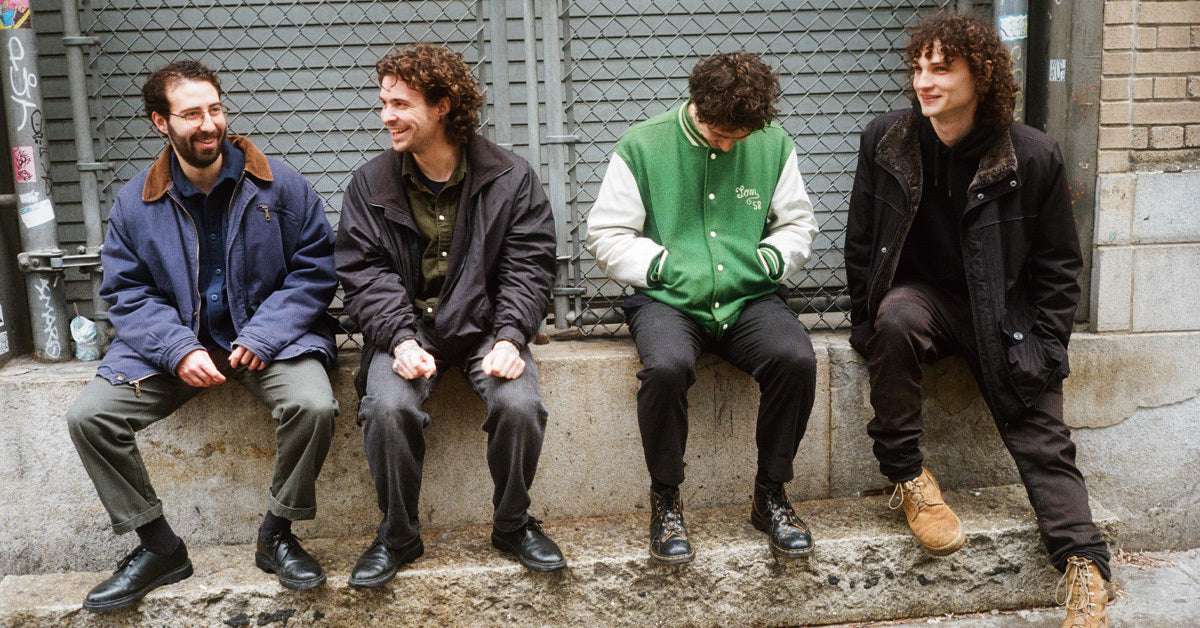
Over the last few years, I have loved a lot of music. But the moments where a sound or set excites me, where the high of experiencing true originality hits — they’re few and far between. With YHWH Nailgun, NYC’s avant-garde quartet — that buzz has yet to wear off, time warped by their idiosyncratic identity, a fusion of industrial sounds, electronics, and visceral poetry. Since YHWH’s 2022 EP, the group has only become more intoxicating, each show, song, lyric a severe and gut-wrenching offering, holding a mirror to nothing but itself. How they got here is ironically simple. It’s a concept derived from Eastern religion — detachment. Freedom from the bondage of craving and dissatisfaction. Through their practice — of detachment and of music — their work is stripped to the bone. Group intuition, synchronicity, and harnessing the essence of YHWH become the solitary goal. Timeless art becomes achievable. This week, with their debut album, 45 Pounds, they may have arrived there.
On the new project, the band — made up of Zack Borzone (vocals), Saguiv Rosenstock (guitar), Jack Tobias (synth/electronics), and Sam Pickard (drums) — have come to YHWH with newfound focus. The project champions their signature uncomfortable, urgent, and tactile sound — though it’s evident the group’s technical telekinesis has strengthened. Whatever happened in that tiny rehearsal room, it was instinctual. On 45 Pounds, the trope of “pushing boundaries” feels almost satirical. Boundaries, here, are false idols that have long since fallen.
Read more: 25 of the most exciting rising artists to watch in 2025
Across 10 tracks, and 21 visceral, brazen minutes, sonic tension is simultaneously built up and released — a revelatory confusion of noise that comes together in a rush of adrenaline. Pickard’s drumming sets an addictively unpredictable pace, spattered with careful, cacophonic polyrhythms. Rosenstock’s textural noise-rock-infused guitar is a muscle, jumping and tightening on each explosion of song — echoed by his production style. Tobias’ anxious, pulsing synth is a vital artery, flooding the instrumentation with bright, upper frequency.

Brian Karlsson
Last year, I lathered it on for Borzone’s vocal performance: “[He] dances through [their music and show], convulsing, threatening to foam at the mouth with the unending energy of Iggy Pop, and an element of controlled focus that’s all his own.” This is truer than ever on the new LP. His poetry is gutting — his heavy, poignant lines are at times spiked with twisted Whitman-ism. “Vultures lift me by my hair/I watch their wings like a baby would/I’m on a white cloud/I’m a Russian plane,” he gushes on “Tear Pusher”— though you may not be able to interpret it in context. Through the lens of Borzone’s distorted hiss, stanzas become entrancing and sinister didactic.
That being said, after an hour with the band ahead of the release — standing out like a sore thumb squatting in the lobby of Brookfield Place, bustling with Tory Burch flats, zip-up vests, and SweetGreen bowls — I can confirm my suspicion that this band prefer the music speak for itself. But while they’ve been painted as elusive, judgmental, or as intense as their performances, that’s easily admonishable — there was no attempt at authenticity, or being “unique.” These are true luminaries — who stick to their principles, follow their guts, and thankfully for us, find inspiration in each other.
In terms of 45 Pounds, the new album, let’s talk about your process. I’m not here asking what the lyrics mean — I resent that question almost as much as artists do. But I’m curious about the evolution of your sound, your process, and what it looks like today.
SAGUIV ROSENSTOCK: The process looks very similar to the EPs. Get in the room and play, and that’s how we write. Zack takes it home and tries different things. For 45 Pounds, the recording process was a little different because we went upstate to a studio retreat for three days, and we did it there — whereas before, we were doing it in my basement, or we once went to Studio G for a day. But we wanted to get away from the city for a second, really just focus on the album…
The place we went to is basically a goat farm. People go there to do ayahuasca retreats, too. It’s really a lovely little property. They have a bunch of little animals. The writing itself is pretty much the same.

Brian Karlsson
How do you think the change of atmosphere — maybe even the addition of live animals — played into the album?
JACK TOBIAS: Our Pet Sounds moment.
SAM PICKARD: I think all of us can probably be sensitive to that kind of thing. You know what I mean? The way, for better or for worse, living in New York and doing everything in this practice space the size of a closet totally informs your experience of making music. So it’s cool to transplant that to somewhere that’s beautiful. There’s a little less of a sense of urgency to it, where it felt like we could just hang out, and do the recordings.
Your music certainly has a lot of urgency.
PICKARD: Well, we’re urgent guys, as you might be able to tell. I think part of it is all of us are just focused on making the song, and not hanging around too long on any one thing musically. Not trying to milk it too much, just be direct.
This is a big, wide-open question — what is your relationship to music?
PICKARD: When it hits you, you feel no pain. That’s the beautiful thing about it.
ROSENSTOCK: This is a weird way to answer it, but it feels like music is me. I’ve just been doing it for so long that I don’t feel like there’s a particular relationship. It’s kind of fused. It’s everything, all the time.
TOBIAS: All four of us are supposed to be doing this, you know? That’s what feels natural about it.

Brian Karlsson
ZACK BORZONE: I really like a band as an art form, too. It holds everything that I want to do in art. Not everything, everything, but you can do a lot of cool stuff in a band. I like that it’s between you and your friends. A band, specifically, is a nice thing. And music, I guess, is a place to drain all ideas into all different media.
PICKARD: That’s a good way to put it. I think, for me at least, it just winds up being the baseline of things, playing music. If I am thinking about something, it just sort of emerges playing music, so it feels interwoven, but I don’t know if I really can point to a relationship…
ROSENSTOCK: It’s a relationship to yourself. But I think in the more material way, what Zack is saying is true, too. When I go out, it’s to a show. Most people I know are from music, kind of in the same way that you’ll see religions conglomerate in little communities. It’s a similar thing.
PICKARD: It’s really helpful for me to think about it as the thing I do, and just sort of leave it at that. I feel like if you push that too much, you can get really self-congratulatory. We’ve talked about it trying to look at it as like, we’re doing this — but it’s not like this band is me, and the expression of me and my great ideas. It’s more just participating in this thing that extends outside.
BORZONE: This is so you can have a neutral relationship to it.
That’s an important point. I feel like with anything creative, the second something becomes a capital C “career” or a capital P “project,” for me personally, it’s easy to get resentful and jaded.
PICKARD: Definitely. I saw a clip of John Frusciante a while ago, talking about how when you sign up to do music — you’re signing up to do nothing.
TOBIAS: I totally know what he means. Even just in a practical way, so much of the day-to-day of doing music all the time is waiting around on tour, waiting in a car, and even when actually doing it, we write songs in 15 minutes sometimes, and then we’ll just chat the rest of the practice.
ROSENSTOCK: It’s like 80% hanging out, 20% [playing] . But I think it also takes time to get to that place where you’re able to have a neutral relationship to it and also some technical skill to be confident.
Did you guys have a stage where your relationship with music wasn’t neutral?
BORZONE: Yeah. It wasn’t before the band. I think it clicked for me when we started YHWH.
ROSENSTOCK: I don’t remember. I don’t remember anything before the band. [Laughs.] When I was younger, probably in my teenage years and very early 20s, I can remember really wanting things with music or out of music. Wanting things, wanting opportunities, wanting to feel like I was doing something right. Having a neutral relationship, for me, feels like not really wanting anything in particular. Obviously, we want to put the record out, but it feels good for me to just let go of it and be like, “OK, this is what we’re doing, and we’ll see what happens.” It’s not having expectations.
Expectations are planned resentments. I can imagine that when you literally are putting an album out, maintaining detachment is something you’d have to grapple with differently.
ROSENSTOCK: Good question. For me, we finished it a few months ago, so I’m like, it’s done. We did everything already.
And you’re onto the next?
ROSENSTOCK: Yeah. That’s how you stay that way.

Brian Karlsson
From 45 Pounds to the next project, is there something in your sound previously that you’re hoping to riff on or diverge from?
BORZONE: You’ll see. We’re all really excited.
TOBIAS: We’re communicating with each other in ways that I feel are becoming more and more vague. It’s cool, and really interesting.
BORZONE: Honestly, it gets more mysterious as you go.
PICKARD: I actually feel like I have less of a clear picture of what’s going on than I ever have. [Laughs.]
And it’s good, it’s part of the neutral thing. I don’t need to have it defined for myself right now.
BORZONE: The further you go into that, too, the more detachment you can have with it, the more simple your choices become. You make choices from a place that you don’t really understand for reasons that you don’t understand, and it happens really quickly. That’s when, a year later, you see what you wrote, lyrics or music or whatever, and you’re like, “Wow, I was really in touch with certain things.”
You’re using your gut, not necessarily your brain. So, if you’re not looking directly for references in music, are there other mediums, themes, or experiences that you are drawing from?
BORZONE: Definitely. But I don’t know if it’s necessarily concrete — it’s kind of everything.
PICKARD: It’s almost like literally everything. Even stuff that we want to avoid winds up cropping up in weird little ways.
TOBIAS: It’s interesting. When we write, it happens really naturally and in the moment. Then, like what Zack said earlier, listening back, it’s like, “Oh, I know where my head was at when I did this specific sound.” And our practice phase is interesting — for me, in the way it’s arranged. It’s really tiny, and I face a wall in it because there’s no keyboard stand, and I’m not looking at the rest of the guys. So when we write, it does happen really naturally, but I’m kind of in my own little world in the moment. Then when we’re listening to a demo or something later, I’m like, “Oh — what I think I was thinking about in that moment — I can only interpret it, because it’s not what I’m thinking about now.” So, it’s weird. Ultimately, I don’t really know what I was thinking.
PICKARD: Because you’re in timeout.

Brian Karlsson
Who are you guys listening to right now?
PICKARD: We all have our own little sphere of what we particularly like, but I feel like constantly we’re just absorbing the stuff the others are into.
TOBIAS: I started listening to Radiohead — for kind of the first time — in a really in-depth way. It’s insanely good. I’ve also been really into Sun City Girls, who I really liked in high school, but I didn’t listen to ’em for years. I was like, “It’s too fried hippie for me.” But I got into some of their solo stuff recently, and then in a roundabout way, I’ve gotten back into the band.
ROSENSTOCK: My friend just showed me the Bulgarian female vocal choir. It’s crazy the shit that they do. It’s so good and it’s very, very technical. They’re so proficient, but it’s also emotive. The other one I’ve been listening to is Bob Dylan — I just got off a tour, and his crooner album was playing in the car.
BORZONE: Did you see that he posted a video of Machine Gun Kelly? It’s like an in-store, Tiny Desk U.K. show? He’s rapping. There’s no caption or anything.
No matter what the comment sections might say, Dylan knows what he’s doing. He can be a troll, but he’s also a guy who loves going down carefully curated wormholes, gathering information.
ROSENSTOCK: He’s inscrutable. Definitely one of the coolest guys, ever.
This book I’m reading about Springsteen mentions how, maybe 15 years ago, Bob Dylan was detained by police trying to get into a New Jersey home. It was the same house where Bruce wrote Born to Run — but under new ownership, and they called the police. Didn’t believe it was actually Dylan. He also famously went in disguise to visit John Lennon’s house. He’s a man dedicated to getting the full story when it comes to music that’s important to him.
TOBIAS: That all makes sense. My friend from Winnipeg was saying he went to the same high school as Neil Young. He said that his brother-in-law once heard a knock on the door — it was Bob Dylan, looking for Neil Young’s house. I respect him. We actually just had an NTS show, and Saguiv played a Bob Dylan song.
Which era?
ROSENSTOCK: It was “Like a Rolling Stone: Live from Albert Hall,” where the drummer does the snares… Honestly, it’s such a good song — exhilarating. Not a lot of songs have that true euphoric feeling.