
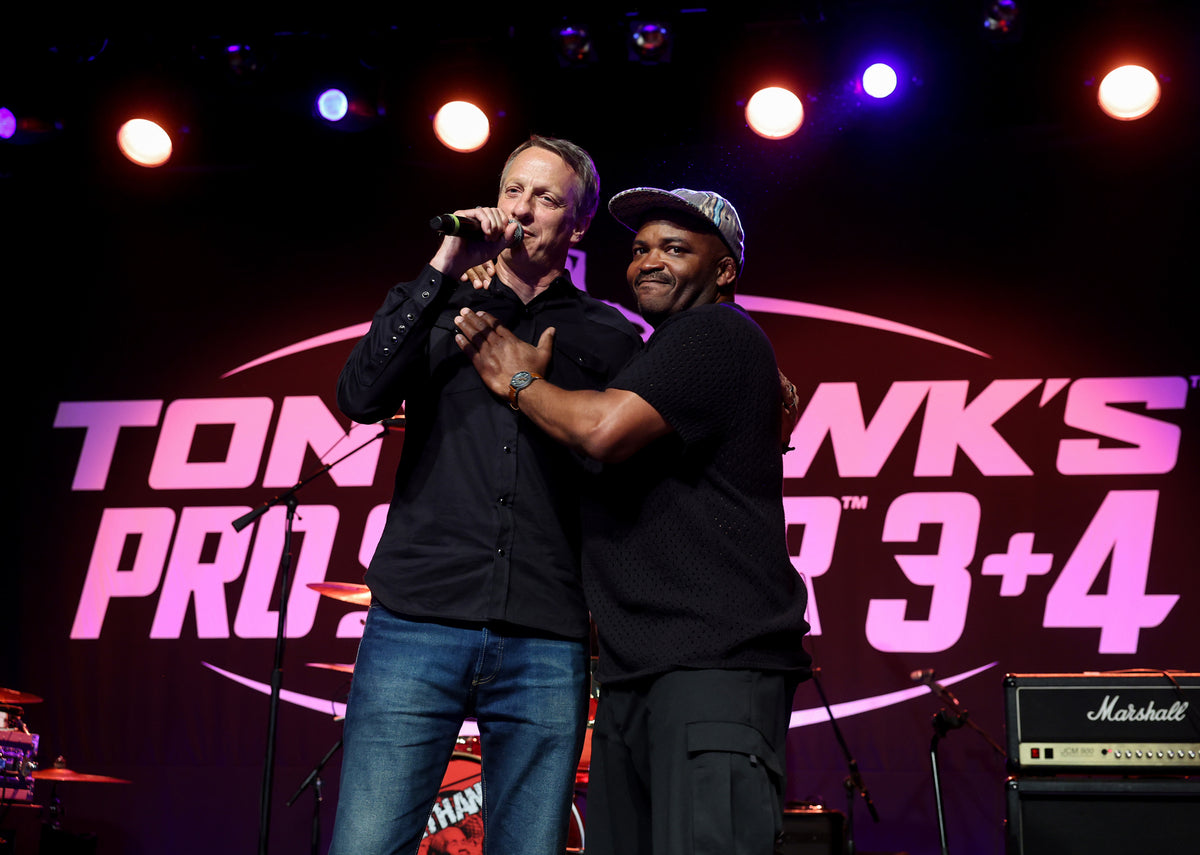
Two questions had flooded my DMs by Friday morning: “Did you play the game?” and “Is that BAM?!” The night before, I’d attended THPS Fest at El Rey — as much a celebration of the forthcoming reissue of Tony Hawk’s™ Pro Skater™ 3 + 4 as the game’s legendary soundtracking, presented by AEG and Activision. It was a millennial punk’s dream, even one who can’t skate — standing elbow to elbow with pro skaters I’ve long admired (many of whom I’d disgraced with my shoddy gaming skills during hours on friends’ basement PCs growing up) and waiting in line for catered Taco Bell next to bands like the Adolescents, who’d shaped my middle school punk-rock awakening, and were one of the first patches proudly pinned to my Jansport backpack.
Read more: How DENCITY is providing a safe space for women and queer skaters in Nigeria
The forthcoming rerelease of 3 + 4 in July comes with a flurry of anticipation. The 1 + 2 remake in 2020 saw exciting nuances — an updated cast of characters, and a few songs, that fuse the old guard with the contemporary skateboarding world, with the addition of Nyjah Huston, Leo Baker, and Lizzie Armanto, and new tracks from Destroy Boys and Skepta. The first few waves of 3 + 4 announcements let us know that we’re in for some similar revisions, fit for 2025 — with the additions of Rayssa Leal, Jamie Foy, Zion Wright, and more, skating to new tracks, by artists ranging from Turnstile to Kendrick Lamar. “There’s so much talent out there, and there has been a lot of talent developing through these last 20-plus years since the last game was released,” Tony Hawk tells me, from his trailer behind the iconic LA venue. “It’s tricky, but I feel like we have a really good mix of skaters that’s inclusive, and some of the best talent.”

Randy Shropshire/Getty Images
At AP, we constantly find ourselves toeing the fine line between respecting the past and empowering the present. Not everyone loves the latter — they’re looking for the nostalgia itch to be scratched. This is familiar territory for Hawk, too: “We’re remaking THPS 3 + 4 — it’s all nostalgia.” He explains, “We brought the best, in terms of the levels, the skaters, and the music. I just wanted to mix it up a little bit.” He unpacks the soundtrack, which has “his signature” on it more than any game previously. “We picked a few new songs by the old bands. We do have some of the classics and some newer songs that I’m really proud of. I feel like we kept just the right amount of nostalgia. That’s my defense.”
In a world that wasn’t always as accepting of “selling out” as it might be in today’s post-social media age, from the jump, THPS did something groundbreaking. It brought the undeniably intertwined worlds of skateboarding and alternative music to the masses — introducing families in suburbs, cities, and the like to the subcultural scene. But in creating a global phenomenon, Hawk didn’t have a light hand. There was no watering down in the digital world he imagined — made clear by the inclusion in THPS 1 of the politically charged Dead Kennedys track “Police Truck.” It’s a game, for sure, but it’s just as much a cultural Trojan horse that changed the trajectory of lives, careers, and communities globally. “I feel like THPS definitely informed my path,” Baker comments. “As a kid, I barely knew what a career even was. But I had THPS, so I was like, ‘Mom, I want to be a pro skater!’ I’m, like, 8 trying to figure out how to kick flip outside. It gave me a path to follow. I saw pro skaters I look up to, and now skating is cool. You get to meet your heroes.”

Randy Shropshire/Getty Images
Thursday night’s event was hosted by sports commentator Selema Masekela, skateboard host and former Activision capture artist Steezus, and THPS skater Nora Vasconcellos — at El Rey, which will be a new location in the game. While I dodged all offers to try the game out with the eyes of in-game pro skaters like Chloe Cavell watching me IRL, we watched four featured artists from the Tony Hawk’s Pro Skater 3 + 4 in-game soundtrack hit the stage — San Diego pop-punk outfit Urethane (with OG in-game skater Steve Caballero on guitar), the Adolescents, Danny Brown, and Lupe Fiasco. “Music has fueled skating in a lot of ways,” Jamie Thomas tells me, while the bands play. “The creativity that musicians have shown and displayed throughout time has really inspired skating, and the feeling of the music also inspires skating. On the way to the spot, all the best skate videos have been put to amazing music, and I don’t think that skateboarding would be what it is without music, in the background making it all come together.”
Famous for hosting a wild cast of secret skaters — 1 + 2 saw Jack Black, the Powell Peralta mascot “The Ripper,” and more — Tony Hawk’s Pro Skater 3 + 4 is proving to be no different. During the fest, Canadian skater Andy Anderson, known for his diverse style, was announced, alongside the return of Bam Margera, a featured skater on the original THPS 3 who needs little to no introduction.

Randy Shropshire/Getty Images
Though I can count on one hand the times I’ve been starstruck, I bee-lined to Margera as he sauntered off the red carpet. It was imperative I ask him about a very specific subject: HIM, a band his in-game character repped on a T-shirt. He’d always been my favorite player, and as a tween who wore too much eyeliner, the shirt had a lot to do with it. What a relief, for 30-year-old me, when all these years later, he seemed overjoyed to touch on the subject. “Gothic type rock [still] soothes my ear,” he beams, continuing, “I was picturing this game as dressing like a character in Mortal Kombat or Street Fighter, so I drew all over my jacket. I was shirtless, so you could see the tattoos I had at the time, and I had some pirate hat on. It’s fun to pick me!”
But on the symbiosis of skating and music, Margera had more to say. “You could work on a three-minute video part for one year, two years, sometimes even three. And if your song sucks, your part sucks. It’s that simple. As long as the music is good, then you’re already 50% on your way to a good part. If you have the right song playing, you can even win contests, because you’ll get so hyped!”

Randy Shropshire/Getty Images
Regardless of their origins, their style, or which generation they fall into — music, it was clear, had informed each and every skater, in and out of the gaming universe. Whether it’s used for a video part or playing through headphones at the skatepark, each pro skater I spoke with had a strong reaction to the topic. “The connection between skating and music is pretty much on an art form level,” new addition to THPS Jamie Foy describes. “It’s a creative dynamic. You have a drum set or guitar, and that’s your tool. You have a skateboard. That’s a tool — and pretty much, the world is your oyster. Some people might say it’s not good. Some might say it’s the sickest thing in the world. It’s the freedom to do whatever you want and just have fun with it.” Bob Burnquist, a character in the game since the first iteration in 1999, gives his take, “The excitement or motivation, when you’re trying a trick — depending on what song, you can go heavy, with Metallica or Slayer when you’re getting up, falling, getting up, slamming. It takes a certain energy. But if you’re competing and throw something like that on, you might explode.” The “fakie 900” inventor goes on, neatly tying music, skating, and gaming together: “It’s all frequency, how you feel and how you skate. Having a soundtrack to your skating is great, and the parallel is having a soundtrack when you’re playing a game. That’s why it’s so tied in. You’ll see that in video games, and in video parts.”
The THPS game has been influential for pro skaters on a visual level as well as audio, bleeding into their careers by offering a dynamic way of trying new tricks, and exploring possibilities — even though many of them skate with the proficiency of video game characters already. “The first time the game came out, there was a closeness to skateboarding — big ollies, airs, flips — but then you would kick flip, and you could do another one,” Burnquist explains. “That was like, ‘Oh that’s a trip.’ You can flip, and flip again. And I remember I learned the Samba flip, which became a flip in another game by seeing the flips and flips and flips. It came from video game inspiration. Obviously, I can’t ollie into a tall building and grab a secret tape, but maybe if I had a big enough ramp… I could.” And I’ve got no doubt about that.

Randy Shropshire/Getty Images