
Welcome to AP&R, where we highlight rising artists who will soon become your new favorite.
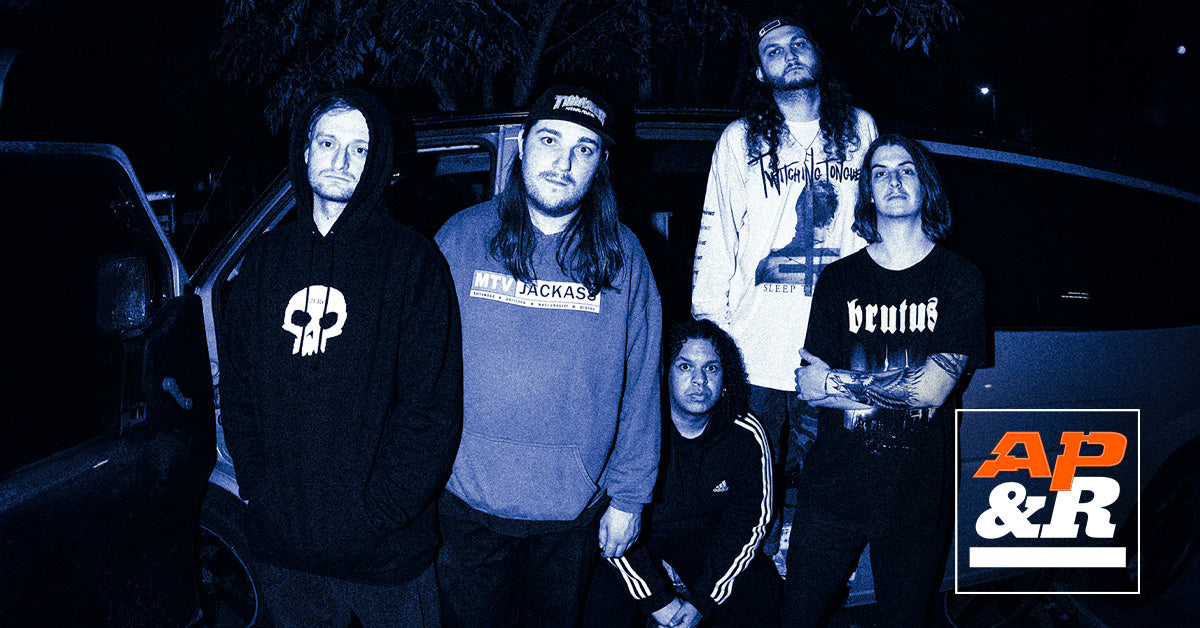
It feels like Split Chain are everywhere. The Bristol-based nü-gaze crew — comprising vocalist Roberto Martinez-Cowles, guitarists Jake Reid and Ollie Bowles, bassist Tom Davies, and drummer Aaron Black — never expected their music to go this wide, racking up millions of views without releasing a proper album. Even so, there’s a hypnotic, assertive power at its core. Their songs are painstakingly DIY but laid out over a deafeningly heavy mix of Y2K emo, shoegaze, and grunge that reflect on toxic homes, addiction, and burnout. In the process, they unravel a similar throughline — living through anguish and having a greater appreciation for the people around you.
Perhaps no song better sums up that ethos than “(Re)-Extract,” a revamped version of an early hit that coincides with their signing to Epitaph Records. Featuring Canadian duo Softcult, the update possesses a grunginess that runs up against a spiraling chorus and delicate verses from Phoenix and Mercedes Arn-Horn. “You’ve got choices,” Davies says of the song’s meaning. “You can either face up to the bullshit you put yourself through and try to make something better of it, or you can carry on down the path, except it’s part of your life and just take it to the grave.” The bassist picked the former, turning toward sobriety and playing music to avoid old vices, which soft-launched the band. “It’s all very personal, but the main points are always getting out on the other side for the better as well — not getting out the other side and being worse off for it. Sometimes this shit happens because it needs to.”
Read more: 9 bands commonly mistaken as emo who really aren’t
Over Zoom, Split Chain shared their surprise over their breakout, coming-of-age soundtracks, and becoming adopted by the hardcore community after opening for GEL this summer. Our call also overlapped with the announcement that they’ll tour with Thursday and Silverstein next year, who the band grew up listening to. The run will mark their U.S. debut, where they’ll play 2,000-cap rooms and continue to find their people, spreading light however they can.
What was the first concert that you remember going to?
TOM DAVIES: Mine was the Kerrang! tour in 2009. I think Mindless Self Indulgence headlined. Dir En Grey, Bring Me the Horizon, and Black Tide played. That was fucking insane.
BERT MARTINEZ-COWLES: We were both there, but we didn’t know we were both there.
How old were you roughly?
DAVIES: About 13 or 14. I was in love with Bring Me the Horizon at that point, so I was like, “I have to go to this show.” Luckily my dad was really chill about it, so he let me go, no questions asked, and I had a really good time.
MARTINEZ-COWLES: My first generic concert was Busted and McFly. It must’ve been about 20 years ago.
DAVIES: You would’ve been, what, 9, 10?
MARTINEZ-COWLES: Yeah, maybe a bit younger. Then my first cool gig was Good Charlotte at the [O2] Academy in Bristol. It was for the Good Morning Revival tour, and I was 13, and that was amazing. That was the first mosh pit I went into.
DAVIES: I was too scared to mosh for my first one. I saw it, and I was like, “No, fuck that.” I stayed on the balcony. I was like, “I’m going nowhere.” [Laughs.]
Growing up, were you a part of any sort of scene at all, or were you just bouncing around?
MARTINEZ-COWLES: Between 13 to 18 was just learning about live music, so there’s You Me At Six, Good Charlotte, Bring the Horizon, all of the bigger scene bands. Then I think around 18, 19 I started getting into emo grunge — Title Fight, Balance and Composure, Superheaven. That transformed into that emo/grunge/hardcore mix. So it was between 18 and 19, around that age, I probably started going to local shows and finding local bands. I had an old band, so we’d play with each other and do small tours.
DAVIES: I was in the MySpace scene, man. Because I’m not from Bristol. I’m from a town just outside of it, so there was a really small MySpace era — deathcore, metalcore, all that kind of vibe. I was always too scared to actually play in a band, so I’d just hang out with my friends who were in these bands and go with them to shows. I grew up in that scene probably more so than anything else. Then when I got to Bristol, it definitely became more all-encompassing in terms of the scene. It’s a blur with the grunge stuff, but my OG scene is MySpace deathcore.

Raymond van Mil
Tell me about your summer opening for GEL.
MARTINEZ-COWLES: Oh dude, so sick. Those were the nicest guys. That was probably our first proper tour I’d say, because we did three shows with some friends’ bands in November, and then we did the Superheaven run, which was only four days. The GEL one was our first proper tour. We were all really nervous. They’re a huge band. We all love them. We’ve not really done it before, and they were just so nice. All the shows popped off, and it was our first time in Europe, and that was amazing as well.
DAVIES: To listen to these bands is one thing, but then to go on tour with them and know they’re nice people on top of it, that’s the icing on the cake.
MARTINEZ-COWLES: Every night they were insane. They’re so tight. They sound amazing. It was definitely an inspiration for us to be like, “Oh shit, they’re so good. We need to get to that level.” So from that we pushed ourselves more. Being out with these bands who we look up to has just pushed us to be even better, and I feel like it is actually working. It’s making us better as a live band.
Their fans really refract their ethos. Even though you aren’t a hardcore band, you feel like kindred spirits.
MARTINEZ-COWLES: Even in Germany where we’ve never been, who knows if anyone knows us there, their fans are still all really nice to us. It’s that crossover that shouldn’t work, but it does work really well. It made us realize that there is this scene, and there’s the community, but it’s not just, “Oh, you are not a hardcore punk band. You are not this. You’re not that.” Everyone’s involved. Everyone’s always nice to each other. Everyone’s always supportive, and it’s just good shows overall.
Does it bother you when people say you came out of nowhere?
DAVIES: No, I think we agree with them sometimes because it’s all happened so quickly. We’re still sort of in our heads playing catch up with it as well. All these fucking insane opportunities are happening, and it’s just like, “What the fuck? What’s going on?” [Laughs.]
MARTINEZ-COWLES: We always say, “Why us?” We have no idea. We always say this band is something we don’t have control of anymore. It’s its own thing.
DAVIES: We were waiting for people to start calling us industry plants for a laugh — just waiting for those rumors to start happening. I can safely say that is not the case. I wish it was because it would’ve saved us a load more time.
MARTINEZ-COWLES: Probably the main reason is because we’ve been so DIY since the start. Pretty much everything that we’ve done was all actually made by us — the graphics, the videos, the photos, the website, the branding, the merch, everything was all made by us. We don’t have that thing being like, “Oh, we chose to work with this guy because he knows this guy.” We want to have control of the band, the creative aspect of it, and I guess it’s worked. At the end of the day, we did this all for fun because we all like making music, and we all love making videos and sharing that with now I guess fans. It’s a weird thing to say that as well, but that makes it just 10 times better.
DAVIES: It feels like an experiment. It’s all been very experimental from the start, just seeing what we can do with what we’ve got, trying to keep costs down. It seems to have really paid off. I think people can see that it does still have that DIY [approach], which I guess is why we do work well in the hardcore scene. I feel like it opens the gate for people a little bit because if they see a band like us, knowing that we’ve done that ourselves and built it ourselves from the bottom up, that encourages people, and it gives people the self-belief that they can also do the same thing
“Descend” is about growing up in a toxic household. How much of your songs are autobiographical?
MARTINEZ-COWLES: It’s quite a lot, to be honest. Essentially growing up, it was a very normal family, and then my parents divorced, new stepdad, things got very bad, quite abusive, etc. It got to the point where I left home. I moved out when I was 18, 19. I was pretty much on my own since then, and then I rekindled with my dad a bit, and he passed away a few years back. There’s some odd relationships because of the timeframe where I wasn’t around family, so now it’s picking up a couple of relationships with family that I hadn’t been around. It’s an odd family dynamic that I’ve dealt with for a lot of years, really. “Descend” encompasses that really toxic [atmosphere] when you’re young, especially having to deal with stepdad or someone that wasn’t there, and then they’re in your life. It just flips your entire world.
The thesis statement of your music feels like finding a way through.
MARTINEZ-COWLES: Yeah, that’s pretty much it. Especially with “Future,” the second song we did, which was based around my dad passing and having this really bad experience dealing with that with my brother. He was just really not a nice person around that kind of issue. You go through whatever you need to do. A lot of times it can be really shit, but there’s always that point you come out it on the other side.
DAVIES: That’s why we chose to rerelease “Extract” with Softcult. I think that song is really poignant in coming through shit by addiction and then out the other side into something good. Me and Bert started the band because I was getting sober at the time. I’d been drinking for ages and decided enough was enough. Essentially the band only came about because when I was getting sober, I didn’t want to go out and do too much — I wanted to keep myself safe and not fall into any bad habits again. So Bert came over and helped me through that quite a bit. Then it was just, “All right, let’s make music for fun.” As a result of that, we are where we are now.
Do you consider yourselves optimists?
MARTINEZ-COWLES: Yeah. If you think about living constantly with grudges, it’s such a boring way to live. Just hope for the best and have a good time doing it. Obviously, life isn’t that easy. Life is about making mistakes or dealing with bad stuff. That is literally part of life, but you can do that and still be an optimist about it.
DAVIES: I would say more so these days, definitely. There was a time, especially when I was a teenager, where I was a massive cynical pessimist, so everything’s shit. But I think most teenagers are like that. As I’ve gotten older, I very much throw caution to the wind a little bit and just try to enjoy it. As you get older, you realize that you’ve only got one go at everything really before whatever happens happens. So try to do most of it. If it works out, fuck it. If it doesn’t, all right.