
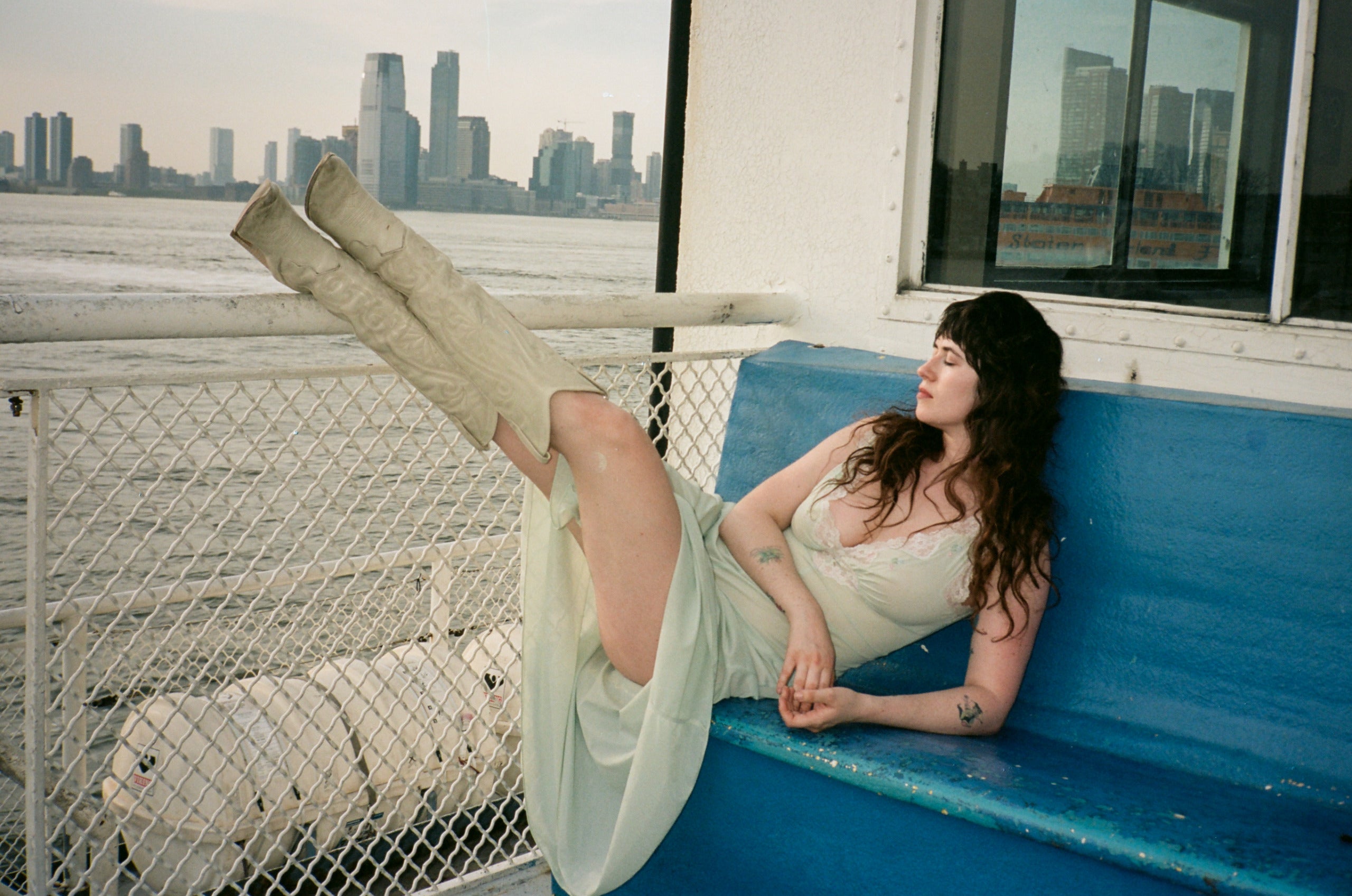
“Heaven Is a Place On Earth” is more than Belinda Carlisle’s massive 1987 hit, or a key change that’ll go down in history. According to Sedona, it’s a theology that can be applied to life in 2025 — one that fuses whimsical otherworldliness with pragmatism and psychology. “Being a human is the closest we get to heaven. It’s not something that comes after,” says the Los Angeles-based artist, who is also a part of the beloved collective Drugdealer. “I’m just trying to learn more about who I am — but that’s something you never stop doing, right until you die. So this idea of like, ‘Oh, something’s coming?’ No, it’s happening right now.”
Since the project launched seven years ago, Sedona has shapeshifted — though the throughline has remained steady. Wandering through a patchwork landscape of Americana, country, and pop, on her debut album, Getting Into Heaven, Sedona nests in a Lilith Fair-leaning alt-rock space, exploring womanhood through a personal, lyrical lens as informed by spirituality as it is the rough terrain of reality.
Read more: Soccer Mommy’s grief is bittersweet
I meet her in Tompkins Square Park, soaking in the sun and the chaos. Sedona is magnetic. She splays her brain out before me with buoyant candidness — decked out in polka dots, horn-rimmed glasses, and stick-and-poke tattoos, she pauses the interview to offer chipping commentary on every dog that passes by. Endearing and erratic, sing-song and unapologetically emotional — like a Zooey Deschanel character with sharper edges, who’d also spent years living off the J/M in Bushwick before heading west.
Her earnestness, musically and personally, is disarming. Self-described as “pagent rock,” the Sedona show takes notes from Gwen Stefani and Liz Phair, Tanya Tucker and Anne Wilson. The nostalgic, vintage air is thick, though her take on sentimentality avoids becoming overly saccharine. “Today, songs often feel rushed, much like our way of living. We’re constantly scrolling and moving without actually connecting,” she notes, adding, “I’m trying to slow down and hang out for a while. I wanna drink a strawberry milkshake on a friend’s porch and listen to the radio… to sit down and stay a while.” And it’s a statement she stands up to — peppering me with questions about myself and my own music taste as eagerly as she answers mine. I listen to hardcore off the clock — but I am a big Heart fan! I try to defend my legitimacy as her interviewer. But Sedona jumps on the latter, and suddenly she’s playing my most recent save, XweaponX, off her phone, bobbing along.
It’s hard to recall an artist as open as Sedona, especially after our afternoon in the East Village. I got a hefty dose of honesty and heartfelt human connection, which, as a writer and daily consumer of near-deadly amounts of press kits and watermarked music, makes a difference. But the 11-track debut — made independently, top to bottom — stood out from my first, blind listen, when it was nothing but an unlabeled link texted to me by a friend on the periphery. Her sound rose like oil in water, before the hours we spent sifting through childhood memories and swapping stories about being raised by musicians — and mostly, for its supreme simplicity, in spite of all the personal experience she’d poured in. For those who like grunge, punk, country, pop — and are able to put aside any outward-facing pretense and find common ground in the likes of Ani DiFranco, Exile in Guyville, even early outlaw country — give Getting Into Heaven a spin.

Sofia Ziman
I want to talk about your album. It’s so good.
You like my album?
I love it. I heard it before it came out. You’ve done stuff before with this project?
Yeah, I released an EP in 2020, right in the pandemic. I released singles the last couple years, but I just haven’t really ever had a chance to finish a body of work until now.
What made you want to do that?
I mean, just mental health stuff. I feel like it’s so hard to finish anything and have the confidence to share it, but now after years, I’m like, “OK, you should just pick 10 songs, make a record.” Then the concept came to me, and I was like, “Oh, these songs make sense. Then it just sort of revealed itself to me. It made itself.
Interesting. Does it feel different than the stuff you made before?
Everything I do feels different, because so much of what I started with was with a producer, and they wanted me to sound a certain way. I just didn’t know how to have control over my own art. I was just grateful that anybody wanted to work with me, and however they saw me, whatever they projected onto my look and my life, I would just roll with — because I can sing so many different types of music. Now I’ve gotten to know myself better, I’m like, “Oh, I like guitar. I like live drums. I like simpler-sounding music.” The record is simpler than some of my earlier songs that are very hi-fi, ’80s-produced. I’m kind of returning to my roots, of just singer-songwriter.
I can definitely hear some Liz Phair in your new record, a little Tori Amos. A little Lilith Fair.
Oh, dude. I can’t stop listening to Liz Phair! Exile in Guyville. My God. The last couple weeks, I listened to it, and I’m like, “I’m not depressed, I swear.” Then I kept listening to it, and I’m like, “Maybe I am.” [Laughs.] She just says things so clearly. Her lyrics are the best. I’ve also listened to a lot of Fiona Apple recently. I didn’t like her for a while, and then I relistened to Fetch the Bolt Cutters, and I was like, “She does that, too” — but in a more schoolbook way. I don’t know what that means.
When did you start making music?
I started writing songs when I was a kid. I’d write poems, and then I would sing them and strum the guitar with no chords. I just was messing around. I would write poems for dead animals that I would find, or animals of mine that would die. I guess the first song I ever wrote where I remember being like, “Mom, I wrote a song” was for this lizard — that was actually a newt — and it was drying up the whole time. I caught it, and then it would sit in my hand, and I was like, “This thing is meant to be with me.” His name was Bullseye. One day, I found it in its water bowl, and the crickets were eating it, and I was like, “No!” So I put it in an Altoids box, the metal ones, in the garage, and would check in on its body decomposition. I was like, “This is so cool.” I must have been 8 then, and I wrote, “Bullseye, my favorite lizard, the Lizard of the Sky, and now that you’re gone, I feel so alone.” I remember the song so well, and it was a good song. I have a lot of little weird melodies that I remember from childhood, but that was my first song, about Bullseye. And my mom’s a songwriter.
When did you start recording music?
I started to mess around with that in 2018. That’s the safest bet for when I was really getting into song production and stuff. But I write a lot of songs. I have hundreds of songs on my computer. I have four albums’ worth of songs. These 11 tracks are like five years old.
I’m curious — I hear from certain musicians that by the time they put a record out, they can’t listen to it. They are already onto the next. How do you feel after something’s been finalized and put out? Especially with songs you’ve had on deck for a while.
I cannot. I put the single out on Tuesday, and I got to my best friend’s place in Brooklyn, and she was like, “We have to listen to the songs!” And I was like, “You can listen to it alone. I don’t need to hear it.” I feel so attached to my songs, and then as soon as they’re done, it’s almost like I want to eat my young. I’m like, “Fuck that.” So it’s onto the next. I have a lot of other songs that I want to put on my second album, but I have to put out the first album still. There’s been a lot of, “When is it going to happen?” But now it’s happening, and fully self-releasing. No manager, really. No agent. No label. I have a publicist, though. It’s my first time having a publicist. I’m spending all my money on that. But no, I have no industry support. I am doing it all on my own, and my friends are helping me. My friend actually got me an outfit for the show tonight, but it can be stressful. I’m like an industry reject or something. [Laughs.] But all the bands like me!
Being a band’s band is a pretty good place to be, at the beginning, though.
I feel like it’s cool. Look, I don’t know, man. Even María [Zardoya] from the Marías, she’s like, “Don’t let it get to you that nobody wants your record.” So, it’s all good.
I mean, even that band’s been at it for a long time. It’s not as easy as it looks to break. Look at Shaboozey, who’s getting noms for Best New Artist after putting music out for 10 years. After a decade of work, his recognition is hitting, and he’s playing halftime shows now.
That’s the thing. Also, there’s no time limit to success. All of them, they started just where we all started — at a bar alone. And I still feel that way, but when I look at it from an outside perspective, there has been steady growth.
How would you describe your music to someone who hasn’t heard it?
Recently I’ve been calling it pageant rock. It’s feminine. It’s definitely a lot about being a woman, or just experiencing things in the world with your feelers out, existing and being vulnerable, regardless of your gender. But at the heart, it’s rock — anything can be rock, to me, because it’s an attitude. I think pop just means that it’s a well-written song, and rock means that it has a bit of anger. And I have anger. I don’t show it, but I definitely have it.
Well, femininity inherently has some anger to it.
We have to deal with the most bullshit. It’s crazy. As I’m getting older, it’s so difficult to be a woman. To just be anyone, honestly. But especially to have a female body. There’s so many creepy people. There are so many sad people everywhere. So I feel like I overcompensate for the world with my music, and with my attitude generally. I’m so happy-go-lucky — and it’s a defense mechanism. I see so much horror that I’m like, “Let me channel this into some sort of levity.” But with my music, and songwriting, I definitely heal. Sometimes I am more honest in my music than I am in person, so thank God I have that. Trying to figure out how to be more vulnerable day to day, and not act like a manic customer service representative.
If you weren’t doing music, what do you think you would be doing?
Let’s go crazy with it. Marine biology. I love the ocean. I could see that. I’d love to live on a boat and just study algae and not be on Instagram. Plankton and stuff. Starfish. Go deep in there. I’d have such a different life. But the reality is, I’m in this for the long haul.
How have the shows been going?
The shows have been really good. I love playing. I’m so excited. You’re going to come see the show after talking to me. I want to hear your take on me. It’s getting really country now.

Sofia Ziman
Do you have a band that you usually play with?
Each time, I have some sort of hybrid of the last band. The thing is, I play with the best musicians in music. My band is always a supergroup, so if they’re not on tour with Mac DeMarco and Remi Wolf, they’re with me. I have this cast — it’s revolving, and it changes the show every time. I was actually talking with someone about how it’s very common in the jazz world to have a new ensemble every time you play. But in rock and pop, it’s more like you want the same band every time, which is impossible unless you guys all write the songs, and I write without a band. Or if you have a huge budget, you can just keep the same band. But it’s been fun.
What song have people been vibing to the most?
Oh, everybody loves “She’s So Pretty.”
And you?
I don’t have a favorite song. My favorite is the one on my computer that no one’s heard, literally. But I really like playing “7 Minutes in Heaven” because we do kind of a power-pop version of it live. I like the songs that we do a little differently for the live show.
Who are you listening to?
I’m listening to the dB’s religiously. It’s just lovely rock. It’s like Beach Boys, ’70s power-poppy. Lou Reed, Liz Pair, I can’t stop listening right now. That’s been the last two years, I think. Just in my late 20s, I’m really hearing the lyrics and getting them. Gwen Stefani is my favorite ever, and Lindsey Buckingham.
I guess the overlap of all the songs I like, it’s like they’re almost religious — or there’s this sense of hope or something. For my record, I called it Getting into Heaven. The last was called Rearview Angel, and I feel like there’s some sort of spiritual state I go into with writing. I like to sing about biblical stuff, almost.
What is interesting is we’re talking about heaven and spirituality — but the vulnerability that’s in your album, it’s so much about humanity.
It’s both! With this record, when I was thinking about a concept, I focused on “heaven,” as in everybody wants to get into it. The club, the bar, the list, their own happiness, reaching the top of their dream. But that doesn’t exist. You have to find each day as its own life. And to find that in you is so hard — because one minute you feel stoked, the next minute you’re like, “This is the worst day.” So, I guess I feel like being a human is the closest we get to heaven. It’s not something that comes after. I’m just trying to learn more about who I am — but that’s something you never stop doing, right until you die. So this idea of like, “Oh, something’s coming? No, it’s happening right now.” And if you don’t soak that in, you’re going to be constantly searching for something your whole life. Just learning to be present is so hard. I guess the record is about that feeling, just sitting in it, right now. There’s a heaven in all of us. I don’t think it comes when we die.