
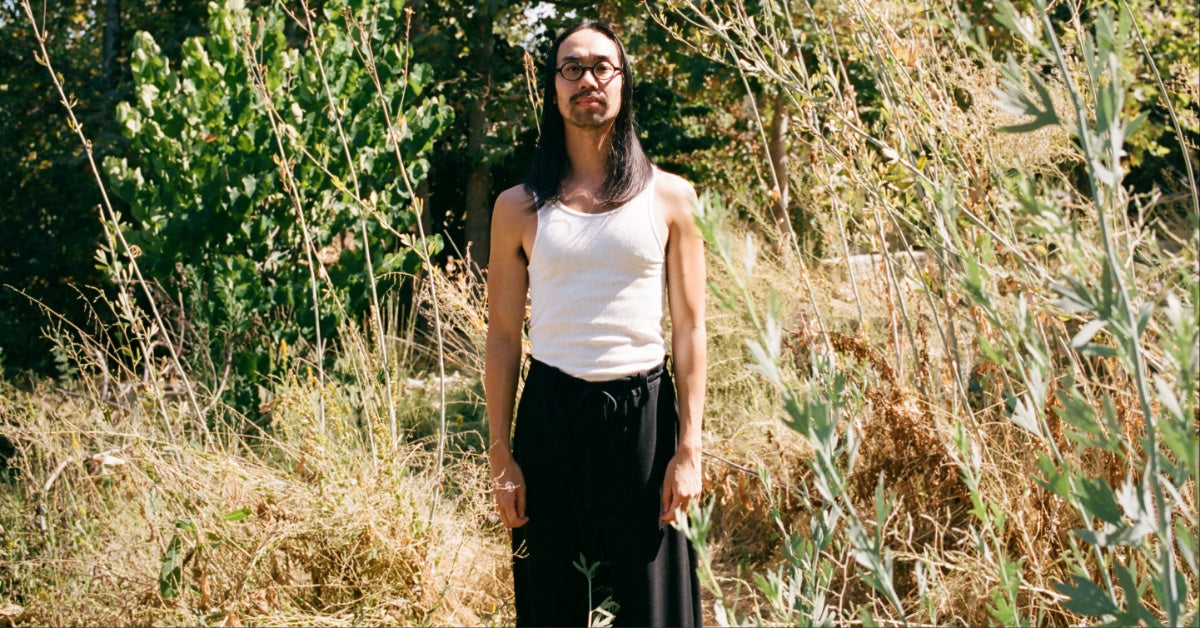
Patrick Shiroishi appears in our Fall 2024 Issue with cover stars Slipknot, Destroy Boys, Pierce the Veil, and beabadoobee. Head to the AP Shop to grab a copy.
Before he became an in-demand saxophonist traveling around LA’s experimental music circuit, and then later the world, Patrick Shiroishi was mostly secluded indoors. Every Tuesday, however, his mother would drive his younger brother to basketball practice, offering him the perfect opportunity to slip out. Once clear, he would bike to the mall and buy CDs with lunch money that he’d stashed away all week, then race back before he was ever missed — a secret rebellion that became the cornerstone of a perennial obsession. “I remember getting [Cursive’s Domestica], and I was like, ‘Man, I don’t know if I like this because it’s so dissonant,’” he recalls, speaking from his home studio after returning from a European tour in July. He had spent cash on it, though, which meant he continued to rack up listens. “Then eventually, I was like, ‘Oh, this record fucking rules.’”
Sometime during high school, practice sessions with his Zeppelin cover band morphed into grimy evenings at The Smell. The all-ages club for underground and DIY, which opened Shiroishi’s eyes to “a bunch of weird shit,” has operated within downtown LA since the late ’90s, widening the door to people who exist on the fringes. “That helped change the trajectory of what I thought music could sound like because, up until then, it was just whatever’s on the radio and my little investigations into indie and screamo,” he says with warm reverence. “It became a place I would go to all the time.” There, he found the liberation he yearned for through a bevy of both local and touring groups — so many, blurred by time, that he struggles to recall specific names. “Damn, there’s huge ones that are on the tip of my tongue,” he says apologetically. “I’ll probably think of it in 20 minutes and let you know.”
Read more: 25 best albums of 2024 so far
Shiroishi, who’s among a crop of forward-thinking musicians, has torn open his own hole in the city that raised him. Beyond his involvement with the Armed, a Detroit punk collective that radiate the same type of blinding, chaotic freakouts as John Zorn’s Naked City, his list of credits is sprawling, appearing where you least expect. Among them are collaborations with Chelsea Wolfe, one-off projects with Claire Rousay, poetic team-ups with Emma Ruth Rundle, and two different records with Agriculture. The multi-instrumentalist, whose virtuosity is only outmatched by his kindness, remains constantly in flux. However busy he may get, though, Shiroishi reaches back to the music that saved him when he was younger. He routinely sits down to listen to albums in full — usually with a glass of whiskey in hand if he’s at home or in the tour van to thwart motion sickness. “I am definitely an extroverted introvert. I love being home — I listen to music every possible second that I can,” he says. “I think that spark of discovery still really rings true in me.”

Sam Lee
There’s also his solo work. Shiroishi’s far-stretching catalog is guided by improvisation, conjuring harsh, squalling moments of tension and release that offer exacting catharsis. On the other side, there are more tender shades of beauty and melody. His range can feel daunting, but there are few limits on how to get there — like when he lugged gear down to a parking lot after midnight in Monterey Park and recorded one improvised take (the result being his third LP, I was too young to hear silence). It imbues his songs with freedom and intensity, often drawing from his ancestry to unravel a deeper story. “I think a lot of the music that I make has to do with what I’m going through in those specific moments — a way for me to process what’s happening around me and inside of me,” he says. 2021’s Hidemi reckons with the Japanese internment camps that his grandfather endured in the ’40s, moving through moments of soulfulness and discord to refract enormous trauma. Elsewhere, his debut for the avant-electronic label Touch, Evergreen, evokes a cemetery where generations of his family are buried, combining field recordings with warm, meditative drone. In a world increasingly less interested in genre divides, Shiroishi’s adept at obscuring the boundaries of sound — an invigorating reminder that innovation isn’t dead.
That spirit oozes to the fore on Speak, Moment, released earlier this year with guitarist Dave Harrington (DARKSIDE, Taper’s Choice) and drummer Max Jaffe. The LP documents their first time playing together, comprising five improvised tracks that bend into an otherworldly, frequently mutating lifeform. It’s deep listening, smudged with moments of hypnotic groove, texture, and jagged noise as you hear the trio respond and react to one another in real time. They’ve been playing together fairly regularly since its release, uncovering their sound in the process, and have already cut another record together, due out sometime next year, that’s an extension of their live shows. The biggest shift is that Shiroishi uses electronics with his saxophone.
His long-term gig remains with the Armed, where Shiroishi distills even more freewheeling strangeness into a greater whole. The six-piece, who once used mind-fucking extravagance to hide their identities, wield radical unpredictability that detonates into an amorphous onslaught. Their initial connection was “very organic and slowly moving,” bridged by longtime Chelsea Wolfe producer Ben Chisholm, who threw out Shiroishi’s name when the band needed a saxophonist. Soon, he was flying across the country to play on what would become Perfect Saviors — the Armed’s first album of proper honesty — getting invited to film music videos, and going on tour. It was a love connection — like finding that person who listens to the same unknown grindcore group. “I think they’re just fucking weirdos, too,” he says gleefully.
Live, the band use that weirdness to harness a constant transfer of energy between themselves and the crowd. There are queasy surges of strobe lights, and fog obscures the band into oblivion, making it nearly impossible to see anything but the glow of white light. All the while, their sound is deafeningly heavy and unremitting, veering from one end to the next with few chances to catch your breath. “My neck hurt for three days,” Shiroishi laughs, recalling his early shows with the group. For all of their ferocity, though, the Armed maintain “a real family kind of vibe,” welcoming outsiders like Shiroishi with outstretched arms.

Sam Lee
“Patrick is music. I know that sounds trite at best and corny as fuck at worst, but I’m not sure how else to express it,” bandleader Tony Wolski says of their partnership, ahead of the group’s Everlasting Gaze EP. “I tend to work fast, and I’m always writing. I can send Patrick a musical thought and have him send a full session of new ideas back within an hour or two — and this is nearly around the clock. It feels amazing to create with him because, as someone whose only real hobby is music, he’s right there in the trenches with you — at a moment’s notice — and even with a couple thousand miles between you.”
This September, Shiroishi released his latest solo album, Glass House, which turns toward home. There is, surprisingly, very little saxophone. Instead, Shiroishi laces together field recordings — torrential rain, clinking glasses, the whirring of a coffee grinder — to express intimate, overwhelming gratitude while exercising the same experimental bent that’s made him completely revered. “I think being on the road now and not having a day job, I’m able to go out a lot more,” he reflects. “I appreciate home more. Then when my partner [fellow saxophonist and Moonchild frontperson Amber Navran] is out touring and I’m home by myself, you hear different sounds.” The tick of a clock, for one, which launches the album, can send you into a spiral when you’re standing alone in your kitchen at 2 a.m., rather than staring into the gaze of a lover. The LP collects sounds like memories — a reminder of the life, and the community, that he’s built around him.
“Life comes in waves as far as the good and the bad,” Shiroishi says. “I hope that if you listen to the record, it feels like you’re on some sort of journey. It does end on an uplifting note because at the end of the day, even when I’m pissed or sad, I think there is hope for a better everything.”