
Anti-Matter appears in our Winter 2024 Issue with cover stars L.S. Dunes, Wisp, Fall Out Boy x WWWYF, and Chase Atlantic. Head to the AP Shop to grab a copy.
If there is one constant in the hardcore scene, it’s change. Norman Brannon, founding member of Texas Is the Reason, as well as former member of Shelter and current touring guitar player of Thursday, knows that better than anyone else.
On Nov. 19, Brannon announced that Anti-Matter would be coming to an indefinite hiatus at the end of 2024. “When I made the decision two weeks ago that Anti-Matter would have to go on hiatus, 18 months later, I had to admit that things weren’t going in the direction I’d hoped,” Brannon wrote in the zine’s newsletter. “I am calling it a ‘hiatus’ in the same way that it was a hiatus when Anti-Matter fanzine became a compilation record, and I will continue to find new forms for it.”
Read more: In conversation with Scowl and Frank Iero
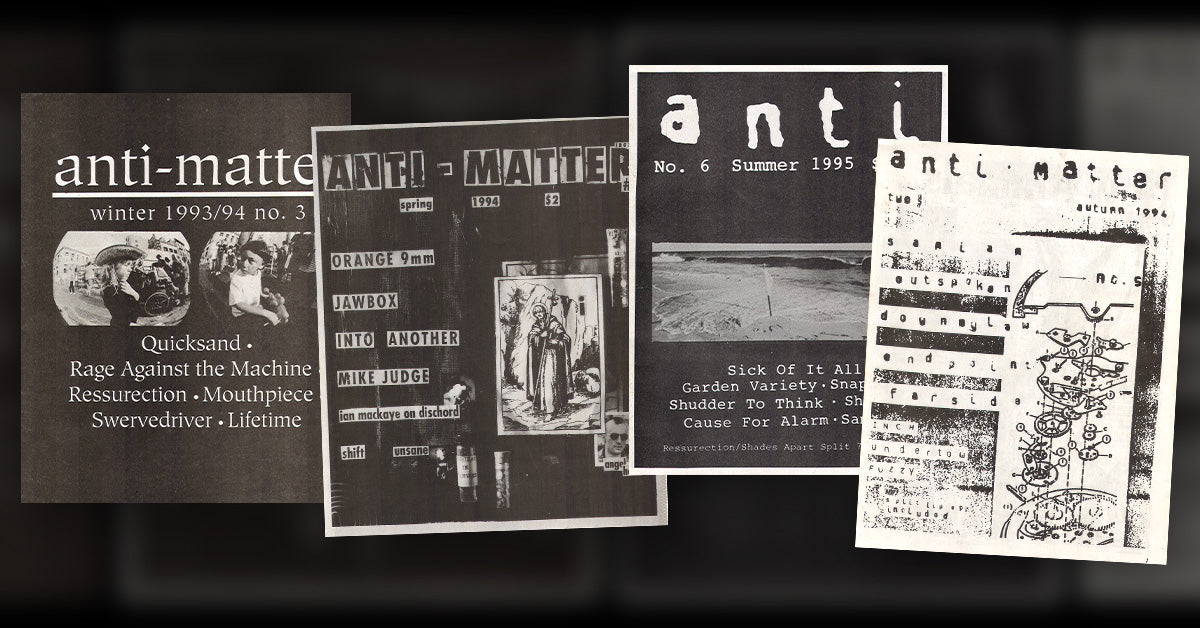
When we first spoke over video call, he hadn’t yet decided to put his fanzine, Anti-Matter, on hold, though the concept of change came up numerous times. I’d be forgiven for wondering if it wasn’t a premonition of the zine’s future. Just 18 months after Anti-Matter’s relaunch, Brannon announced that the fanzine would be going on an indefinite hiatus. In 1993, Brannon saw that the hardcore scene was experiencing a transformation. Bands moved away from the straight-forward punk that dominated the ’80s as they got more technically proficient at their craft, and found new influences in adjacent genres like metal and noise rock. He felt it deserved to be documented. As one did in the ’90s, he started his own fanzine. Though In that initial format, Anti-Matter only lasted for two years and four issues, Brannon’s zine gained something of a cult following. As a queer person of color, his perspective differed from the overt machismo that characterized much of the ’90s.

Norman Brannon
Brannon relaunched the zine, after a 30-year hiatus, at a time when hardcore was experiencing yet another major vibe shift; one that resembles the collective growing pains that Brannon first wrote about. Hardcore kids often have a reactionary streak. A lot of us spend so much time reminiscing about the way things used to be that we forget that we are responsible for the culture around us. Brannon is different — he knows what it means to be a member of a community; what it means to see forward momentum slowly turns into material progress. He’d deny having such influence, but the truth is his voice nudges the scene in the right direction. Brannon says that the life cycle of hardcore is cyclical. It seems that Anti-Matter can be described in the same way. If we’re lucky, Anti-Matter will one day return to catch us up on all of the discourse we’ve missed. Until then, here is our conversation with Brannon, just weeks before the indie publication drafted its goodbye letter.
Why did you feel the need to revive Anti-Matter now?
When I decided to revive Anti-Matter, there was a practical reason, which was that Thursday was not touring, and I needed something to do. But there was a philosophical aspect to it as well. I could see a lot of the same issues were coming up. A lot of the same arguments and fights happening online today were happening in the ’90s in zines. There were conversations about people doing Taco Bell commercials or signing to major labels. There is nothing new under the sun, so there was a sense that I could also be a bit of a bridge, someone who could create some perspective.
You take a historical approach to your work. What do you find important about these perspectives?
I don’t think that history is a monolith, and I don’t think that any one person has the key to the “correct version of events,” or even the correct interpretation of events. I’m not trying to record history in some stayed, frozen way. I’m trying to make us look at things a little bit differently. I do believe in that idea of knowing your roots, and at the same time, I’m aware of the fact that at this point, hardcore is like 50 years old. Anyone who gets hardcore today has so much to draw from that there’s no possible way that they can fully grasp or maintain everything that’s happened in the last 50 years. When I think about it that way, I think of knowing your roots as a vaguely light request, right? I think [what’s] more important is, who are you today, and try to make it something that’s relevant to you.

Norman Brannon
There was a time when hardcore was very conservative, and I notice some of those reactionary tendencies repeated today. Is there anything that you hope your readers take away from the bits of history you share?
I’ve said this before in essays where I talk about hardcore being as much of an oral history as anything else, or an oral tradition. And I say that because at the particular time that I became involved, I learned about [hardcore] through stories. I learned about it through meeting people who had come before me. I’m not interested in telling any of my readers what is or isn’t hardcore. That’s the oldest fight in the book. I’m just going to tell them what I know, what I’ve experienced, and stories of people that matter to me, and I feel like, because we all came from the same place, we’ll all arrive at the same place.
Last year when you first relaunched Anti-Matter, you wondered what the hardcore landscape might look like two years from then. A year-and-a-half after relaunching Anti-Matter, do you have any insights or predictions for the direction the scene is headed?
There was a moment in time in the ’90s that was very perceivable, when everyone either broke up their traditional hardcore bands and started new bands that sounded very different or just changed the fuck out of their band. From a cyclical perspective, that seems inevitable. As someone who plays music, I can say that there was no way that I was going to play one-chord hardcore for the rest of my life because I got better at my instrument, and I wanted to play good things — it was just natural. There are a lot of things that are happening right now that very much echo the past, and I think that’s a great thing. The thing that I am trying to impress upon my readers, if there is anything, is that there’s room for all of us.
Over the past year of writing Anti-Matter, is there anything you’ve learned about either yourself or culture at large that has been particularly surprising?
I think that I always considered being queer to be a potential barrier to connection. It’s one of the reasons I waited so long to come out, and even though now is a completely different time, there was a little piece of my brain that brought me there. What I realized over the last year-and-a-half is that not only is it not a barrier to connection with today’s community, but it’s become a major piece of Anti-Matter’s identity. That’s something that made me really happy. This scene is actually beginning to realize all of its promises, all of the things I saw in the mid-’80s when I first came around that weren’t just lies — they were just seedlings of an idea that hadn’t blossomed. I feel like we’re in the blossoming era.

Norman Brannon