
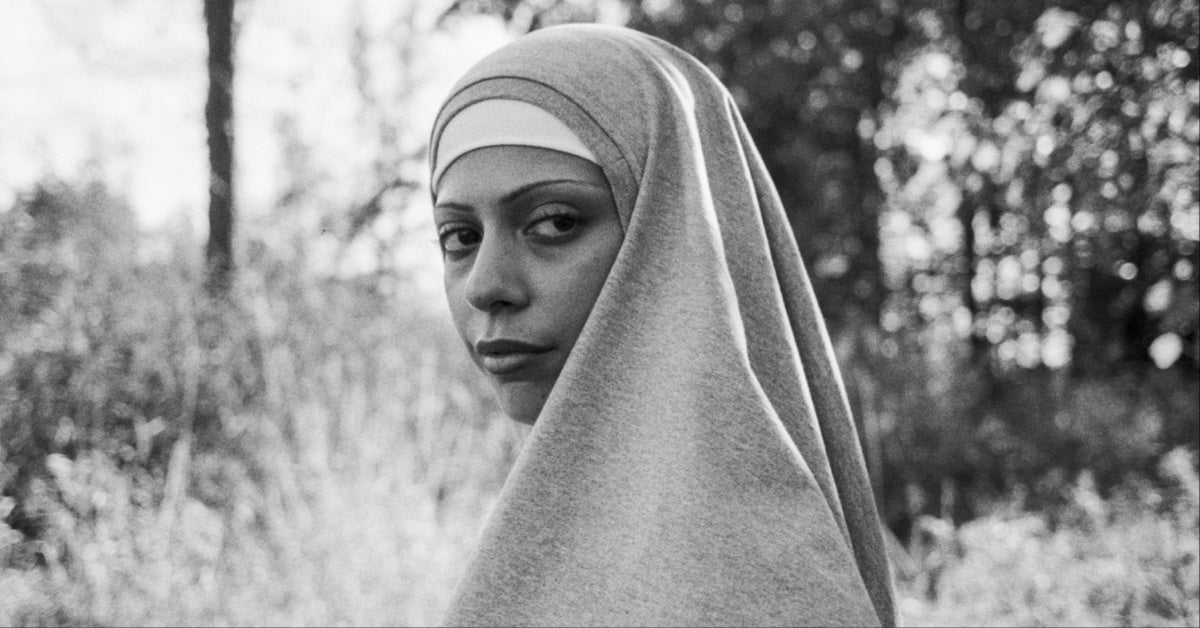
Nemahsis appears in our Winter 2024 Issue with cover stars L.S. Dunes, Wisp, Fall Out Boy x WWWYF, and Chase Atlantic. Head to the AP Shop to grab a copy.
“When I was younger, I barely spoke. The only time I’d make a sound was when I was humming melodies,” Nemah Hasan says. She’s home in Milton, Ontario, piecing together memories from her childhood. “I became really good at remembering songs and learning them quickly. If I heard something in the store, I’d try to hold onto it, humming it over and over for days until I heard it again because we didn’t listen to music at home.”
Hasan — known to most as Nemahsis — has spent nearly a lifetime perfecting the art of stretching ordinary moments such as this. Raised on a small farm in Milton where her father — a second-generation Palestinian-Canadian — and her mother, who immigrated from Palestine, kept only Arabic cassettes, music became a thread connecting Hasan to her converging identities. Growing up as the only Muslim family in a predominantly white area, she sees her father’s reluctance to embrace Western music as a way of safeguarding their heritage in a place where it wasn’t readily accessible. Choosing to sing in English rather than Arabic became part of that balance — an effort to bridge the world she was born into with the one she inherited.
Read more: 50 best albums of 2024
“For a long time, I felt like I couldn’t intertwine Palestine into my music because I wasn’t singing in Arabic or pulling direct references from traditional Middle Eastern sounds. Then I realized the world already only sees me as Middle Eastern, as Arab, as Muslim, so I can weave in and out of my culture and identity however I want, and it’s never going to be fraudulent,” she says. She points to Adele, whose song “Million Years Ago” caused a stir for sampling a Turkish melody. “It was this intertwining of an Arabic vocal technique in such a modern way that made me realize I could do something similar,” she says.

Norman Wong
Hasan’s instinct for holding onto melodies also shapes her songwriting, in how she weaves in and out of genres and references without losing sight of her present mind. Her songs reflect a process of recalling past emotions and considering if and how they’ve changed. Unlike artists who often write about raw, immediate emotions — think Mitski or Clairo — Hasan needs distance to process. “I’m too sensitive to write while emotions are fresh — I wouldn’t want to be biased. Most of my songs are about things that happened months or even years ago,” she explains. For Hasan, this distance isn’t detachment but a way of revisiting her past self with clarity. “A lot of writers are known for writing about other people’s experiences, but they forget they can shadow an old version of themselves,” she says. “It’s like writing about someone else — a person they once were — which feels more objective.”
When I speak with Hasan in early October, a month has passed since releasing Verbathim, her debut album, and she’s already dreaming about her next move. “I’m planning the tour, but I’m also ready to create new music just to see how I feel,” she says. “The last song I wrote was ‘stick of gum’ in August 2023. Who knows? Maybe I’ll write a whole album and release it next month.” This spontaneity mirrors the way she shot the single’s music video this past spring with Palestinian director Aram Sabbah while visiting family in Jericho. “It was just, ’Who has a camera? Who has a car? Who can drive it?’” she recalls. “I was laughing with the wind in my face, my eyes watering. There were cars lined up behind us, honking and cheering us on, not upset that we were holding up the road.”
Releasing the record wasn’t without its challenges. Finished in September 2023 when Hasan signed with a label, things quickly took an unexpected turn. Following increased global awareness of the Palestinian liberation movement, she was dropped from the label for supporting the cause. “I had full support from the industry, and then overnight, it was like no one wanted to work with me,” she says. While feeling defeated, she quickly found that her connection with her fans only grew. Initially, people questioned her success, branding her an “industry plant.” “Before, it was hard to fill a room with just my music. Now, I perform to an entire room of fans, and no industry people are really there. My guest list is dry. Nobody’s asking to come,” she laughs.
Verbathim is more upbeat than anything Hasan’s released before, but that doesn’t make it any less personal or emotional. She toes the line between music meant to be danced to and that which inspires deeper introspection. It feels cyclical, as if one song loops effortlessly into the next, with the final track flowing seamlessly back into the first. Verbathim invites emotional release, allowing the listener to feel everything at once — joy and sorrow, lightness and weight, euphoria and melancholy. Like a poet, Hasan negotiates with language, folding layers of meaning into her words.
On the opening track, “old body, new mind,” she sings of returning to the past with her present mindset: “I’m not s’posed to be back here/I’ve invaded our time/Sucked me back like a vacuum/To observe from a bird’s eye view.” These first few lines offer a glimpse into the themes that guide listeners through the winding road of the record, almost fable-like in its nature — imbued with the sense that to move forward, one must first look back. I share my interpretation of the song’s title and lyrics with her — that it reflects an ancestral connection, with the body as a lineage tied to her mother, grandmother, and great-grandmother, but the mind as something entirely her own, shaped by her personal experiences. “There is that,” she says. “I’m trying to tell people I’m not what I look like — that I’m a whole different person than how I might appear.”
The song is also a reference to her favorite movie: Eternal Sunshine of the Spotless Mind. Hasan tells me of a time when a close friend compared her to the character Clementine. “My heart fell through my chest. This was the first time I felt someone might really know without needing all of the context. I felt so exposed,” she says. But instead of acknowledging the connection, she denied knowing the movie. Hasan explains that she’s always been secretive — “protective of her energy and space” — an emotional guard that resonates deeply throughout Verbathim.

Norman Wong
A standout transition is the shift from “miss construed,” in which Hasan soars, to “delusion,” where she lands with a confident, almost snarky droll reminiscent of Fiona Apple’s “Paper Bag.” On “miss construed,” she sings, “I throw an idea to the world, not sure how they’ll take it/But when I hear it back, at least I know I made it,” reflecting the dissonance between what she expresses and how others perceive it. Yet even within this guardedness, there’s an underlying sense of openness, one that becomes especially apparent on tracks like “coloured concrete,” in which she recalls tearing out the old carpet in her bedroom and painting the concrete floors when her parents couldn’t afford new ones. The contrast is further mirrored in “old body, new mind” and the closing track, “chemical mark.” While the former reflects a return to the past through a present lens, the latter speaks to the nature and weight of intergenerational trauma.
When I first heard Verbathim, I was on a plane, between jobs, restless and grasping for an escape from a life that suddenly felt unfamiliar. I felt caught in the strange suspension between the life I’d left behind and the one waiting ahead. This search for meaning in the spaces between feels intrinsic to the record — in the way Hasan uses music not to find closure, but to embrace the ongoing process of becoming. Perhaps that’s the most powerful thing about her music: It invites you into the very space where transformation happens, where everything is in motion, and the search for meaning is as important as finding it. Wedged between a snoring man whose head bobbed rhythmically to the songs in my headphones and a woman sketching faces in her notepad, I closed my eyes and surrendered to the in-between.