
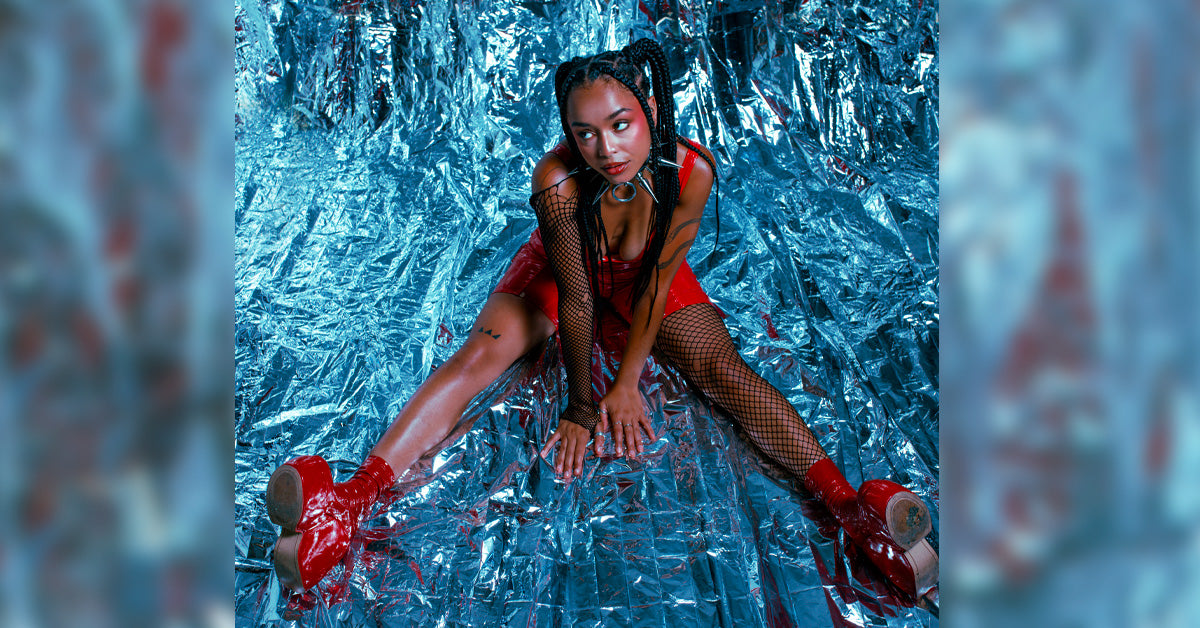
King Isis appears in our Fall 2024 Issue with cover stars Slipknot, Destroy Boys, Pierce the Veil, and beabadoobee. Head to the AP Shop to grab a copy.
Since King Isis was a child, music has surrounded them at every turn. From a mother who was obsessed with Outkast and Erykah Badu to learning classical and jazz on their great-great-grandmother’s piano, their inbuilt ambitions were destined to lead them down a musical road. But being able to find a space in which to flourish and thrive was a journey they had to undertake on their own. Growing up in the Bay Area, after attending private school fully funded, they found a dissonance between the rest of their peers. It was after graduating that Isis sought to find a space where they belonged — one that still resonates through their sparse offerings that detail depth with tinges of crushing grunge and pop melodies.
Read more: King Isis and Flora MMA find symbiosis
Embarking eastward to study in New York, it was here the idea of King Isis began to crystallize. Finding their feet at open mics and as a covers act, it was the space and community that welcomed them and one that’s allowed them to flourish today. Eventually moving back to LA to chase the dream properly, including some cold emails to various journalists and industry types, they found a home in Dirty Hit. With two EPs under their belt — including this year’s grimy shed — only greater things await.
What was the first instance you recall music speaking to you?
Honestly, it’s embarrassing, but my big three in middle school were Fall Out Boy, Paramore, and Panic! At the Disco. One of my favorite singer-songwriters was Bright Eyes. The first tattoo I got, which I regret now, was lyrics from his songs. I never liked his voice like that, but the lyrics did it for me.
You come across as very driven. Has that always been the case?
I think I’ve always been a driven person. I always wanted to be a musician, but I was like, “Realistically, how is that going to work? I’m never gonna make any money off this. I’m gonna be a lawyer.” I would consider myself a perfectionist, but, honestly, not really. I think I just have a lot of anxiety, and then mixed with wanting to feel like what I’m doing is enough, it becomes a perfectionist thing.
How are you reflected within your creative process?
My creative process is pretty isolated. I write the core and the skeleton of the song alone in my room. I’ll have a sketch with the acoustic guitar, the lyrics, and melodies, so it is very fundamentally me in the songs, even once they get produced and fleshed out. And I think people see that and hear that. Even when I was playing my songs in high school, my closest friends would be like, “Wow, I feel I hear the most of you in these songs.” So for me, it’s always been the way that I feel I can communicate the best, just being somebody who is naturally more shy and introverted and bad at speaking when it’s not lyrics.
Community feels like a big part of what you do. How do you go about bringing that together?
I went as far as I could go to school because I wanted to be in New York. I loved the idea of a gigantic city and all that. But I feel like going to New York and being able to fully be away from everything that I knew also helped me feel more comfortable in myself beyond music and my sexuality and that part of my identity, which was something that I wasn’t able to do at home. That chapter is closed — we’re definitely all good there. But growing up, it wasn’t even something that I felt I had the liberty or the safety to explore, in terms of my queerness, specifically. So going to New York — and being around a bunch of different people who had similar experiences and were super open with their queerness and being told that’s OK — helped in finding my community.
When I was in New York, I felt accepted fully and the most I felt at home in myself, and creatively able to do shit without fear, which is something since moving to LA I haven’t necessarily found. There are a lot of alternative Black artists out right now in LA, too. But most of the people that I’ve met, or most of the people getting recognition, are more male-dominated. Yeah, there’s WILLOW and Nova Twins, but I feel like there needs to be more space for the queer Black girls. So community is really important to me. And ultimately, being able to play with more POC is important to me, just because I’ve experienced some weird shit because of how people perceived me.
What do you see yourself building down the line?
I like to plan out. I know an album rollout isn’t as important anymore, and story rollout isn’t as important to listeners and people coming into the world, but for me, I love when other artists do that, and I loved that growing up. I just think story and world-building are really important to me, at least in music, and I love threes. I want to do one more EP, then do an album, and a little short film to close out that world.
What would you say is your overarching ambition as King Isis in that case?
I grew up in Oakland, so I had access to music, which was great. But I love alternative music. I’ve always had a love for that. Most of the artists I listened to growing up were white artists, and I do love all their music, but for me, [I want] to be an artist that inspires other Black queer kids and Black queer girls to make music, honestly. Even at shows, people come up to me and say they fucked with the music and how it inspires them to play, to go practice guitar, go write a song. That’s the overarching goal because seeing people who look like you in spaces that you want to be in does have an impact on shit, and as somebody who’s struggling with mental health shit and being in a lot of spaces where I don’t see anybody that looks like me, it has affected my ability to feel like I’m enough. I feel like there are a lot more alternative Black artists out right now, but it’s still pretty male-dominated, too. So being a Black queer femme person in the alternative scene, I just want to be able to make music and share it and inspire others to do that, too.