
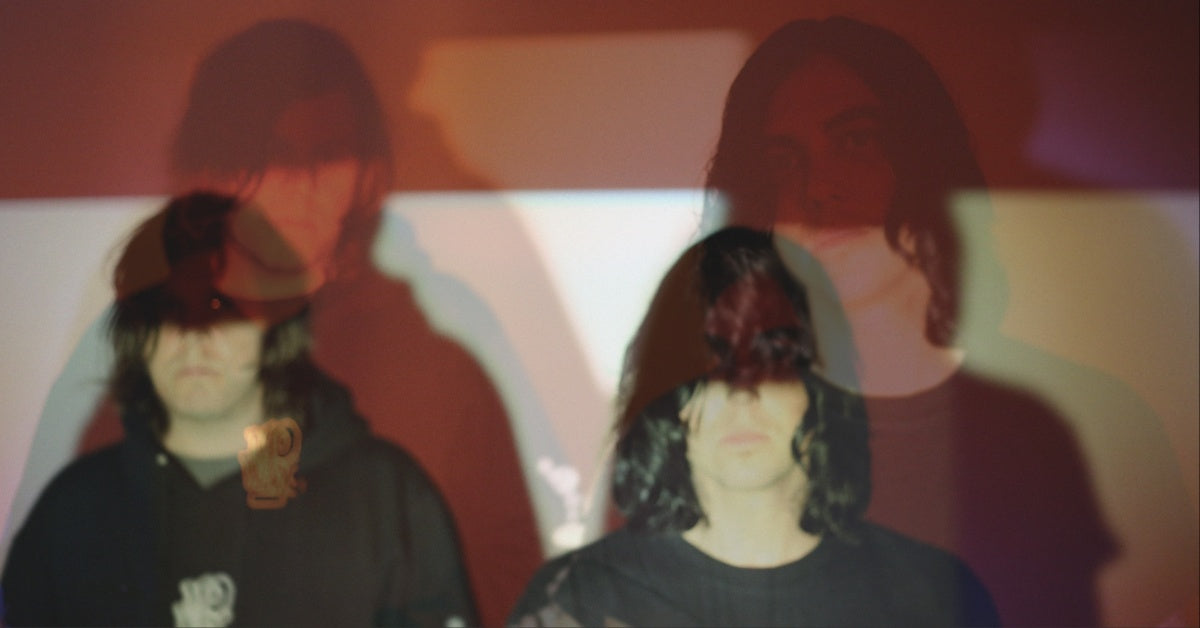
Kellin Quinn and Aaron Marsh have spent years mastering their creative voices. While Quinn’s Sleeping With Sirens have penned quintessential post-hardcore hooks across seven full-lengths, Marsh’s Copeland have steadily softened their early aughts, emo edges into lush, reflective indie-pop. Connected as collaborators since the debut Sleeping With Sirens record in 2010 — where Marsh offered his vocals to “Let Love Bleed Red” — the two artists have shared a deep mutual respect for one another’s work across over a decade of friendship.
While Quinn is best known for his skyscraping melodies on singles like “Better Off Dead” and “If You Can’t Hang,” he recently found himself inspired to create something more subtle to circumvent the weight of presumptions from his best-known project. Not interested in the typical solo route, Quinn immediately knew his friend and early inspiration Marsh was the perfect collaborator to bring out something wholly, creatively new. Thus, Quinn founded Haunted Mouths — an indie effort co-produced by Marsh whose sound is as intimate as the writing process behind it.
Read more: Will Yip keeps it moving
In the span of just two weeks, Quinn and Marsh entered the latter’s brand-new studio, and between welcomed breaks at local restaurants, transmuted Quinn’s notebook scrawlings into a collage of 10 stunning musings called A Collection of Greetings. Thematically a love letter to Quinn’s wife, the debut Haunted Mouths project boldly reimagines the vocalist’s maximalist register into something more delicate. Lead single “Further Til We Disappear” finds Quinn crooning over lo-fi ambiance; the title track surges with reassuring soul; and his vocals on the closing cut “You Built This” slowly, intimately echo into infinity.
A Collection of Greetings is clearly the result of two musicians whose collaborative efforts are built on trust and the elimination of expectations. And while it might not be as flashy as Quinn’s best-known Sleeping With Sirens hits, the debut Haunted Mouths record is a true success of its own. Taking a wide view, it’s fascinating to unearth how 15 years of rapport between Quinn and Marsh sparked a lightning-fast flow state, with A Collection of Greetings as the result.

Pooneh Ghana
KELLIN QUINN: The first time I ever heard of Copeland was on a mix CD that my mom’s friend had. We’re driving in her car, and “Testing the Strong Ones” was on that. I remember hearing the music and just being like, “What is this? This is something that I would love to listen to further.” I’ve been a huge fan ever since and have been following the band for as long as I can remember, really as long as I’ve been listening to music. Copeland’s always been a staple. The first time I actually met you was when we were making our first record, With Ears to See and Eyes to Hear. I asked you to be a part of a song that we were recording, and you very graciously said yes. I think we met in person after that, but that’s the first time I’d ever communicated with you, from my recollection.
AARON MARSH: I remember getting an email out of nowhere. I don’t know if anyone actually connected us, or if you just got my email somehow and wrote to me. You guys weren’t even really a band before the first record was made, right? You became a band and made the record, kind of simultaneously. I got this email; this guy’s name is Kellin Quinn. I was like, “All right, there’s not really any information on the band.” I found a video of you at an open mic night singing “Santeria.” You had a buzzed haircut, like, almost bald. And the energy onstage was electric. The crowd was with you. I actually went and looked for the video, and I couldn’t find it. Maybe you successfully got it washed from the internet, your former persona, and then I found a video of you beatboxing in a Denny’s.
QUINN: It wasn’t a Denny’s. It was actually a truck stop.
MARSH: I think it was an Aaliyah tune. You’re kind of singing and beatboxing at the same time. Everyone at the table was transfixed. And I was like, “Man, he has a lot of tools in his toolkit that [are] a really great way of interacting with whoever he’s performing for.” That was enough to make me say, “Yeah, let’s do it.”
QUINN: I didn’t know you did that much research before. Actually, you know what’s funny? Now that I’ve had some time to be in a pretty established band, I’ve worked with a lot of younger artists doing collab stuff in my own career. When you’re a young musician, you just have no care. I guess I was nervous that you would say no. But at the same time, I was just like, “I’m sending him this song, dude. He’ll probably say yes.” It’s crazy to think of the confidence level that I had back then. I’m so grateful that you did that, though, because I feel like our friendship has really been a mainstay throughout my career. I’ve been able to show you some stuff that I worked on in the past, coming up as an artist, and I’ve really respected you since I’ve known you. Just being able to work with you on this project has been an amazing experience.
MARSH: I appreciate that. Honestly, I’ve had little moments in my career like that where I’m like, “Man, I really made the right call. I saw something great.” Fast forward to doing this kind of project with you, which I mean truly on a writing level, was a very intimate experience. It was just you and I in a room. There was no assistance; there was no engineer; there were literally two humans in a room. We just buckled down and followed the songs where they led us. It’s pretty crazy, especially after all these years of being friends from a distance and cheering each other on.
QUINN: I was definitely wanting to do something besides my band, and I had worked on some songs with other people to get an idea of what it was I wanted to do, because I knew in my head that I wanted to do a project. I didn’t want it to be like a Kellin Quinn solo thing. I wanted it to be its own thing. I was on my phone and saw you had got your studio to a place where you were starting to have people come in. And I was just like, “That’s 100% who I want to work with on this music.” Because I feel like you do things in such a beautiful way that don’t seem cheesy or like they’re trying to be something they’re not. It’s just raw emotion. And I thought to myself, “You’d be the perfect person to bring something out of me that other people wouldn’t.” I feel like people have this preconceived notion of what I should sound like. Going in and working with you was an experience of, let’s try things you’ve never tried before.
MARSH: I moved out of my studio space, my former studio, right around the COVID era, and then for about four years, I literally had my studio in my kitchen. I had my computer and my monitors, and then the stove was right next to it. All my instruments were in storage. I was really only making records at that point with a MIDI controller and a microphone. I signed the lease on this space, I moved in, and then you were the first person in. I felt an uncorking of a bunch of pressure [that] had built up. I hadn’t had any real instruments at my disposal in a really long time. I was like, “Oh, finally. I have some tools and have a project,” and the writing chemistry was immediately good. I think we both just had an openness of, like, “OK, there’s no rules. We’ll just follow where the song leads us.”
You and I had talked about doing stuff in years past, and I knew you would want to do something different and want to get out of the sounds that people would expect to come from you based on your extremely successful band. I really understand that because I’ve always tried to push myself and not put rules on my music. Just because I’ve become known for making one thing, I’ve tried to always push myself. So I appreciated that about you, that you wanted to push out of your comfort zone and what people were expecting from you.
QUINN: Initially, I had a journal full of lyrics. This was one of the only projects that came with a bunch of words first, and [I] didn’t necessarily base it off a melody first or what I was hearing musically. I just brought in a bunch of random things that I wrote, and we created really cool stuff out of it. I definitely feel like that spearheaded some of the sounds, too. Because I would read you some of the lyrics that I was writing, and I feel like that inspired some of the music.
MARSH: I’ve always known you had a knack for writing songs, but the way you write hooks and melodies is so concise. Maybe it’s partially in the delivery, but you can write these melodies that are just instantly repeatable, instantly singable, and that is not something everyone can do. I get so technical. I’m envisioning notes on a page or keys on a keyboard even when I’m singing. It’s almost like you can write from the perspective of a listener, which is a little superpower.

Pooneh Ghana
QUINN: The surprise was the speed in which we were creating things. I know you mentioned that when we were going back over songs, [but] not in a rushed way. It just felt like we would go in, and we would leave with a song, which is not something that happens all the time when you’re making music. When you say I have a superpower in writing things that are instantly repeatable, I think that’s more of an attention deficit disorder. I go with what feels good, and I don’t really question it, especially if I feel like I’m not trapped within some sort of confined box. If I feel like I’m free to move the way I want to, then I just trust my instincts on that. And I’m very grateful that I had someone like you. It was cool to bounce ideas off you and have you change little things. Those little things were monumental. It’s helped me grow a lot as an artist in the way that I’ve considered writing now and in the future. You’re very technical when it comes to making sure things are right, and that’s something that I admire a lot.
[What I’m most proud of from this album] was the experience of making [it] with you. It was the opportunity to get outside of what I’ve been doing for 15 years and put myself in a different head space and create this beautiful music that is just really special. It’s just a full album-listening experience. I’m really proud of the songs we made, and I think that everyone’s going to be really excited to hear them. It’s a different perspective from me, and it’s an album that you can put on and listen to, and don’t have to worry about it being this specific thing. It’s just this beautiful music that you can listen to at night or you can listen to while you’re driving in your car. And I think that it’ll move people.
MARSH: What I’m most proud of is the record came together so fast. I think it was two different sessions. The first session was four days, maybe five days, and we wrote four songs, and that’s coming in every morning with nothing but a journal full of words, but no real musical ideas, right? So coming in in the morning with nothing, and by the time we leave that day, we’ve written and tracked a song, and they kept getting better the more we did. It wasn’t like we would burn out. Then the second session was six days. It might have been seven days, and we wrote six songs. So we did it in essentially 12 days. We wrote 10 songs in two different sessions, and it’s just such a snapshot of time. I felt like we were showing each other music and reaching for inspo, learning from each other’s writing processes. Because it was so condensed time-wise, every song sounds different, but there’s this cohesion to it lyrically. There’s a cohesion to it sonically and arrangement-wise that I don’t know if I’ve had another record that quite has this mixture of being cohesive and incredibly dynamic.
That comes down to how quickly we made it. Some of these songs are just really beautiful, really moving. And one of the things that I wanted to accomplish was to essentially frame your voice in a way that no one’s ever heard before. You have such a unique voice; it’s such a beautiful instrument. And I was like, “Man, there are so many things that I can hear his voice doing, and so many ways I could frame this musically that no one will have ever even thought of before, just because he’s been in a freight train of a rock band.” There’s so much nuance in your voice. You have such a powerful melodic sense, and you dial your melodic power back to this fragile, nuanced, great delivery of very singable things. It was just really special.
QUINN: That was very nice. Thank you, Aaron. I’m proud of it, too. I felt like every day we walked away with something. I’ve had experiences where I’ve gone in to make songs in the studio before, and you walk out going, “Did we do anything today or not?” Every day I left your studio, I was confident that we did something really great. I felt that way about every single song, and I still do.
MARSH: It’s funny. In the second session, we did six songs in a row. Man, by the time we got to day six, I had no idea what the first song sounded like. I could not have repeated it if there was a gun to my head. It was so quick. It was so in the moment. That’s probably the closest thing that I’ve done to being almost improvisational. I would come in the morning. I would usually get here about an hour, an hour and a half before you would get in, and I would just start getting some sounds, throwing down some in-the-moment playing, and you would get in. I don’t think you ever told me, “No, I’m not feeling this one.” Every single one of them, you were like, “Yeah, let’s do it.” There’s an openness and a flow to it. Everything came together so well.