
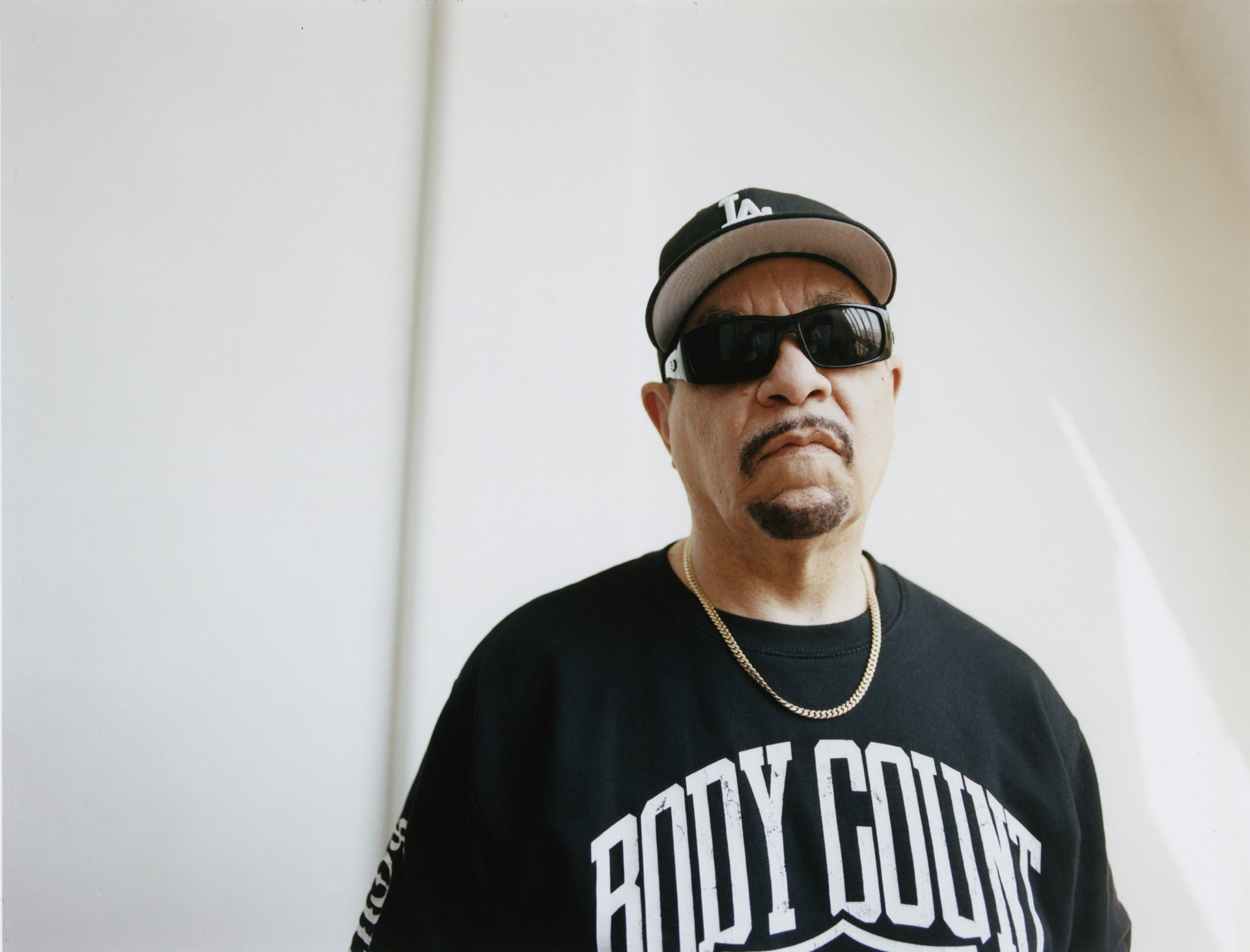
Ice-T appears in our Fall 2024 Issue with cover stars Slipknot, Destroy Boys, Pierce the Veil, and beabadoobee. Head to the AP Shop to grab a copy.
What came before the world as we know it today? Ice-T. With lyrics that function like street journalism and a cadence that influenced Ice Cube, Compton’s Most Wanted, and Snoop Dogg, Ice-T was essentially the first gangsta rapper. After starring in Breakin’, his first feature film in 1984, Ice-T was almost one of the first rapper-turned-actors. He has since lent his voice and talent as narrator, character actor, and gone on to become the longest-running actor in a TV series for his role as Detective Odafin Tutuola on Law & Order. Not to mention, in the ’90s, he predicted the rise of streaming and the collapse of the music industry as we once knew it. “I just downloaded the whole Titanic movie to my computer,” he told a shocked reporter in 1999. “This is the future.”
Read more: 15 greatest supergroups across rock, punk, and metal
Ice-T was also one of the first to realize the strong alliance between hard rock and rap. At Lollapalooza 1991, he brought those two worlds together when he introduced Body Count for the first time, a heavy-metal band for the ages that predated the rap-metal of Korn, Linkin Park, and Rico Nasty. Ice-T carried into Body Count his vivid, violent MCing, and found hard rock an even better vehicle for his will to shock than rap. Today, over three decades into their career, Body Count — who are still putting out records and touring — are a Grammy-winning act with seven albums to their name. Merciless, their eighth, is on the way, and comes with a surprise feature from one of the most legendary (and difficult-to-pin-down) acts in rock history — more on that later.
Alternative Press caught the legend that is Ice-T while he enjoyed some very rare downtime, the Olympics on in the background (but not the “horse stuff,” he said, “that’s some goofy shit”).

Alonso Esteban Ayala
Your music, especially as Body Count, has always felt like the sonic equivalent of a horror film. It’s so visual, so grizzly. Have you ever considered directing a full-length horror film?
I’ve thought about it, but that would have to be something I would do after Law & Order, because that’s a very heavy, intensive job. I directed my own documentary called Something From Nothing: The Art of Rap, which we took to Sundance and put on streaming services. But if I were to direct a film, it would be a horror or some type of very cult movie. Like Trainspotting or something weird like that. One time I talked about directing with Quentin Tarantino, and he’s like, “You don’t need my help. I mean, you’ve been writing movies your whole life. All your music is theatrical.”
I actually first gave Body Count the name Grindhouse because, like those films, I think Body Count is meant to be so outrageous that if you don’t get the humor, it’ll scare the shit out of you. It’s intentionally way over the top. In Body Count, the guy doesn’t grab a gun — he grabs a rocket launcher. We always wanted to have that bit of outrageousness in our music.
You seemed to lean into that outrageousness more than ever on the latest Body Count tour. The shows were so theatrical and over the top that they reminded me of old-school metal shows, an Iron Maiden type of deal.
Yeah, and Alice Cooper. But the thing about our music is that it transcends different types of rock. Some of our stuff is very punk, some of it is very speed metal, some of it’s theatrical and big like Black Sabbath. I like to shift between those because a lot of metal bands that I love and listen to, it’s like one note. I wanted to do variations of songs so that the delivery was totally different.
So we started out doing “Psychopath” first. I wanted a fucking stocking mask for it, you know? Then Lil Ice [his son] was like, “You should kill me.” So I just started gutting him onstage, cutting his throat. There’s no creative director. It’s just my brain. And I’m like, “You know what? It would be cool if Chanel [his youngest daughter] came out and introduced a song. Then she’d get shot.” I love my kids. I got a different kind of family. Let’s just say that.

Alonso Esteban Ayala
You also have Chanel and your wife, Coco, screaming on “Psychopath.” What made you want to get your family more involved with Body Count?
Well, Chanel has this incredible shriek. She was doing it in the car one day when we were driving, and I almost backed up when I heard it. Then I was like, “I’m gonna put that on a record.” Chanel’s been coming to Body Count concerts her whole life. So when I told her that she could be on the record, she lit up. She’s like, “Hell yeah, daddy.” So we’re doing “Psychopath,” and once we made the record, I had sound effects. You hear gunshots in my records. You hear all kinds of stuff. Because to me, this is entertainment. So I came to this part in a song where it was a breakdown, and I’m like, “That’s where somebody needs to scream right there.” So I took Coco and Chanel, and I said, “Look, go to the bathroom with an iPhone and scream like I’m chasing you with a chainsaw.” They went in and did that.
In the early ’80s, your transition from rapping to acting was pioneering. Going back to that time, why do you think filmmakers were so interested in getting rappers on board, and why do you think you appealed to them in particular?
Well, I was the first rapper to act. That was before Will Smith. I was the very first. The only other rappers that tried to act were Run-D.M.C., and they played themselves. So as far as a rapper having a character in a movie, that was me, and I got picked because of my record sales. I also got picked because there weren’t enough Black actors to do this Black Scarface movie, which was New Jack City. Wesley [Snipes] had only been in a couple movies, so we didn’t have any Black stars yet. I’d sold millions of records, and they thought, “He’s kind of politically correct and gangster.” And they went to rappers because we had the big fanbase, and we actually helped get the movie funded, because we were in it. So at that point, it was just because of my fame and music. It’s funny when people ask, “Well, how did you get into acting?” I’m like, “Well, they picked me because I had a successful music career.” They say, “Oh, you got in the easy way.” I’m like, “Yeah, go sell 4 or 5 million records. At no point should you think that’s the easy way.”
You were sort of typecast as a cop very early on in your acting career. What was your thought process at the time?
Well, my first movie was Breakin’. They called me the “local rap talker.” They didn’t even know what a rapper was. But my first proper acting role was New Jack City. I was terrified! I was dropping an album called Original Gangster, and at the same time, they wanted me to play a cop! But I had a lot of good people around me. It’s like, “Dude, if you turned down this opportunity, you lost your fucking mind.” So I took the risk, and everybody loved it. Since then, every rapper has played a cop, from Dre to 50 Cent.
Going back in time again, let’s say toward the start of your rap career, did you have that mentality as well — “don’t guide life, ride life,” or did you have a vision?
I had no plan. My main plan was getting out of trouble. Rap was a chance to do something other than the shit we were doing, which definitely would have got me either in prison or dead. When you’re on the streets, you’re hustling — drug dealers, robbers — everything you’re doing out there, that shit is short; the existence is short. My friends were catching big cases. I’ve got friends that have been in prison even before I started rapping. They missed out on all this Ice-T because they were fucking around, and I was fucking around with them.
I just wrote a book called Split Decision, where I explained some of it in detail, about how me and one of my friends might make two different decisions, and I’m here, and he did 36 years in prison. So that was my first agenda. You know, when I got into hip-hop, nobody had even bought a car. So people were looking at me like, “Why are you leaving this street life for rap?” But I was fortunate in hip-hop. It just kept growing and branching off. Other people started loving it in different countries, and it just evolved into something that was mega. By being there early and sticking with it, I went for the ride, and I never looked back. I’m very comfortable making all these decisions now, but early on I was scared shitless.
You didn’t know what the future of hip-hop would look like then, but did you want it to have some kind of longevity? Did you want to grow old with rap?
I just wanted to stay involved in whatever I was doing. Like, “I’d love to do this for the rest of my life.” I was making legit money, paying taxes — I hate paying taxes, but you know. I’m the oldest person right now who’s still on tour. I just came off tour with LL Cool J. So we don’t even know if you age out of hip-hop. I really don’t think so. I don’t think you age out of art. I think that Miles Davis was dope till the day he died. It’s not like playing football. I just think that the fans age with you. I think the big mistake as an artist is reaching back for a young fanbase, like worrying about what a 20-year-old cares about. My fanbase from hip-hop, those girls are now mothers, and they watch me on SVU. Same person used to be in the audience, so they’ve evolved with me.
I’m sure you couldn’t have foreseen touring with LL Cool J, your greatest rap rival back in the day. That’s quite a nice twist.
Yeah, I stopped in the middle of a show, and I was like, “I bet a lot of you guys out there are saying, ‘What is Ice-T doing onstage with LL motherfucking Cool J?’” And the crowd laughed, and I said, “Explain that to your kids when you get home.” Hip-hop is competitive. We build careers off that energy.

Alonso Esteban Ayala
How do you look at the state of hip-hop today?
Well, it’s less the state of hip-hop and more the state of music. Streaming has really destroyed the music industry. Back in the day, I signed with Warner Brothers, and I negotiated a deal where they gave me a dollar a record, right? I got a great deal. So I sell a million records. I make $1 million. Of course, I got to pay taxes on my producers, but that’s still $1 million.
I never agreed to streaming. I never cut a deal where I said you could leak my music. Streaming, to me, is leaking. You like my song “Psychopath”? Well, if you are signed up with Apple, you can go listen to that shit for free. You know, it’s insulting what you make. Per stream, you get $0.07. I never even met a pimp that can break a penny down. That’s some cold shit.
The music can’t evolve because there’s no artist development. They’re not signing artists — they’re signing numbers. They’re signing people that learn how to shoot the algorithms on the internet to make it look like they have a lot of followers. That’s not what artists do. Artists aren’t tech people. When I signed, I signed to Seymour Stein, and he was a visionary who signed the Ramones, Talking Heads, and I had some people there to guide me and help me with my music and send me in the right direction. Now, the record business doesn’t evolve. The artistry is devolved.
From what I see, the only way artists can really make money now is going out on tour. And touring is extremely expensive, so it’s a hard game right now. I mean, if you’re Taylor Swift, it doesn’t apply to you. But let’s be real, I just came off a sold-out tour, 30 cities in Europe. By the time we paid taxes, for the tour buses, the 27 people on the road, the flight — it’s not a lot of money. You’d have to tour 250 days out of the year to make it work.
What else can you say about the new album? Is it true there’s a David Gilmour feature?
I mean, they asked us not to speak on it, but at this point, he’s got his part for the video, so it’s a done deal. What happened was I wanted to cover “Comfortably Numb.” I like the bassline to it, and I wanted to write some real heavy shit to go over it. So we did the track, but to get it released, we had to go through Pink Floyd. At first, their publisher said they don’t clear records. So my manager was able to get to David Gilmour and Roger Waters, but apparently they weren’t getting along. The other member was making some comments, but Dave Gilmour heard the record. And he fucking loved it. So it went from there. Then he comes in and says, “I want to play on the record.” We’re like, “Fuck.” Then Roger Waters had to sign off on it. He was just concerned with who was doing the singing when he’s the singer, and when they said it was Ice, he signed off on it. Next thing you know, we got a record featuring David Gilmour from Pink Floyd. How cool does that sound?
Law & Order takes up so much of your time. Why spend the only couple of months when you’re not filming to do something so exhausting as going on tour?
I love music. I always tell people I act for the money, and I use music to remain sane. When I act, I’m doing a role. I’m doing what the director wants. When I make music, it’s all me. It’s me from the ground up. I produce the records. I write the songs. Then also when you perform, you get the gratification of the crowd. So I’ll always do music.
What would your next hustle be?
I’ve got a lot of things I could do. As far as being an actor, I would probably go out and read for all of Samuel Jackson’s parts. I could tour a lot more with Body Count. I’ve got so many occupations. I’m at a point in my life, financially, where I don’t have to work. But I would never retire because I think that you need a purpose. Humans need a purpose. I also think entertainment is something that you never retire from. An artist will make art until they die.