
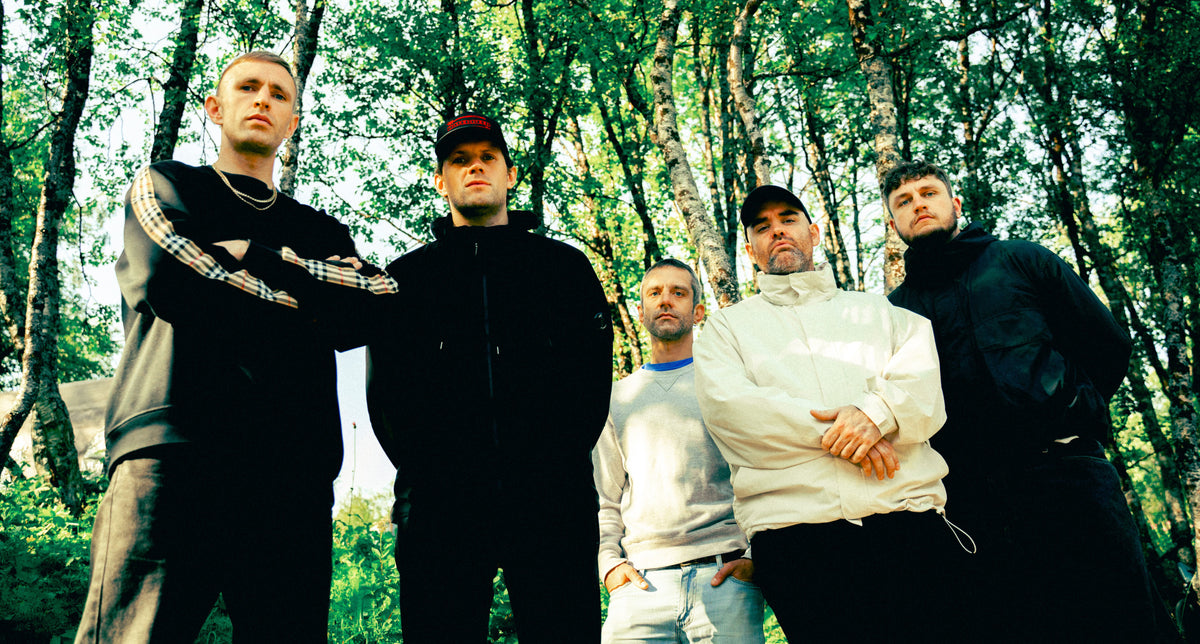
High Vis appear in our Fall 2024 Issue with cover stars Slipknot, Destroy Boys, Pierce the Veil, and beabadoobee. Head to the AP Shop to grab a copy.
There will always be tension between where you come from and where you’re going. On their new record, Guided Tour, High Vis bend this reality to their will, punctuating an expressive, boundary-reshaping set of songs with lyrics and imagery that anchor them in shared experience. Framed in a Zoom window late on a Friday afternoon, a hastily made cup of tea in hand, vocalist Graham Sayle still isn’t sure how to feel about it. It’s heavy. “I’ve just listened back to the record and fucking hell, man,” he says. “You sit with these songs for so long, but they’re also chronicling a period of time. It triggers things in your head. It’s raw.”
Since forming in London in 2016, High Vis have made it their business to walk this tightrope. They are exciting purely because they are challenging. When they first came together, Sayle, drummer Edward “Ski” Harper, and former bassist Rob Moss were fresh from logging time in Dirty Money and Tremors, operating in parallel to bands such as Arms Race and Violent Reaction, who would eventually help to define the New Wave of British Hardcore.
Read more: Militarie Gun are doing it faster
Immediately spinning away from that scene stylistically, the music they began making was rooted in post-punk and baggy Madchester grooves. It came decorated with Sayle’s characterful, rough-diamond voice and lacerating words that pulled apart grief, decay, and reconciliation, both with himself and the societal scaffolding of his past. “When I hear [the songs], it brings me back to little moments — I’m so deep in that,” he says.
With the heady atmospherics and refined melodies of 2022’s Blending, these sentiments started to resonate in a manner that positioned High Vis as one of several influential bands breaking apart hardcore’s boundaries. That has taken some getting used to. “Music’s a weird thing — people attach feelings, moments, and time to it,” Sayle continues. “It can be the most important thing in the world. It’s mad how many people have talked to me about ‘Trauma Bonds.’ When I think of that song, I think of what I think of. People are like, ‘I know what you mean.’ No one knows anything, but we all connect somehow.”
Guided Tour both underlines and expands upon what came before it. Sayle and the band — rounded out by bassist Jack Muncaster, plus guitarists Martin Macnamara and Rob Hammaren — have fashioned a record that offers a series of fizzing, euphoric releases without ever losing sight of the grit and hurt that working-class people are walking around with. Its many hooks, its strident, impassioned choruses, are essentially an invitation to join in. As Sayle sings on the title track, “If you need a light, I’ll be your guide.”
“The idea of collective power is something,” Sayle says. “You’re searching for belonging. Through doing this, you can find community. You can find people to lean on and help you through. I’m processing this stuff, working through feelings that got stuck inside me, and they’re coming out in songs. I couldn’t do that without the people around me.”
Recorded with returning producer Jonah Falco (the London-based drummer of Canadian hardcore greats Fucked Up) and engineer Stanley Gravett at Holy Mountain Studios, Guided Tour embraces expansive, glistening guitar sounds. It recalls U2, the Cult, and the Alarm alongside moments such as the Harper-driven “Mind’s a Lie,” where rolling bass and undulating vocal samples from DJ Ell Murphy coalesce into a blissed-out club cut that’s roughed up by Sayle’s insistent bark. “D’ya wanna gi’s a chance to try?” he sings, all gut feeling and belief.

Brage Pederson
“We do what we want to do, really,” he says. “We haven’t tried to sound a certain way. We have just tried to push ourselves in a way that’s honest. It sounds corny to say that, but all of us want to lean into what we’re doing. It feels nice having these huge, warm sounds. I love it. Who thought we were worthy of that kind of thing? I’ve always had image issues, like, ‘I can’t sing. Of course I can’t sing.’ And, technically, I can’t. But you do the best at whatever you can do.”
Setting off a fascinating push-and-shove dynamic, though, is the effort High Vis have made to remind us that the more things change, the more they stay the same. There is hope here, both lyrically and in terms of the record’s huge creative swings, but it’s not empty. It’s been earned and fought over. When Sayle sees the boys frozen in black and white on the album’s sleeve art — one of them astride a dirt bike in the shadow of a Liverpool tower block, his mate half-swallowed by the back doors of a mobile shop — he sees an image that could have been cropped from his own youth. “I wanted it to look like my memories of growing up, just fucking around,” he says.
Sayle was born in the mid-1980s and raised in New Brighton, a town on the Wirral that stares across the river Mersey toward the streets that photographer David Sinclair once trained his camera lens on. The place was a picture book example of the “managed decline” Sayle sang about on the Blending standout “0151,” where empty buildings met crumbling infrastructure and mass unemployment as Thatcherism ground the city beneath its heel. “As kids [in that environment], what do you do? You’ve got loads of energy… That’s still how I feel,” he says. “I’ve got loads of energy, and I don’t really know where to put it.”
When Sayle moved to London at 18, to study fine art at Goldsmiths, he felt dislocated. He was angry, alone, unmoored. Around him, the city’s extremes bit at each other. He didn’t recognize himself in its gleaming surfaces or see himself in the moneyed students he shared classrooms with. Hardcore shows became a place where he could dredge everything off his chest — a place where energy could go. “When I was younger, I had some really bad role models,” he says. “People around me were just horrible. A lot of them are now in jail or fucking dead. Through hardcore, I found good role models, positive stuff. I found a lot of hope in hardcore and punk. It gave me something to do, and I’m still here doing this.”
Sayle is keenly aware that’s not a given. There is a sense that High Vis, as people and musicians, are moving forward because they have to. They made Guided Tour in a matter of weeks, not months, with friends rather than buzzy names. The shifting sands of their sound might defy any categorization, but they hold tight to the hardcore ideal of community. “It’s our lot,” Sayle says. “It’s our thing. It’s mad that people are liking it. I’m so fucking allergic to any interference. The dance between trying to do something because people seem to like it and living a life without anything financial to fall back on is mad. We’ve got nothing. We’re all trying to juggle this shit. But we’re doing it with our mates. We’ve been working on it for a long time. We wanted to try.”
In isolation, High Vis’ music isn’t hardcore. But to see Sayle onstage, tears welling in his eyes in front of a tangle of bodies, is to understand that it is, in every way that matters. If hardcore is about release, about emotional transfer between a band and an audience who are trying to find the same things once the house lights go down, then High Vis are every bit a hardcore band. “I’m playing the songs for me,” Sayle says. “I’m doing it for me, really.”