
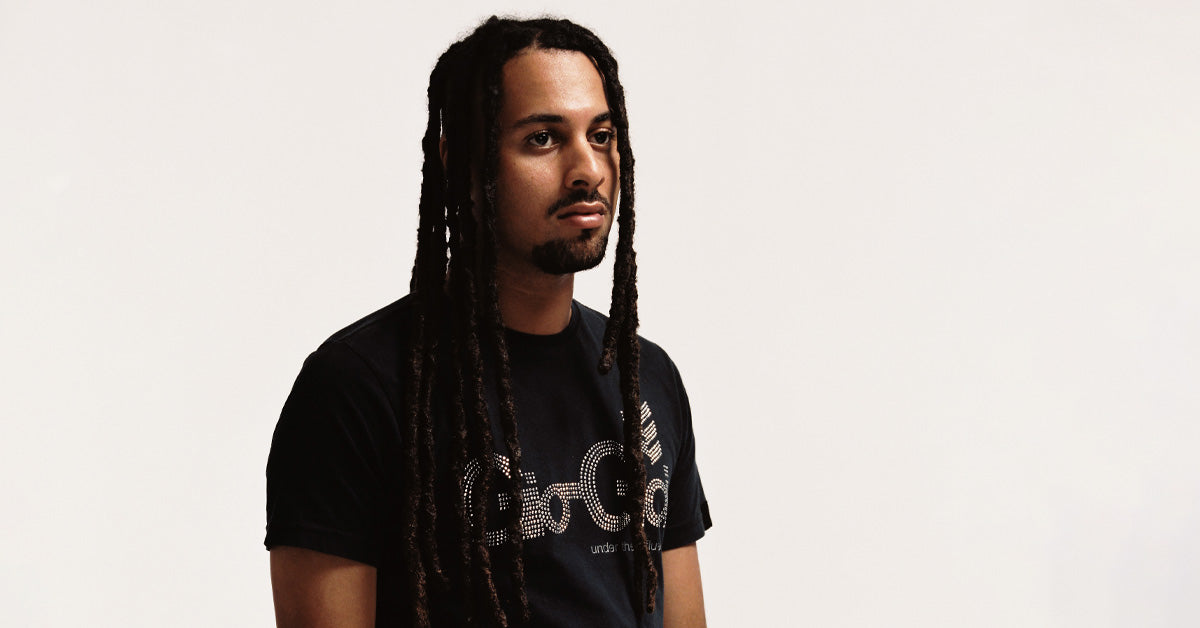
Haich Ber Na appears in our Fall 2024 Issue with cover stars Slipknot, Destroy Boys, Pierce the Veil, and beabadoobee. Head to the AP Shop to grab a copy.
Nothing happens in Peterborough. Located in England, it helms the reputation of one of the most depressing places to live. It’s neither clean nor dirty. People who live there are just going on with their lives. Singer, songwriter, and producer Haich Ber Na has lived in Peterborough his whole life. Haich understands the hardships and stigma of being born into the working class. Unlike the U.S., where money can provide mobility on the social pyramid, in the U.K. you live by what you’re born into. “In Peterborough, loads of craziness [and] loads of sadness doesn’t happen,” Haich explains of the working-class town.
It’s understandable that frustration among blue-collar families is growing with no relief in sight. The Everyday, Haich Ber Na’s debut album, lends a voice to hushed and overlooked individuals who are under pressure from rising living costs and unlivable wages.
Read more: 25 best albums of 2024 so far
Haich’s parents are from Leeds, which is north of England. They met when they were young, while his dad worked as a shop manager and his mom taught kids with special needs. Due to his father getting a promotion at work, the family was forced to relocate to Peterborough to manage the new store location. Both of Haich’s parents loved music, opting for Northern soul as their genre of choice. His dad, however, was more involved with rap music, putting a young Haich on to Kanye West’s Late Registration.
Growing up, the sounds of rap and grime swirled around him. In his late teens, he delved into more regional rap scenes like 2010s Atlanta trap and Chicago drill music. Haich considers rap to be his first religion when it comes to music. “In my late teens, I became more of a music head,” he says. “I knew about Nas and Masta Ace, and I really used to love ’90s hip-hop. I grew up listening to that.” Peterborough is predominantly an Asian and white town, and the Black youth would use hip-hop as a means of connecting and creating community. They often linked up and held ciphers and dance battles. As Haich got older, he was introduced to genres like house, soul, and niche grime music. This became the trigger for Haich to start creating his own.
Since school, Haich’s friend Diesel used to beatbox while they spit rhymes together. One day they asked themselves: What if they didn’t have to beatbox and could make beats instead? After watching a video of Soulja Boy creating his viral track “Crank That,” Haich did just that. He made different variations of rap beats, creating his own soul-sampled beats and iterations of grime. At 13, Haich was already producing beats for small-time U.K. and American rappers, receiving payments via PayPal and sometimes Western Union. Haich continued to mesh his social groups with different ethnicities, introducing him to bands and electronic music he was never exposed to prior. It inspired him to try making music out of his comfort zone. Indie rock and rap music became Haich Ber Na’s bread and butter.
When discussing The Everyday, the reality of high living costs and dead-end jobs looms over the conversation. As Haich’s first album, it’s an opportunity for him and the fans to connect on common ground. Relatability is an important factor in making The Everyday. “I don’t know how people in that middle ground who don’t wanna take the risk of doing madness and also don’t have big family money [survive]. I don’t know how we’re gonna keep doing this shit,” Haich expresses.

Geray Mena
“Sandringham,” its first single, sees Haich back in the phone store, as well as a clothing joint he used to work at, stuck in the ruts of a 9-5 job. While “Sandringham” sets the tone for the album, the rest of the songs revolve around a coming-of-age story. “It’s like the character who is me in that song is dreaming. You know, one day I’ll become the richest man in Sandham,” he says.
“Running Circles” is the first song Haich wrote for the album. Produced with his friend Marcus Andersson (SOPHIE, Rina Sawayama), their high-octane chemistry is on full display. Haich’s voice sounds delicate, layered over the synths and snapping electric snares. He sings like a longing lover, a hopeless romantic looking for the perfect kiss at sunset. “Me and him made a bunch of stuff, and we made that a summer or two summers ago. We just had this mission where we wanted to make a song that started straight away, as in there’s no fucking intro, there’s no drum, and the shit just starts playing,” Haich explains. They would set challenges for each other, which helped expand their creativity together.
The concept for The Everyday is love at first sight and having ruminating thoughts go too far. It’s the need to know more about the person under your gaze — what music do they listen to? What makes them tick? But when those feelings boil over, embarrassment and guilt take the steering wheel. As Haich describes, it’s like someone catching your glance and being stuck at a standstill.
The only feature on the new album comes from Paris Texas. Haich met one-half of the alt-rap duo, Felix, in 2018 during his stay in Los Angeles. After chopping it up and making friends, they stayed connected over the years. “Then they ended up forming Paris Texas, and they sent me the early shit, and I was like, ‘This is the music of my childhood dreams — guys rapping with some humor on fucking weird beats with LA accents,’” Haich says. They would all continue to hang out and play each other music until Haich showed them a beat that Felix fell in love with. Haich later played the same beat to Louie, not knowing their tag partner was recording verses to alleviate the pressure. That song ended up being “Hallelujah!”
Haich Ber Na remains hopeful. He tells me he just wants to keep making the music that he and his friends enjoy and to do it for a long time. There’s anticipation to perform more shows and spread the music to every ear that’ll listen. Haich is a firm believer that comparison is the thief of joy, so he’s embracing the fact that he’s making original music being a Black man from the suburbs of England. There’s a sense of grace and joy when hearing Haich talk about the future. He understands that this is a blessing, a moment where he can be creatively free. He stresses the importance of living in the present, as being stuck in the past will only hold you back. “You’re not 10 anymore,” he urges.