
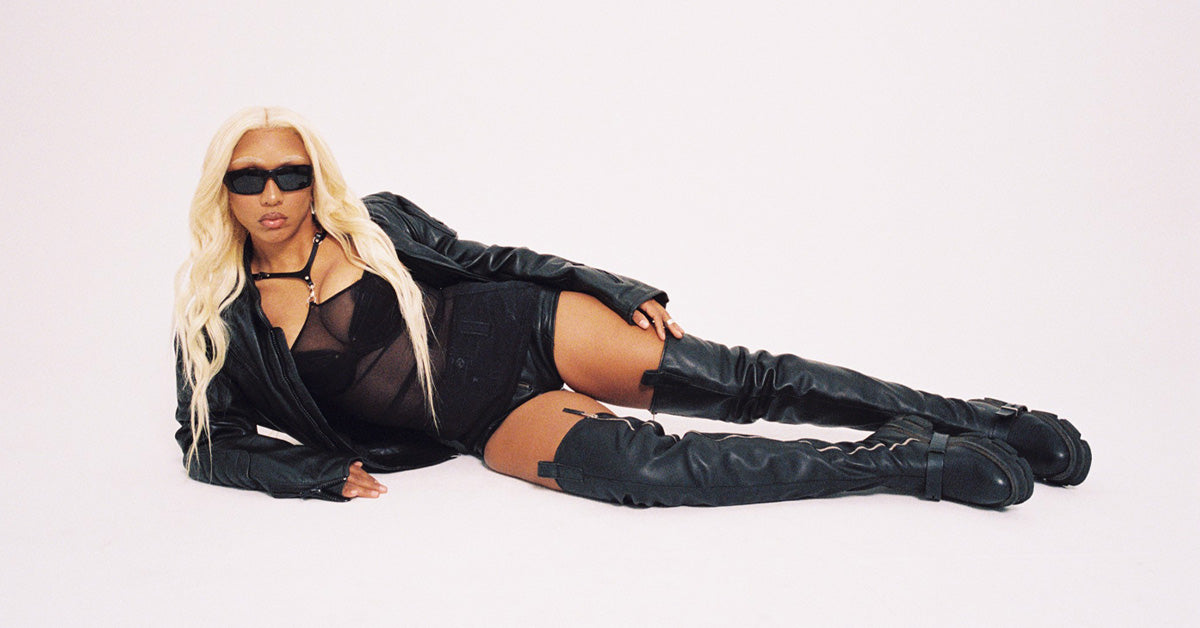
Fousheé appears in our Winter 2024 Issue with cover stars L.S. Dunes, Wisp, Fall Out Boy x WWWYF, and Chase Atlantic. Head to the AP Shop to grab a copy.
Fousheé has fallen in love — with her familial homeland in Jamaica; with a partner; with the music she creates — and her sophomore album, Pointy Heights, is a testimony to the way that love can be the catalyst for both personal and creative growth.
Many of the pivotal moments throughout her career seem to correspond with the search grounding; she’s always ready to reinvent herself based on her given mood. After releasing the grunge-infused softCORE, Fousheé hit the road with her frequent collaborator, Steve Lacy, and performed both selects from softCORE, along with the songs, like “Deep End,” that first gained her fame. She found that oscillating between such juxtaposed emotions onstage was draining, especially as the initial pain she sang about began to heal. “It felt like a part of me, but a part of me that I was growing away from,” Fousheé says. But touring on softCORE after “Deep End,” TikTok fame had other challenges. “On tour with Steve Lacy, it wasn’t always accepted,” she says of performing softCORE live.
Read more: Stream Ethel Cain’s new project Perverts
Regardless, she’s proud of her journey. “I love that I did it, and I need to make myself uncomfortable more often. It’s those moments where you make other people uncomfortable — that’s where innovation is,” she says. “But at the time [of writing Pointy Heights], it felt like it was time for something different.”

Zhamak Fullad
The thoughtful, if timid 28-year-old sipping a matcha latte while speaking to me over Zoom seems far from the woman who screamed her way through tracks like “die” on softCORE. The anger that was so prevalent throughout her 2022 record has receded from view. “It was definitely a reaction to being in the industry and being a new artist,” Fousheé says. “After I did [softCORE], I didn’t feel angry anymore. I fell in love with someone. Super cute.”
Romantic love isn’t the only thing that has softened Fousheé. While writing Pointy Heights, she visited Jamaica for a family reunion — the first time returning home since childhood. “It was during a time when I was searching for grounding and meaning in my life,” the artist says. “Seeing the family history right in front of me, I was like, ‘Damn, this is what I need to be writing about.’” This is what Fousheé really wants to discuss. Her family and the plot of land outside of Old Harbour they live on, which they call “Pointy Heights.”

Zhamak Fullad
Removed from the rebellious punk energy of her freshman release, Pointy Heights acts as a sunny vignette of stories brought back from her time in Jamaica to her life in Los Angeles. “Each song is a separate lesson,” Fousheé says. “‘closer’ was the first song I wrote in a long time, though it’s supposed to be about letting go of your idea of someone and just being OK being in their life.”
Fousheé’s lyrical love notes, like “We’ll sit aside the palm trees/I’ll lay aside my savings/Say my goodbyes and make a life with you” from “feel like home” inject Pointy Heights with a sense of humanism that counters much of the frenetic and paranoid Boiler Room energy that dominates pop music today. “I want to make music that sounds like sunshine and feels good and can last forever,” Fousheé says. It’s a bold claim to try to make timeless music, but if someone has the ability to do it successfully, it’s Fousheé. The young artist has proven herself adept at incorporating new influences into her work without losing her voice in the process. “I worry about how fans will react to the change in sound, of course,” she says, “but it’s always after the fact. I can’t make an album full of requests.”
The reggae influence is evident throughout Pointy Heights, from the groovy guitar riffs (“100 bux”) to the funk-inspired basslines (“do you have a soul?”) and dreamy vocal harmonies (“war”). It’s a sound that suits Fousheé naturally, so I wasn’t surprised to learn that Jamaican reggae was embedded into her own childhood, despite having been separated by an ocean from her extended relatives. Her mother, Fousheé tells me, was a drummer in Jamaica’s first all-girl band, PEP. “They never got that big, but I grew up hearing tapes of her playing. It’s probably all her fault that I’m doing music now,” Fousheé says. She speaks of her family with an infectious smile, and I feel warm just hearing her explain the tight-knit community they’ve built together. Speaking of music and blood connection, Fousheé is suddenly at home — temporarily transported back to that small plot of land her grandfather built from nothing.

Zhamak Fullad
Returning from her personal pilgrimage, it seems as though Fousheé found her stride. She likes describing it as “softness,” an attribute she’s fond of, but I think that “happiness” is probably more fitting. As though a break from the stimulant-fueled breakneck pace that culture moves at today, it’s refreshing to hear a new artist move at her own grooving pace — one that isn’t afraid to slow down to enjoy the view.
Onstage, Fousheé exudes confidence. Between playing guitar, incorporating visual elements, and executing her vocals flawlessly, she’s earned it rightfully, but offstage, she embodies a much quieter type of self-assurance. She’s deliberate with her words, not afraid to fill the space with silence as she considers the question before answering. She looks up as she thinks, as though the corners of her eyebrows possess a teleprompter that provides her with the words to say. She doesn’t want to say something she doesn’t mean — she knows her words have weight. Fousheé has worked hard to cultivate her image, but that isn’t to say it isn’t authentic. “I get nervous every time I perform,” she says. “It can be uncomfortable at times. I try to create a character I can hide behind.” For Fousheé, this stage performer alter ego isn’t disassociated with the one calling me from her bedroom, just “amped up a little,” she says. “There is a blurring that happens. I block out things I normally pay attention to.”

Zhamak Fullad
As her fan, the determination is exciting. I want to see where she will go next, what growth will take place, and how it will shape her sound. “There’s always something to improve,” she says. But listening to Pointy Heights, I only hear someone perfectly content with the way things are. Maybe that’s a testament to love. Maybe she just makes it all sound easy.
For now, Fousheé is focused on her first headlining tour and connecting with her fans, something she wasn’t able to do when she first entered the scene. “When I came out, it was in the middle of COVID. I didn’t get that one-on-one with people. So I don’t know what my fans look like,” the artist says, “or if I even have any. I guess we’ll see. I have to develop that relationship with my fans from scratch.” Something tells me that she won’t struggle to connect with her audience.