
Grian Chatten wears rose-tinted glasses when he tells us romance is a place. He’s wearing a “Brat green” jacket and three-quarter-length Ed Hardy shorts, too, but the choice of pink-hued eyewear lends itself to the storytelling. From the Reading Festival mainstage, he articulates a worldview of relationships as a necessary force for both good and evil, where a romantic lens is the only one worth seeing life through. It will lead to certain doom but also fathomless possibilities. That Fontaines D.C. are here on the same day and same stage as the greatest songwriter of hopeless romance in the 21st century, Lana Del Rey, somehow now, in 2024, makes perfect sense. Neither fans of the band nor the band themselves would have guessed this transformation was coming.
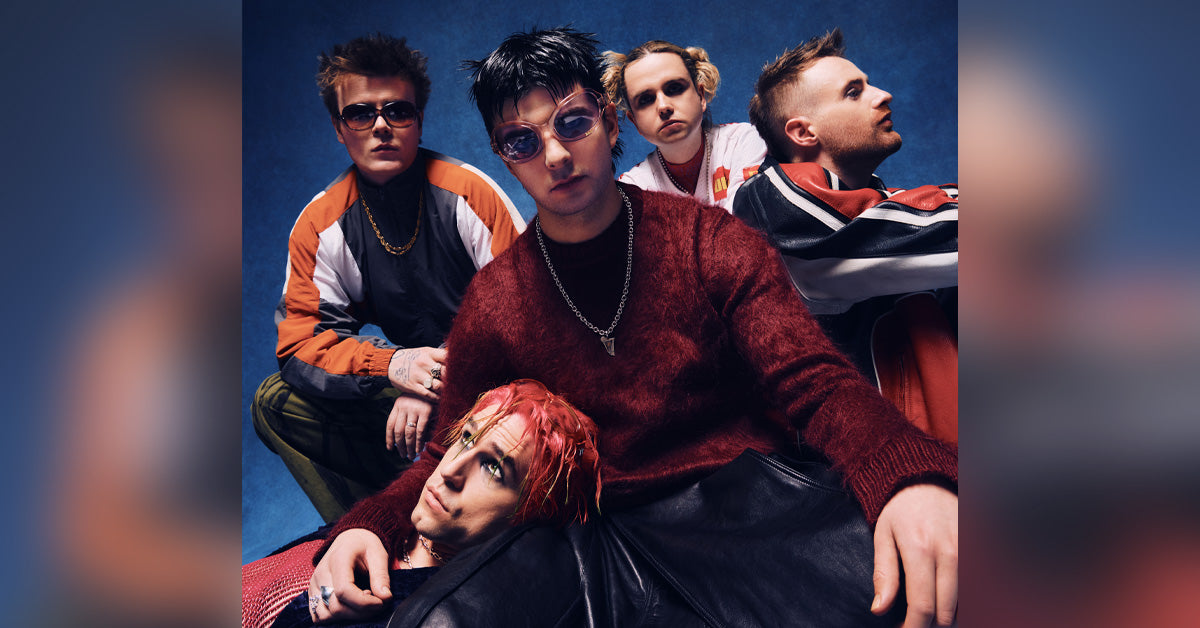
Where life and art used to be grayscale, Fontaines D.C. have started to see in putrid splashes of neon. The Irish post-punk band — consisting of Chatten, Conor Curley, Conor Deegan III, Tom Coll, and Carlos O’Connell — were beloved for their dreary depictions of their hometown of Dublin, opining on dour social and political ills, and soon enough, on leaving Ireland behind for fame and homesickness. This surprising ’90s and ’00s alt-rock reinvention as they consider the subject of love has produced their best album so far in Romance.
Read more: 25 best albums of 2024 so far
“I chose to see the way that we live and our position in the world and society as something that could be fun and ridden as a wave, as opposed to something that was making a tortured artist out of me,” frontman Chatten tells me a week before their Reading Festival appearance. “What I found by doing that was that it was almost an entirely new creative color. It gave rise to that more celebratory feeling on the record. It’s coming to grips with what we’ve become and fucking enjoying it.” They stepped away from their longtime producer, Dan Carey, for this fourth album. With the help of new producer James Ford (Depeche Mode, Gorillaz, Arctic Monkeys), Romance has elevated them away from post-punk contemporaries IDLES and Shame into a dreamy alternative-rock space where Placebo might cover Lana, or where the Cure going cyberpunk is a legitimate possibility. The change — particularly in the group’s look — has been silly and brought them all closer together. “It’s really fun looking across the room and seeing Conor the bass player wearing something fucking mental — it’s nice to access that part of each other’s vulnerability as friends again, because not many things open those doors, especially when you’ve known each other for a very, very long time,” Chatten says.

Theo Cottle
One of the earliest references — one that Chatten insists organically entered the process — was a band that terrified him when he was young with an active imagination: Korn. He remembers buying CDs to listen to while doing his homework, and one of them was Korn’s Greatest Hits record. “The world they built was so convincing and funny and fleshed out,” he says. “I was an easy convert. I was a believer in all of that darkness. I didn’t see any of it as being contrived. I didn’t even fully see them as human beings who go to the toilet or make sandwiches; I just fully thought that they were vampires.” Their frontman Jonathan Davis’ femininity — from occasional makeup to performance style — was something Chatten could identify with. “Not to equate femininity to vulnerability but, Korn wasn’t macho.”
Many of the artists that made their way onto a reference board that the band have passed to anyone who is currently working with them, from stylists to lighting engineers, are ’80s to ’00s alt-rock icons like those mentioned. While you might not be able to hear or see the exact links between nü metal and shoegaze and the songs on Romance, what the Cure, Korn, and Fontaines D.C. all share is a dedication to their fantasy. “I’ve always been interested in artists that are able to build really specific worlds, because I feel like everybody has one in them,” Chatten says. For the same reason, at Reading and at all the shows they’re currently playing, they open with the terrifying “Romance,” which informs the crowd that romance is a place, and they’re now living in it. Its carnivalesque quality imitates, Chatten thinks, the unsettling nature of Gene Wilder in Willy Wonka & the Chocolate Factory, a film they’re fond of as a band.
So, what are Fontaines D.C.’s theories about romance? On first listen, you might not discern whether they as a collective are die-hard lovers or a cautionary tale because everything you hear is in extremes. The droning contemplation of “In The Modern World” depicts a numb city where tiny sparks of happiness or something like it can be found, but the nauseating drain-circling of “Death Kink” puts you on the emotional merry-go-round of an abusive relationship. This discordance was by design: “I wanted it to be maxed out on both ends, 100% dark and 100% light. To broaden the spectrum, go further in both directions,” he says. It reminds me, I say, of how relationship experts will advise that a good relationship involves not two people giving 50% to make a whole bond but both giving their all. He hasn’t heard that, he says, and starts to say that he feels happiest in his relationship when he’s fully functioning as a partner, then slows to a stop, because he’s getting too personal.
“We romanticize things in order to process them and contextualize them. Or: to have them touch you, to make yourself sensitive towards them, you romanticize things, life in general,” he explains of the album’s hypothesis. “But I think that to romanticize is to become delusional. At a certain point, you’re no longer really operating with reality whatsoever, and I like the idea, in a melancholy way, of completely committing yourself to that fantasy. Of taking both your feet off the ground and just allowing absolute delusional romance to wash over you and never check back into the reality, whatever form that might take.”

This works, of course, if both parties involved in a relationship agree on the shared delusion. Otherwise, it’d be chaos. A Nietzsche quote comes to Chatten’s mind: “What is the truth but a lie agreed upon.” If everything is subjective, the singer continues, we all have to agree upon our own version of reality. Why shouldn’t it be a romantic one?
His mobile mind jumps to another piece of critical theory: Baudrillard’s ideas of simulation and simulacra. “We’ve rendered our idea of romance as a symbol,” he says, of the way we share a reductive collective idea about what romance is. “Then we die and the next generation comes to life, and they see the symbol before they feel the romance — the symbol informs their idea of romance — so all of a sudden, the symbol precedes the actual thing.”
His current interest in this subject is certainly down to the fact that the world feels like a dark place politically and environmentally. The constant exposure to the way things are through social media is intense and relentless, he says. “The desire to run away into a delusional state of romance — perpetual romance — is more and more intriguing, as sad as it is.”
The album itself, for all its color and play, is a dark one. The final track, and second single, “Favourite,” is a sunny burst of shoegaze against painful lyrics about the unstoppable nature of time. For Chatten, there is some happiness in the fact that by the end of the record, the decision has been made to commit yourself to the romance. That decision is mixed with the sad knowledge that it’s an act of delusion. “To me, it’s like a white flag,” Chatten says, as happily as he’s said everything else. “It’s relenting. You’re happy because the struggle of the friction is over, but it’s at the cost of your own surrender.”
Against the songs of toxic relationships and feeling anesthetized, there is a relief for Chatten that artists can take liberties. They can make things up, embellish the facts for the greater vision. “It’s the privilege of someone who’s working in the arts to be able to explore those extremities without actually fucking doing it. Imagining them to a point that a lot of other people just don’t have the time to do,” he says, while patting a sausage dog that has waddled up to him in the park. “I’m not actually going to live on the fringes of society. I’m not going to turn into your man out of Into The Wild.” Then he pauses, clearly remembering that Into The Wild is based on the memoir of a man who gave it all away to find himself and in the process was no longer a functioning member of society, dying alone and in starvation. “Actually, that’s quite sad,” he remarks. “That was a true story, wasn’t it?”