
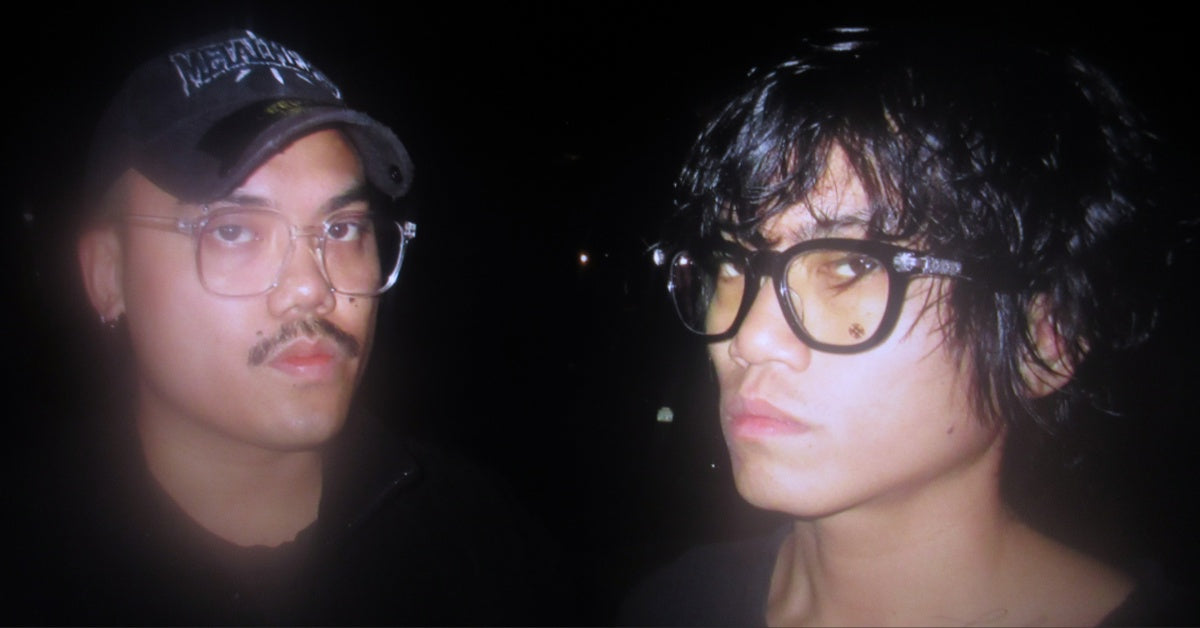
Dream, Ivory wouldn’t exist without the internet. Growing up in Southern California, the brothers of Christian and Louie Baello spent hours trawling through blogs to add songs to their bursting libraries. In their house on Flowerhill Drive in Lake Elsinore, where they learned to play piano, they were spellbound by a plethora of musicians, torrenting shoddy MP3s from Slowdive, Beach Fossils, and Damon Albarn and falling down SoundCloud rabbit holes.
“Whenever I hear Fall Out Boy’s ‘The Take Over, The Breaks Over,’ I [remember] trying to find that on LimeWire for so long when I was a kid,” Christian recalls from his apartment in Los Angeles, ripping milky vape hits. “I kept seeing that title, and it would just be a completely different song. [Like], ‘Oh, you scammed me again.’”
Read more: My Bloody Valentine’s Loveless is still groundbreaking after 30 years
Discovery still rings true for them, serving as a throughline across their work. Over Zoom, the duo are as warm and curious as the music they make, eagerly gushing over their old YouTube channel, uncovering songs from their birth years (1998 and 1999, respectively), and a documentary they recently watched about NASA’s Voyager mission. As they continue to upload new songs, they never forget those early days, constantly tapping into the magic of finding something for the first time and feeling swept up in all its possibilities. “I love to hear a song that makes me feel like it’s something I’ve heard before, but I’ve never actually heard it before,” he adds. “I think we’re trying to invoke that with our music while also bringing in a modernity.”
“Every time we write, I’m always thinking about [childhood],” Louie says. “Sometimes I live too much in the past. That’s something I need to get better at, but I love that feeling, thinking back to good moments, and doing something with that… There would be so many times Chris and I would cook up an instrumental, and we’d be like, ‘Oh, my God, this reminds us of 2007.’ The song that we end up writing has nothing to do with that period of time, but it just sounds like that.”

Lilia Shibuya
That sentiment is hugely felt on their latest album. Throughout When You Come Back I Have So Much To Tell You, the pair assemble their gauzy sound into songs of intention, lingering in the bleary-eyed memories that nostalgia can offer. Their evocative, fuzz-drenched guitars ground the album, whereas other bright surprises, like Christian’s longtime girlfriend, Lilia Shibuya, co-writing a few of the tracks or dreaming up love songs inspired by the solar eclipse, add more weight. It’s a layered record that can make you feel nostalgic for an era you didn’t even live through while taking an unflinching look at home, addiction, and unshakable bonds. But though Dream, Ivory frequently borrow from indie, dream pop, and alternative rock, they aren’t beholden to a single lane. “We weren’t ever supposed to be this band of one sound,” Christian urges, alluding to the wistful reverb of their viral single “welcome and goodbye.”
More than any sound, When You Come Back… is bound to a melancholy sense of longing. That feeling, accurately summed up by its title, runs rampant throughout the songs, most profoundly on “Sometimes” (“It’s about a distance that’s toxic and had to have been made, but they still miss each other,” Christian reflects) and “Tangerine Dream,” the latter of which sounds more like a weed strain than a song about “withering at your own reflection, feeling both violence and sadness.” Closing the album, it holds intense meaning. “Seasons change/Memories fade/Life goes on without you,” Christian sings over a narcotic guitar part that juxtaposes a clearer headspace. In a way, that line feels like the album’s statement of intent. “It truly embodies the title,” Christian says. “That lyric can be taken to be talking to yourself, as well, because it’s a very self-reflective song. Looking at the water and skipping rocks just to throw punches at yourself while staring at your reflection. I like how it’s ambiguous — just as ambiguous as the [album’s] title.”
Part of that longing can also be traced back to their parents’ — a pair of first-generation American immigrants — move out of the country. When they relocated to the Philippines, Louie found home in Los Angeles and lived with Christian and Shibuya, who’s beginning to earn a deeper role in the band (they’ve already had one writing session and are plotting out more in the coming months). Despite the clashing time zones, they still speak to their parents twice a week — usually when it’s just morning there but nearing midnight for them. “We used to send them our old [demos], and they wouldn’t get it, not in a bad way,” Christian says. “They would just obviously smile and be like, ‘This sounds cool, but we can’t hear your voice.’”
“Our vocals are more upfront [now],” Louie says. “It’s less brash-sounding. I feel like this album’s more emotional. They really like it, which is so funny because you can tell when our parents like music.” For as much distance that flows between them, the love resonates.

Christian Baello
Dream, Ivory weren’t the end goal, but they’ve always been grounded in music. Growing up, the duo absorbed their parents’ record collection — everything from Bee Gees to the Eagles — while learning music theory and listening to anything they could find. “I was forced to do choir in middle school,” Louie says. “I didn’t really like it, but looking back, I feel like I would do it again. I was just too caught up in my image.” It was only a matter of time before they created their own music, though it sounded nothing like their influences. During the face-tatted SoundCloud rap boom, Christian and Louie began uploading songs to the internet. Louie penned rhymes while Christian handled production, riding a chemistry that felt as natural as coming of age together. “That was what was cool,” Louie says. “Everyone in our high school was trying to be rappers, so we tried to get on that.” He’d never played in real bands, only coming close when preparing for a high school talent show and practicing cover songs. “I never actually knew how to play my instrument. I mean, I still don’t,” he laughs.
“Towards the end of my high school career and while Chris was a freshman in college, that’s when we started being like, ‘Let’s do the band shit,’” he adds. “That felt more true, whereas when we were doing rap, it was just like, ‘Oh, this is such a fun summer project.’ At the end of the day, I’m not necessarily being me on the mic when I’m rapping. I’m just having fun. With Dream, Ivory, it’s a way more vulnerable space. It feels genuine when we make it.”
Christian is quick to point out that their switch from hip-hop to a more alternative space didn’t even feel like a conscious decision. It merely retraces their love of music, never boxing themselves into a specific chamber. “It was just natural for us to try out everything because we rock with rap music just as much as we rock with the music we make and listen to,” he grins.
“We have so many newer rap songs that just will never see the light of day,” Louie adds. “We’re still doing it.”
They didn’t think they’d get to finish the album, though. During the making, Christian realized that he needed help after relying too much on alcohol. He’d come home, take shots, and feel stagnant, consumed by the reputation of their early success. “When I was at my rock bottom, I was already thinking at certain points, ‘Dude, the band is over. There’s no way I can continue because I’m out of here,’” he admits. Louie and Shibuya were there to lend support during the heaviness, giving him encouragement and space to recover (Louie has since moved into his own apartment, though they’re constantly texting and skateboarding around LA). He credits them both as the “biggest factors” in getting sober from alcohol. “If it wasn’t for them and having the rest of my friends as a support system, I would’ve fallen off the deep end,” he says. “At Zero” addresses a dire low; “Bleed” gets caught up in guilt; “Lost Angeles” recognizes that the end hasn’t arrived yet. “I was acknowledging that they were giving their hands out, but if I didn’t take it soon enough, that shit would’ve been done,” Christian says of the latter.

Liam Walsh
Through all the turbulence, the duo have a lot to be grateful for. They just celebrated their new album with a release party at Pour Vous in LA, have a tour with viral shoegaze musician Wisp on the books, and are planning to visit their parents in the Philippines around October. And, of course, there’s always new music on the way, already conceptualizing a deluxe edition of the album. Nothing ever seems too far out of reach (“I wish I could get so rich and just buy that house,” Louie gushes, thinking back to Flowerhill Drive). They recognize the heavy times but keep slinking forward, knowing that they have to grow through the cracks.
“Sometimes I really forget to just sit here and look,” Louie admits. “We did this because people gave us a chance and fucked with our shit, and that allows us to continue doing it for a living. I don’t think about that a lot, and I feel like I should. Sometimes I focus on the negative, like, ‘Fuck, this song should have done at least a couple K more plays.’ It’s hard to get out of that mindset, but we’re at such a good place right now, and I need to take that in. I don’t want to rush. I shouldn’t expect things to come faster or slower. I should just live in the moment.”
Christian agrees. “I have a lot of gratitude for my age and time and how much we’ve done thus far,” he says. “I tend to always look back, and every year it’s like, ‘Oh man, I haven’t been doing enough. There should be more I can be allotting my time to. I can be more productive. I could be a better person.’ I have a lot of gratitude towards having all the people I love since I was a kid. All my closest homies, my girl, and my brother’s with me after all the bullshit. I can still look around and feel grateful, even though I was at rock bottom before.”