
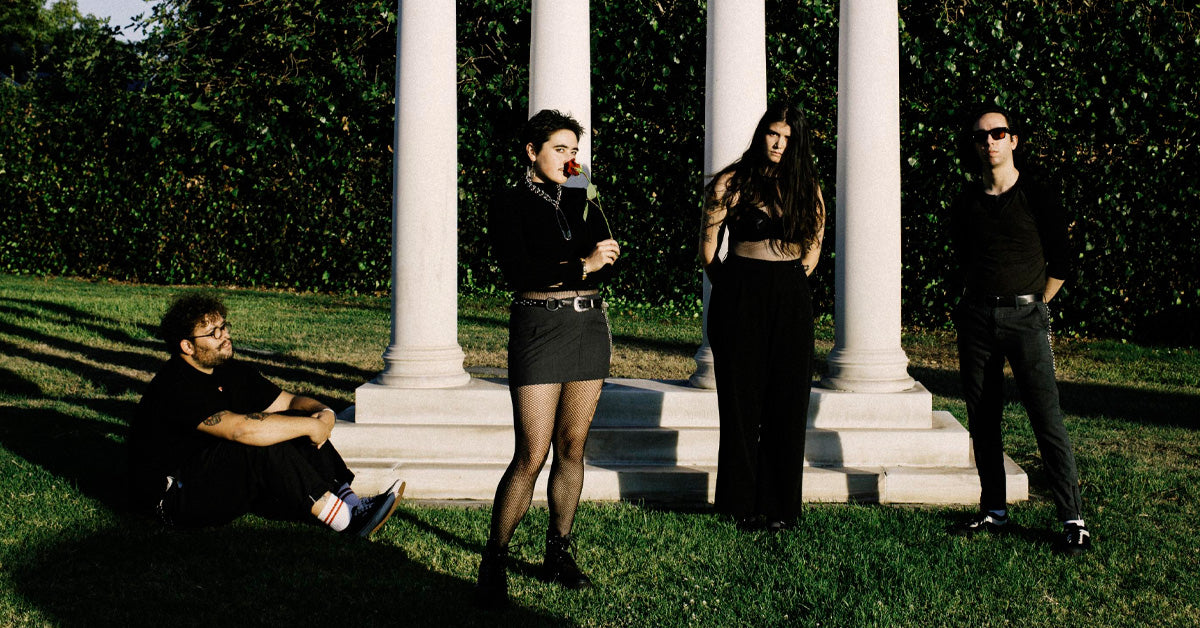
Destroy Boys appear on the cover of the Fall 2024 Issue — head to the AP Shop to grab a copy.
Some months ago, in the clusterfuck that is my ceaseless inbox, an email caught my eye. It was from a publicist, pitching an artist-driven column. It’s a hit-or-miss proposition, but one I’m always open to. Just one response and a few days later, I found myself on a Zoom with Alexia Roditis. There wasn’t a second to waste — before I could take a breath, the Destroy Boys lead singer and guitarist began. With dead honesty, Roditis, you’ll learn, doesn’t hold back. They don’t observe stifling rules or regulations — they take action where action is needed. It’s an ethos and a quality that’s shared across the foursome, and has permeated Destroy Boys’ work across four fundamentally impactful albums. In perfect cadence, Roditis and the songs they croon with statuesque range showcase someone who is deeply caring, altruistic, and eager to connect.
Read more: 15 best final girls of all time, ranked
From a sunny bench in their backyard, the pitch they lay out is compact. “It’s about lunar rock,” Roditis tells me. It’s a genre the artist has coined to describe bands like chokecherry, Scowl, Mannequin Pussy, and DEBO. Songs reflect feelings and themes. “Like what happens between phases of the moon. One band can reflect a full moon, the height of brightness in the dark night sky, and can also reflect the new moon, a time of dense interior reflection… The bands in this genre share some commonalities: divine rage, trauma processing through music, heavy, emotional lyrical content, subconscious exploration, and also a wide range of moods throughout a discography. There’s something about music made by people who experience sexism that hits differently for us,” Roditis says, making sure to mention that this title is a reprieve from the exhaustion of being reduced to a “riot grrrl” act — a vital sound, time, and movement that’s been warped into an umbrella adjective to describe female or queer acts in the rock space.

Levi Berlin
Not only does DEBO own this concept on their new album, Funeral Soundtrack #4, but they put it into action across the LP. “You Hear Yes,” a ferocious clapback at an industry, and world, that’s objectified and overlooked othered artists, features Kat Moss of Scowl and Mannequin Pussy’s Missy Dabice. On “Boyfeel,” Roditis’ vocals dance around Debbie Harry, dipping low only to swing upward, louder, clearer, and far more formidable — while proudly excavating experiences of gender and sexuality nonconformity. I realize now, having sat and fallen in love with the new album, that every attribute of lunar rock that Roditis regaled me with on that bright afternoon back in summer’s early days is a box Funeral Soundtrack #4 has ticked. Between Roditis and guitarist Violet Mayugba, bassist David Orozco, and drummer Narsai Malik, they’ve only grown stronger as a unit, a sonic force, and a vessel.
Before the haze of a new album fully hit, we sent a photographer to meet Destroy Boys in LA. Somewhere along the line, in haphazard attempts at organization or wrangling, we lost the thread — and all control. The results were an evening as unruly as one might imagine, and a couple of photos that are a bit too NSFW. Starting off in their beloved van, the quartet made Robert Smith proud and lurked in a graveyard. From there, they racked up an impressive bill over a steak dinner, and, steeped in wine and ice cream sundaes — sleepy but not yet ready to give up on the night — DEBO rambled home, with AP still in tow. There was definitely life lived from top to bottom of the evening — but you don’t have to have been there. With a band as built upon honesty and action as DEBO, to truly love, know, and understand is what it’s all about.

Levi Berlin
In explaining the Funeral Soundtrack #4 concept, you’ve mentioned this experience of “death” and rebirth that happens to you as artists, from album to album. Though today we’re squarely in DEBO’s fourth lifespan — I’m wondering if you can take me through what’s behind us, and those first three funerals.
VIOLET MAYUGBA: The reason we came up with Funeral Soundtrack #4 is because all three [previous] DEBO records are representative of super transformative periods in our lives, where we gained new things that let go of old things. On the first one, Sorry, Mom, we were teenagers, going through all our teenage stuff, and then on Make Room, we were finally 18 and having more adult problems, letting go of our high school years and teenage-dom. On Open Mouth, Open Heart, we had gone through so much during COVID-19, so we were grieving those losses. With this one, we’re in our mid-20s now. We’re dealing with the serious adult stuff, and reckoning with the fact that that super youthful time has passed us by — or rather, what I mean is, we’re past it.
ALEXIA RODITIS: I feel like now I am more in control of my life. That’s what this album represents as well. We’re branching into more thematic, broad strokes stuff, as opposed to personal issues — which I think has to do with being a teenager and a young person. In your early 20s, you’re focusing on what’s going on around you, and then as you get older, it’s like, “Oh, wait a second. There’s a world.”

Levi Berlin
When did you start writing FS4?
MAYUGBA: Some of the songs on this record are literally years and years old. Alexia wrote “Plucked” when we were 18 — six years ago. The songs that are brand new, like “Should’ve Been Me,” were written in December. So there’s a big spectrum of time. But even if a song started in 2017, it wasn’t finished until late 2023. It had its own evolution, there in the studio. It’s about taking a song that I wrote when I was 17 and putting it in the 24-year-old, 23-year-old perspective.
RODITIS: Even as we were making the record, we were growing up and dealing with stuff.
Some things take a while to articulate. What are certain things that you noticed had changed about your perspective?
MAYUGBA: I feel like I am more controlled, even tailored, about what I think or say compared to how I used to be. I was a lot more angry, and I’ve tried to learn how to cope with anger in a different way, and see behind the veil of, “Why am I angry?” That’s a big part of it. Also, I have our fanbase more in mind. As I listen to an album, or as I’m writing, sometimes when I’m stuck on something, I’ll be like, “What would I want to hear as a fan?” Or what I think would help some of our listeners in regards to this topic. I’m trying more to serve the people.
When it comes to considering your fanbase, who are they? What do you consider when tapping into what they might need or want?
MAYUGBA: I think that a lot of times they need to be reminded of their own autonomy and their own control over life. I think that they need to know they’re not alone with their problems. Everybody has fear. Everybody has insecurity. Everybody also has strength, and everybody has resilience. It’s important to remind people that they have power on a small scale.

Levi Berlin
How do you feel like Destroy Boys are offering that message to people differently than other bands that might have a message of empowerment?
RODITIS: We write really honestly, and we always have. Since we purge our emotions through these songs, it’s very raw, and it’s honest. I feel like people can relate to that clearly — because what we’re feeling is very clear.
MAYUGBA: We also bring it into the live aspect, too. We chit-chat about personal problems sometimes or about things that are plaguing everybody. I think that we’ve consistently been pretty vulnerable through our music in the way that a person is. There’s that, and there’s also stuff that we do during our live shows. Alexia talks a lot onstage.
DAVID OROZCO: The way I think about it, and I’m only thinking from my perspective, is that I think as a band, Destroy Boys has a very unique voice. That’s what sets it apart. I think great art is about making people feel OK with being uncomfortable. People are so fucking afraid of being uncomfortable. But it’s being vulnerable. It’s like going on a roller coaster: “This is kind of scary, but I feel safe.” DEBO is that safe space, and especially with Alexia being at the front and talking about things like being gender nonconforming, or whatever it may be, it opens up a conversation that not a lot of people are comfortable having.
RODITIS: [Onstage], I like to foster a sense of community. I almost always bring mutual aid groups, or speakers, to come up onstage and talk about local political issues wherever we are. We were in Indiana last night and had a sweet person who came up onstage and talked about Land Back. There’s a person in Indiana who’s a land protector, which is really cool.

Levi Berlin
MAYUGBA: In bringing that community vibe around, people can feel supported. It’s easier to make a stand about something when you’re not the only person doing it. If the band whose show you came to see are saying, “Hey, if someone’s being shitty, go do something about it. Don’t be a bystander. Go do something about it,” it can empower people to speak up. The mutual aid groups have been really receptive toward it, too. I’ve gotten so many comments about, “Oh, my God, that’s so fun. We never do stuff like this.” Or, “One of your fans became one of the leaders in this part of the country or in our city.”
RODITIS: It all came about because I used to talk onstage about this stuff myself, but it became overwhelming — that’s not what I’m there to do. We’re there to entertain and let people have an escape. This is our compromise, bringing mutual aid groups along, because I would also hear from fans, like, “Oh, I want to get involved in my community, but I don’t know how,” or “I don’t know where to start.” I think people really, really want to help their communities and just feel overwhelmed by the amount of options. This makes it easier on everybody. And it’s cool. Punk is so political. Its roots are in politics — I really love the Clash, and every one of their songs has some sort of message behind it. That’s important for me to keep alive, especially with how the United States, in particular, is right now.
I love that you say you began with outward anger. There’s so much evolution in allowing the message of action to come from someone within the community, who’s doing the work there. Right there is enough evidence to the fact that you’re letting go of this angry, younger self while working to get an important message across. It mirrors what you described as the fourth chapter.
MAYUGBA: A hundred percent. If someone who’s not from my city came in and tried to tell me what to do, I’d be like, “What do you know? What do you know about this place?” It’s also cool to be able to platform those people and literally give them a stage to talk their shit.

Levi Berlin
I was especially moved by “You Hear Yes” from the new album. The messaging, the song itself, the insane features from Missy of Mannequin Pussy and Kat of Scowl. Can you give me a bit of backstory — was there an idea that they would be involved, or did that invitation go out while the album was in production?
RODITIS: It came to be because Vi and Carlos de la Garza [Paramore, the Linda Lindas] had made the instrumental. It was really awesome, but I was having a pretty hard time coming up with a solid melody for it. I just couldn’t figure it out for a while. Then I had the thought that it would be cool if we had a very outwardly, obviously feminist song on the record. We don’t really have a very fuck-the-patriarchy type of song in any of our catalog, though that ideology runs in the undercurrent of almost all of it.
“You Hear Yes” came about because we wanted to do something like that. People in the music industry are always trying to pit girls against each other, pit women against each other, pit AFAB people, and pit marginalized people against each other. There’s a “there can only be one girl band” vibe. People have actually said that to me, but I don’t talk to them anymore. But Kat and Missy are both such powerhouses in rock. Mannequin Pussy has been a band for over 10 years, and Kat and Scowl are carving out a really cool pocket in hardcore. I thought that it’d be really cool to bring all of us together to talk about this issue, which is also a universal issue.

Levi Berlin
As an editor, I definitely see Destroy Boys, Mannequin Pussy, and Scowl as North Stars. What you’re doing represents everything that publications, labels, and festivals need to represent if we want to reflect the real musical landscape. We’ve all got to carve out this space to move forward.
RODITIS: Our fans are about 60%, or 70%, young women or young queer people. It’s important for people to have bands, actors, and artists, and people in the industry for that matter, represent them because they are the ones who consume the music. They are the ones who listen to those bands. It’s important to give back to them and be like, “I see you. I have these same problems. We all do.”
MAYUGBA: Obviously, I’m proud of the fact that I’m a woman in music, but I just don’t think it should define our career. Female-fronted isn’t a genre, and it’s not a label. I just don’t think it’s fair to be reduced to that.
That’s what I see in what you’re all doing, along with the others shaking off the industry’s dust. Your music is the message, not your gender or identification. It’s just honest, soapbox-free, nonreductionary music, which can ultimately open the floor for conversations about those things.
RODITIS: It’s just general life shit! I write about the same shit that guys do, but people just only want to talk about the gendered aspect sometimes. And it’s like, “Why don’t you ask me about the love song? Why don’t you ask me about other things?” It’s very reductive.
MAYUGBA: People used to label us as “riot grrrl” all the time, even though we never claimed that label. That’s just not what it was. We started a band and go to punk shows. But when I say that, people might want to take it as, “Oh, you hate riot grrrl?” or like, “Oh, you aren’t feminine.” And it’s like, “No, bitch. I’m just not in the ’90s. It’s 2024.” If a male-fronted band — a term that’s never been used in the history of music — were like, “We’re not metalcore. We’re post-emo…” everyone would be like, “You’re so right. So glad you said that.” But when we’re like, “We’re not riot grrrl,” the response is, “Oh, so you hate yourselves and women? That’s crazy.” No, motherfucker. It’s a genre.

Levi Berlin
Well, I actually feel like just in this year, I’ve talked to probably 10 bands that were like, “We’re not riot grrrl. Please stop calling us that?” Trust me, I’m a fan, and I love Kathleen Hanna. But I doubt that Hanna’s goal was ever to create yet another box that female and queer artists would struggle to escape from. This isn’t about Bikini Kill — it’s about a term that’s been mistranslated.
MAYUGBA: A lot of male journalists and fans seem to have only heard of heavy music sung by women who were riot grrrls. So they don’t think to categorize it as anything else, because there are power chords and Alexia as vocalist. They don’t think to put us in the post-punk category or the rock category. And that’s not fair to us. They wouldn’t do that to a male-fronted band. It just wouldn’t happen. People would never be like, “Oh, Knocked Loose reminds me a lot of Green Day,” just because they have two dudes singing. It’s crazy. And I love both those bands, by the way. Those are two of my favorite bands.
RODITIS: The Sundays and Paramore are both female-fronted, and that doesn’t say anything about the music.
OROZCO: Also, we’re not even female-fronted.
RODITIS: Not anymore. Ah! I’ve become the thing I hate! Just kidding. I don’t even hate boys. I love them. To a fault.
Your sound has shifted between albums in subtle ways. But I read a quote where you said, “But it didn’t lose our identity.” Two part question — firstly, what have been the biggest shifts here, and secondly, what is the DEBO identity? What’s the core of this band?
RODITIS: I think the biggest shift in this album is something that we try to achieve in between every record — a big, clear jump in quality of songwriting, musicality, and production. We worked with Carlos de la Garza on this record, and he has a pop thing going on, which was really helpful for us as a resource. To try to write more in that sphere is not something we’ve ever done before. But at its core, it’s still Destroy Boys because it’s honest and true. It’s rocking and kind of confusing to define.

Levi Berlin
This seems very broad, but one of my favorite questions is something Rick Rubin asked Iggy Pop on Broken Record. What is your relationship to music?
MAYUGBA: We go through phases, ups and downs, but she’s my life partner.
OROZCO: As any artist, it’s such a unique and personal experience. But for me, for so long, I had no idea how important it was to me. Ever since I realized, I’ve been fostering the relationship and trying to nurture it in a way that’s fruitful for the both of us. I keep my antennae clear so that I can have the messages sent to me and be able to convey that. Listening and writing, they’re two whole different ways to go about it, but both can be just as artistic — the way you consume and the way you create. You know what I mean? Music is God’s voice.
NARSAI MALIK: I like it as a vessel to convey different messages and voice different thoughts and feelings. It’s a way to share ideas through sound. Lately, for me, it’s a nice escape from everything, especially going to shows. It’s a release of energy. You get to go through the visual aspects, through the performance. For me, it’s an experience and a means to feel something. I just think music is very beautiful.
RODITIS: My relationship to music, often, is a way of processing things in my brain. It can make you feel less alone, and it allows me to connect with others on a spiritual level. You can hear people’s voices from the past through music and get an essence of who they are or who they were. My relationship with music is an important part of “divinity” for me, of being connected to the universe and myself. It’s a tool for expression. It’s a unifying thing.