
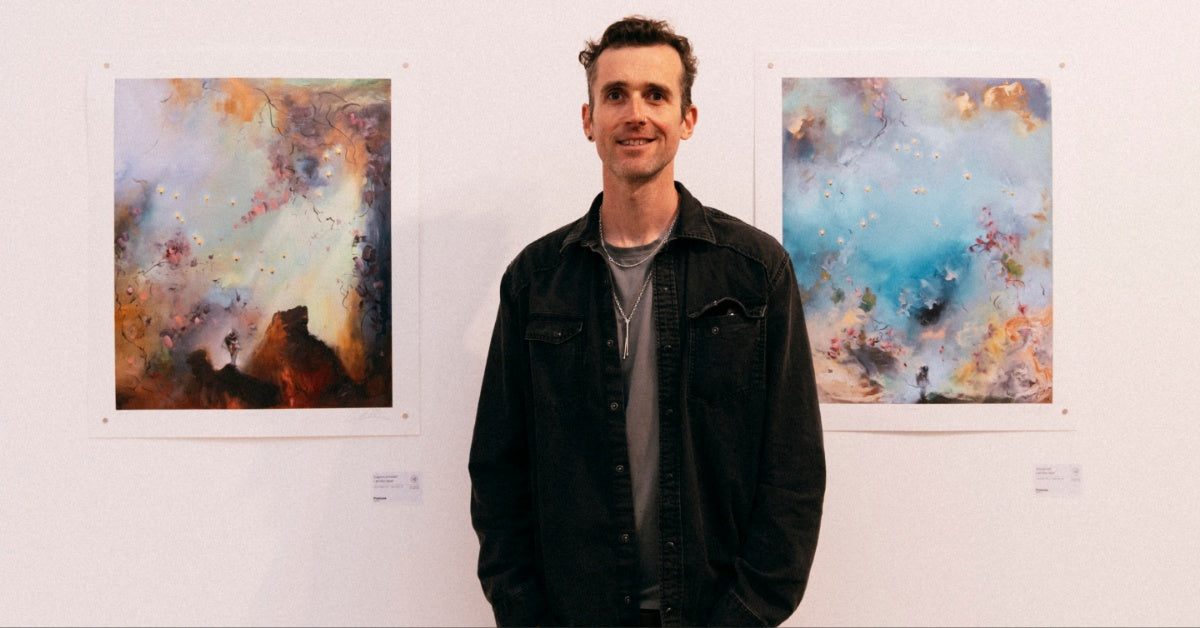
When most hang up their drumsticks, they tend to take it easy. They rarely travel more than they did on tour. But ex-Heaven’s Basement drummer Chris Rivers treads a different path. He’s now an artist with A-list fans, serious collectors, and shows worldwide.
Rivers first began painting in 2014, during touring downtime, using his old drum skins and cymbals as his canvas. But it wouldn’t be until his group disbanded in 2017 that the Manchester-based creative fully committed to his new craft. “I’d already left the band six months in my head before I’d physically left, so I was already set to go straight away,” he recalls. “There was no backup plan.”
Read more: 9 drummers on their early days, favorite players, and onstage mishaps
With his latest collection, he’s pushing his artistic vision even further — this time deeper into the cosmos. Running until May 31 at London’s Pontone Gallery, The Zodiac Universe is a rich, immersive double series of star maps and landscapes. It reimagines Rivers’ trademark oblivion style through the lens of personalized signs and astrological history. The Zodiac Starmaps series boasts an impressive array of detail. The Zodiac Landscapes series is more emotionally driven, with Rivers focusing on how each star sign feels as his trademark lone-astronaut grounds the viewer in his fantastical landscapes. There’s a serenity that runs throughout the entire collection, each drawing from astronomical, astrological, and mythological traditions — an element that Rivers was eager to explore.
His attention to detail unfurls as you approach each piece in the sparse, white-walled gallery. The colors — vivid, expressive — depict the zodiac personalities interlacing with centuries of symbolic heritage. “It’s endless material to draw from artistically,” Rivers enthuses.

Sophie Buckley
Each work features gilded stars — part of a new process for the artist. Drawing inspiration from 15th-century monks and historical gilding techniques, Rivers literally breathed the stars onto the paper, forging them by hand. “I like doing things authentic to the medium,” he says.
Surprisingly, the gilding wasn’t the most difficult part. “The trickiest thing with this series was getting the stars in the correct positions,” he explains. Using officially recognized star charts, he meticulously placed each constellation — emphasised by copper-foil circles on the Starmaps pieces — in its precise astronomical location. “It was enjoyable, but it was one of the things I had to get in the zone with because it took so much time,” he admits. “I don’t like to cut any corners. I like to geek out on it.”
A student of his craft, the results shine — literally. As the sun filters through Pontone Gallery’s front windows, the copper, silver, and gold details shimmer like constellations being born in real-time. Rivers has reached for the stars and delivered a celestial experience with care and craft that feels lightyears away from its Central London showcase.
Sitting down with Rivers at the gallery, surrounded by his work, the artist discusses his journey to date and this latest collection with AP with all the ease and earnestness of someone living their best life.

Sophie Buckley
Where did you get the idea for this collection?
I’ve always loved doing big, ethereal, abstract paintings, but with details that tell a story. There was a period where I was doing these big pieces that looked like nebulas in the sky, a few constellation pieces, unnamed, not any specific constellations. Then I started thinking about where I could go with that, and it led me to the Zodiac constellations. Then I started doing astronomy research, as well as astrology, and mythology — so all this material that I could take from was a gold mine for a painter, and then the penny dropped — I’m going to do a whole series on Zodiac constellations. Everyone has one, and artistically, it suits my abstract, dreamy style. It all came together naturally.
What is your relationship with the pieces now that the collection is done?
Always, when I finish a painting, I’m very rarely completely happy with the finished result. But I think that’s a good mentality to have. I always try to create my masterpiece. I don’t think there’s any point in putting a canvas on the easel and attempting to do something that’s not going to be your masterpiece. It just seems like it would be a waste of time. Even if that falls short, you keep that mentality for the next time you do it to keep you striving. But I have a great relationship with them. They’re all like my children.
How does the collection represent you as an artist now?
That’s a good question. Everything I do now… It’s my childhood interests. This sounds weird, but sometimes I go into my childlike mentality when I’m painting because I’m doing things that I’ve always been interested in: space, astronomy, and that’s something I try not to overthink. To compare it to music, I think there’s a very similar pattern when you try to find a style, and where you fit. Sometimes you can overthink that, but you’ve just got to do what comes naturally to you. And this style just came naturally to me.
With that, how has your journey affected your perception of art?
As a painter now, I’ll go to the National Gallery and go a few inches away from some old master painting that’s worth millions, and get told to step back, because I’m looking at the brush strokes and the colors and trying to analyze how they’ve done this and that. Then there’s the whole other side of it, which I think nonpainters love about a lot of the historical artworks — the stories. Whether it be Van Gogh, or stories of the paintings, of all the old Italian Renaissance paintings, the mythology — there’s just so much interesting stuff throughout history that I wasn’t aware of before. Some of these guys are the David Bowies and the rock ’n’ roll stars of the 15-1600s. Some of them were [football/soccer star Lionel] Messi, big time.

Sophie Buckley
I was going to ask what the process was for you, and if music is involved
Music is a big part of my process. I’m always listening to music in the studio. I find that it affects the mood of the painting directly. I listen to literally everything, from electronic and classical to Norwegian black metal and nü metal, old school, the whole spectrum. If I’m working on something a bit moody, I might put on Satyricon or Slayer. I’ve been listening to Deftones a lot recently. I find that the music matches this work nicely because it’s that kind of ambient, big, spacey, open sound.
Do you miss the music side of your life?
The ultimate adrenaline is being onstage when your band’s firing on all cylinders and with the crowds, the energy… It’s a great feeling. It’s been a few years now, and I look back on it in a different way — I remember the good stuff and forget a lot of the nonsense. But we meet up a few times a year, and we all get on. I’ve always thought it’d be good to be able to do something again, but I just don’t have time or space to be able to do it anymore. Whatever I do, I have to go full-on. I have to throw all my eggs in the basket and do it.
Given your past, is being a painter more freeing than band life?
When you’re in a band, you’ve got all these different personalities, different opinions. Writing a song, you’ve got four or five people involved, a producer, sometimes an outside songwriter, and it was a very laborious and slow process. So, it was liberating to be in a room and do something without having anyone to run it by. And that’s still the way I get ideas, myself alone in a room. Dom [Pontone, gallery director] has got a great understanding of my work now, so I will run things past him, and it’ll open a bit of a mind for me.

Sophie Buckley
So you consider yourself more an artist than a musician now?
I’ve never thought about that actually… But an artist now, because I don’t drum much anymore, apart from for fun. I’ll start getting my kit back in the studio because I’ve been storing it at my friend’s studio for a few years. I opened one of the boxes last week, actually. It’s like a time capsule. A setlist was in there, and my ear molds and my battery pack turned on drumsticks, and an empty drinks bottle opened up inside. I want to set it up in the studio, though, and just have a bash on it once in a while.
That sounds full circle, given you started your art journey sketching and drawing on your drums.
There’s a good direct relation between painting and music. Going back to listening to it when painting and being part of the energy of painting, I have these ideas I’d like to delve into more in the future with music. For these paintings, James [Moffatt], a composer in Liverpool, wrote some original pieces of music for this whole set of paintings, so that’s something I’d like to explore in the future as well.
Do you feel like you’ve mastered the craft by this point?
Oh no. And I hope that I never do master it, because then I feel like you stop searching for new things, and you’ve got your formula. I think I’ve mastered it in a way that I’ve got my methods of mixing things that I’m comfortable with. However, at the same time, when I’m putting a canvas on the easel, I’ll still sometimes put out a random set of colors that have differences from the usual ones, and experiment. I know the tools and technically what certain brushes are good for, and certain things are not, but I still like to just throw the rule book out the window and experiment and try something different. When I was growing up learning the drums, and I hear someone like The Rev from Avenged Sevenfold, and I’m like, “He’s amazing, I want to learn to play like that.” But after a while, you accept that’s not your style. My style was old-school AC/DC… You play to your strengths, and that’s what I try to do with painting.