
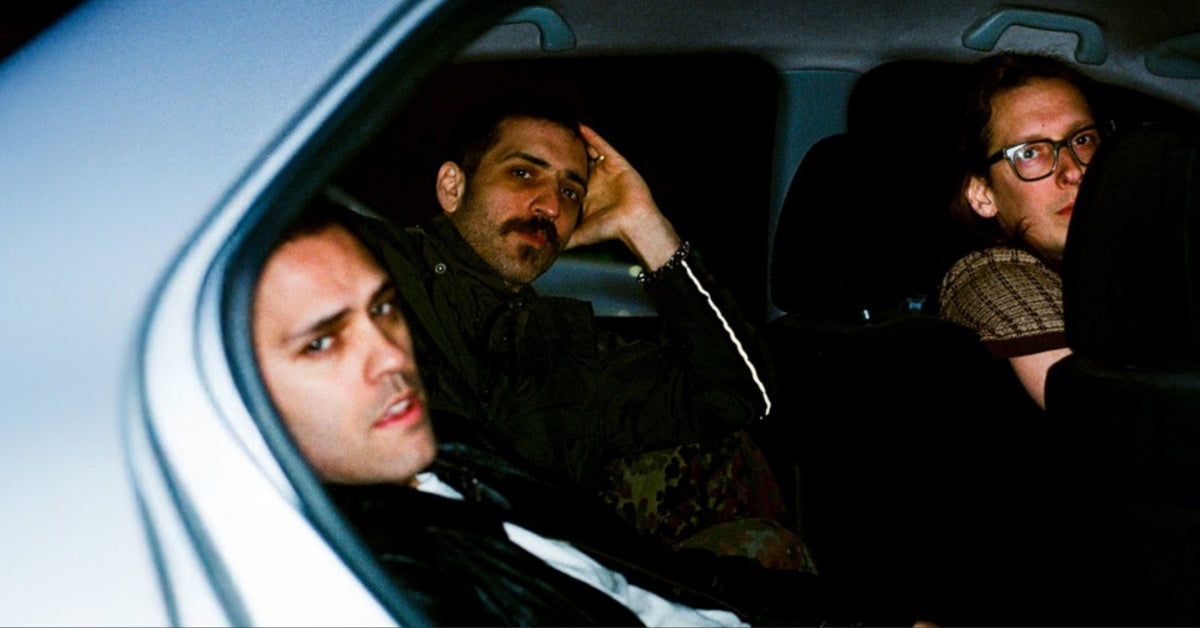
The moniker “noise rock” has been applied liberally to the New York-via-Georgia trio Bambara — twin brothers Blaze and Reid Bateh, along with William Brookshire — for nearly two decades of their ascendance. But sanding the burrs off their boots over the years revealed a Mojave-tinged groundwater beneath their scorched-earth approach. Meanwhile, lyricist and vocalist Reid channels a vile yet sparkling Lynchian surrealism, battling in his lyrical approach. Their fifth album, Birthmarks, takes a more severe turn toward the experimental, psychedelic, and atmospheric aspects of their post-punk twang. Notably, the band tapped U.K.-based producer Graham Sutton, of legendary post-rock group Bark Psychosis, to oversee the album.
Read more: 10 most criminally underrated Green Day songs
Ahead of a fall tour in support of Birthmarks, AltPress caught up with the group from their Brooklyn practice studio. We went over the concrete metaphysics of the record, weathering the destructive force of the pandemic, and what it was like opening for Foo Fighters.
How did you all come to be in contact with Graham Sutton?
We just mentioned him as a potential producer years ago to our manager. He’s like, “Oh, actually, I know how to get in touch with that dude.” It was a lot easier than we expected. He was down immediately.
It seems that’s how it sometimes works. Albini was the same way, right? You could just write him an email.
Yeah, exactly.
I think a lot of people would be wondering why this noise-rock band would wanna go work with this more subdued trip-hop almost guy.
We’ve always had a little bit of that side to us, the slow-burn brooding thing. We’ve always been into very textural stuff. We just wanted to lean into that a bit more. He’s so good with ambiance and cinematic feel, which we were drawn to. Listen to Boymerang, his drum-and-bass project in the ’90s. He’s very attuned to rhythm and the way it interacts with everything else. He’s also a master at using very little but making everything carry its weight well. With him, we were able to trim it down and make each sound more interesting on its own instead of piling on a bunch of sounds.
Was it super experimental? I think I saw one video where Will was dropping cymbals.
We did all kinds of shit. We went into the studio with the intention of recording the demos the three of us had been working on. Something about getting in an actual studio and hearing everything back recorded well just made us realize that the songs weren’t finished. The things we were focusing on with the songs weren’t the correct things to focus on. So we left there with a lot more questions, but in an exciting way. We came back to New York and spent about a year editing over email with Graham. That’s when the album really took shape.
What was the wrong thing you were focusing on?
It happens every time we make a record. We think songs are done, but we realize once we record them [that] we just scratch the surface. There’s a lot more going on beneath that we need to get to. It takes a lot of rearranging and dismantling and experimentation before we find the true depth. This was even more so, having a producer so skilled with any idea you have. We’re so used to doing most everything ourselves. There’s a lot of stuff we don’t really know how to do. In previous recordings, we buried the drums a bit under walls of other layers. By actually zooming in on the drums, then we could reverse engineer the space around it, to find a way to keep the ambiance, while letting the drums be bigger in the mix. It’s a big revelation for us on this record. Graham was a master at that.
So it’s a totally upside-down approach to what you had been doing?
Yeah, bringing the beat and the drums into focus instead of the ambiance.
What about the other collaborators on the record?
We always have a short list of people we want. So that’s pretty natural, and luckily we’re able to get everyone we wanted, vocalists that have an innate character already to their voice. So it brings an extra certain personality we want in that song. We’ll pull from our friends. As far as the other instruments, they’re just all really fucking good at what they do, and we’ve worked with most of them before, and we know how to work with them and how to get performances we want out of them. Their instincts are different from ours, so we’ll tell them to do things, and they’ll do something completely different, better. We end up just building a palette for the whole record, of different sounds we put all over the place, even in songs we didn’t anticipate. That’s the best part of the whole process, taking little clips of recordings and dropping them in. Some of these songs were built that way.
You mentioned different characters, and that’s more prevalent. You said the word cinematic… These are things that have been coming out more as you make these more narrative albums. What’s driving you to tell stories this way?
I’ve always seen records as a way to write either short stories or novels, with a different format. I enjoy all the restrictions of it. I also have never really been one much to talk about myself in songs. So, in order to get the feelings out that people would get if they write about themselves, I take the personal feeling and find a way to express it through characters. I get wrapped up in the story and wanna see how far I can take it. Every line has to have a purpose or it shouldn’t be there. It becomes a huge puzzle that I’m solving.
I guess if you’re working from a feeling, then with everything, like fiction, “quote unquote,” when you’re writing a puzzle, you have an unlimited palette to solve that puzzle. In nonfiction, you would be limited to your experience.
Exactly. Another limitation is it has to match the feeling of the song. I always write the lyrics after the music’s done. Because the lyrics need to reflect the emotional core of the song itself. What would be happening with these characters in this world that would be causing this feeling? What would be happening with these characters where this song would make sense?
You must have a lot of fun.
Oh yeah. And misery, too. It’s a heavy dose of both. It takes so much time. I envy these bands that can just crank a record out. With the lyrics, too, I’m always in solitude. It becomes very taxing. It usually takes a month or so on the past records, but this one was about five months. I would just wake up and write and go to sleep. I would stay up all night and go to sleep at 8 in the morning. It was really long, and it was fucking brutal. There’s a lot of focus that I need to have, and it’s in some ways nice to have a very specific purpose. But it’s also just very isolating.
So what would you say the driving force or emotional theme of this record is?
I got really into reincarnation for this one. The strong emotion of love finding a way to exist after death and the idea of being haunted by past loves. Different angles of that idea.
What were you drawing from more explicitly? What do you think people would be surprised to know that was an inspiration on the record?
This one is actually personal… my girlfriend said, “Would you haunt my room if you died?” And I didn’t have an answer for it. Then like 10 years later we’re broken up, and I was fucking sad, and I was like, “Well, I’ll answer that question now. I would haunt your room, and I would make sure you’re OK.” From there, I got obsessed. I read a book about the studies of this Dr. Ian Stevenson, who spent his whole life collecting reincarnation cases, but just the facts of them. He wasn’t interested in telling anyone what to think, just collecting data. There’s a whole division at the University of Virginia Medical School dedicated to that. I read a bunch of his studies, and I read a bunch by his protege, who’s doing it now. I thought it would be cool to not just express the thing metaphorically, but from a literal sense. I wanted to have a real-world foundation for this idea of reincarnation instead of just coming up with fantastical shit.
I don’t think a lot of people would consider academic research the driving force of a record like this.
I always end up doing that. But this one was interesting because it’s academic, but it’s also a fringe academic sort of thing. They are doctors and study and do all their work at UVA. I don’t know if they would call it pseudoscience because it’s all just straight-up data, so it’s things you can’t argue with. But it’s also weird. We’re off the beaten path.
Like a concrete metaphysics.
Yeah, exactly. I don’t like it when things just float too far away from reality, even if you’re talking about things that feel like they’re from a sense of unreality.
I was wondering how you weathered COVID-19. To me, it seemed like a lot of bands either broke up or wrote a record about the pandemic itself.
That was a brutal time for us, because prior to that was a level of success that we never had. Then COVID stopped everything in its tracks, and we had to build back again. It’s a sad sort of thing. It happened to a lot of people. But the fact that our last record, Stray, came out right before COVID… It was pretty brutal. I guess we thought that during lockdowns, as soon as things open back up, we need to get back on the road, so we were trying to write a bunch of music remotely for a while. I [Will] was down in Georgia, [and] Reid and Blaze were still in New York. We’re trying to put together an EP or something to just have ready to go so we can get out touring again.
COVID obviously lasted longer than we all thought it would, and that worked in our favor because we did our normal thing and just scrapped it and started that one over, too. That did line up to where we were able to try to tour it soon after things opened up. But we always threw ourselves into making something way sooner after the completion of another project than we normally would like.
It felt like the EP was a pretty big release, but, compared to a full-length, it just never gets quite the attention. It’s just as detailed and just as thought out and meticulously recorded and planned and written. But because it has that label of an EP, even though it’s more like a mini album, we didn’t have the presence. The reach of it wasn’t as far. Five years is longer than one person’s whole time in college. We had to reintroduce ourselves with this album.
Were the Foo Fighters shows before or after COVID?
That was our first show after COVID. So we woke up from a sleepy experience of two years and then walked onstage in front of 20,000 people booing us. The show before that Foo Fighters gig was in Dallas to like 20 people because COVID was already starting to affect everything. Then our next show was 20,000 people opening for Foo Fighters, 20,000 people that did not want to see us.
They were actually booing?
Before we even played anything. Twenty thousand rain-soaked people that were getting progressively drunker while they waited for the show to start. Because Foo Fighters were an hour late. So when we walked out, they were like, “Who the fuck are these dudes?” On a Wednesday night this band’s playing at the time they wanna see Dave roll up there. I will say that was awesome, really invigorating. It makes you just wanna be even meaner onstage.
So it totally fueled the performance.
We got to play for longer, too. The production team needed us to while Foo Fighters got there, and they were like, “Play more songs!” Like, “Jesus, really? OK.”
What a weird combination of factors.
Dave’s a nice dude. He came backstage and hung out with us for a while. He spent some time just shooting the shit. It was cool. He thanked us for holding down the fort for him, like, “I’m so sorry about last night.”
Is that gratifying in any way? I mean, everyone grows up with Nirvana on some level.
Honestly, it felt strangely neutral to me. It felt strange. Maybe because of how surreal it is to just wake up out of COVID and play in front of 20,000 people. It almost felt like after it was over it didn’t happen, you know? Strange time, fun trip. It’s just so surreal [that] it didn’t make much sense to my brain.
What are you dying for people to take away from this record?
I just hope that they have the patience to dig into the world and the atmosphere. So much music these days is made for immediacy, and it’s hard to expect people to. Even from our singles, our label always pick the ones that are more upbeat and immediate, regular punk songs, and I think some people still even think of us as that type of band, but there’s so much more on this record that I hope people get to check out. I’m sure for a lot of people it’ll take a few listens to grow on them. Which is cool. I mean, all my favorite records were that way. But also lyrically, too, I think it’s the kind of record you’re not even gonna be able to understand what’s going on the first time, allowing yourself to dive into it. The more you listen, the more you understand the story.
