
Head to the AP Shop to grab blue vinyl of Better Days and other Yellowcard merch. Plus, see all of their upcoming tour dates here.
“How many bands can say they have a rock ’n’ roll violin from the 1600s?” Sean Mackin asks me. Not all questions have easy answers, but this one does — for scene members and beyond, all signs point to Florida pop-punk outfit Yellowcard. Though considered a foundational player in what would become pop punk’s first wave, back in Jacksonville in ‘97, Yellowcard were formed as a hardcore group. But along with the millennium came change — in lineup, musical style, and, soon after, a swift new trajectory. In 2000, with Ryan Key as lead singer and guitarist, and Mackin as full-time violinist, they were only a couple of years from an album that’s permeated popular culture since its 2003 release, Ocean Avenue. Just the first single, “Way Away,” alone would make its way from TRL onto shows Pepsi Smash and The O.C., and even the SSX and Madden NFL 2004 video games. That album would also land them their first magazine cover — Alternative Press, March 2004. Twenty-one years later, they’re gracing the cover once again.
Read more: 10 criminally underrated blink-182 songs
It’s late May of 2025, and I’m standing in the shadow of a 12-foot-tall blink-182 bunny statue, flanked by Floridians. It makes more sense than it sounds. The rabbit, in fact, is the unofficial warden of Travis Barker’s famed Woodland Hills studio, where Yellowcard and Barker spent the last year building an album from the “ground up.” The album, Better Days, is a big deal. It’s the band’s first full-length in nearly a decade — a decade during which, in 2017, the band quite literally broke up. And when they said goodbye, it wasn’t a Gene Simmons goodbye; they meant it. “Our last show was March 25, 2017 at House of Blues Anaheim. There was a period at the end of the sentence, the door was closed, it was the end. I truly believe we all felt there was no chance that we would ever make music together again,” Key tells me, wide-eyed, sitting in Barker’s drum room. “We had put so much thought into how we were stepping away from the band on our own terms. The reasons were valid, and the reasons were our own. We made the decision together. I think we did something really beautiful in the end, by creating that final tour. Plus, it was the most successful tour we had done in a decade. It went better than we could have ever imagined. But there was, waiting in the wings, people who believed that someday these wounds are going to heal, and Yellowcard will be back.”
Family and other projects populated the years that followed. But whatever crystals those people were charging, whichever chakra they’d tapped, seemed to have worked. “We got a phone call in late 2021. I think it was about playing Riot Fest in Chicago. We started talking about that in mid-2022, and the show was going to be in September of 2022. Even that, we went in with, ‘Let’s just see how it goes.’ There were no future plans, certainly not making an album with Travis Barker and all of the wild things that have happened since that night in Chicago.”
After the fest, the real healing began. That year, the band reconciled to celebrate Ocean Avenue’s 20th anniversary, embarking on a global tour to support it. The seed of new music was planted, though in nascent stages. The prospect of a new creative era, full of nuanced changes and challenges, was yet to unfold. The band, who always value intentionality and patience now more than ever, agreed that making a new album was futile unless it was the best of their career. “We’ve really taken a lot of time to make sure we had the right songs and that for everybody, this record was going to have the weight and scope that it needed to. If we’re going to make a full-length, it needs to matter.” They refused to push, or rush, the process. And in allowing themselves that space, the time to heal, and to find balance between the past and present — for the first time, Yellowcard asked for help. “Look, I listen to ambient electronica and film scores,” says Key, laughing. “At my age, putting the hat back on and really getting into rock ’n’ roll and pop punk, the music that we do best together… I felt like, for the first time in our career, I was open to getting some help.” Mackin adds, “But we wanted our people, our friends, people that work with the band we know.”

Daniel Rojas
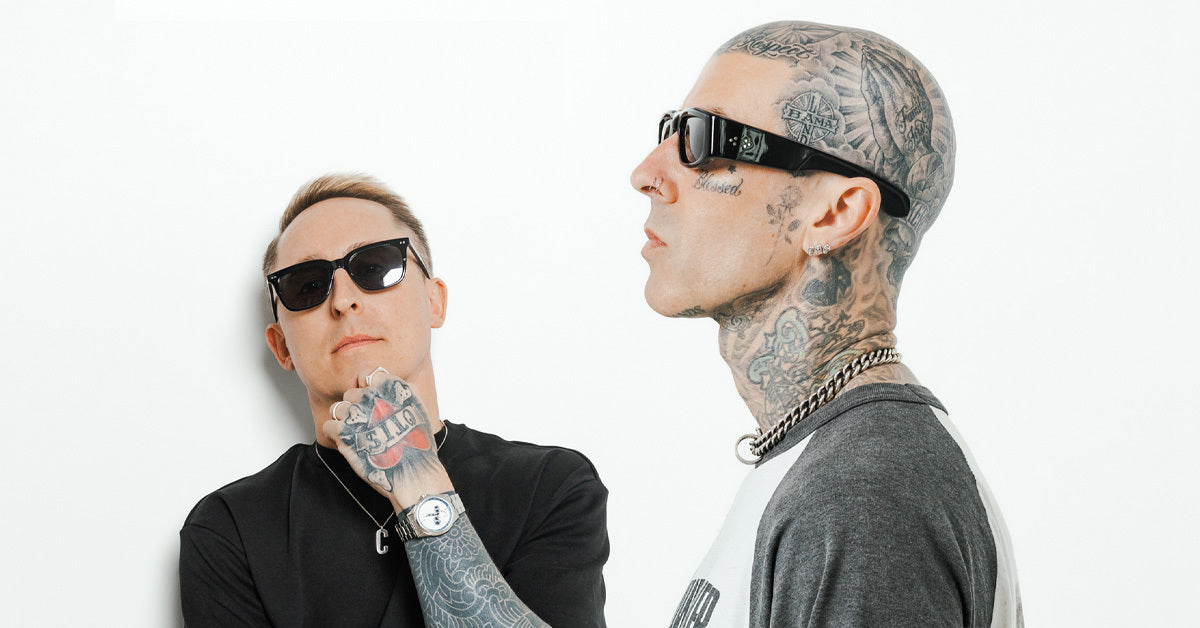
Thus, Barker was brought into the fold. As they toyed with the concept of collaboration, guitarist Ryan Mendez reached out to Nick Long — a friend and prolific songwriter who had made hits with King Princess, and of course, blink-182. I asked Barker how it wound up on his plate, and ever so casually, the iconic drummer and producer recalls, “My friend Nick was doing a day with them, and I had a day! So I was like, ‘I’ll jump in.’ Didn’t really know what I was doing, but he’s one of my best friends. So I was in for the idea of working together for the day.” And with the same serendipity of Yellowcard’s entire arc since reuniting, it fell together from there. “We had a really good time the first day we worked together, and my next day opened up randomly, so we got in again, and we did another song the next day. From there, it was such an easy project and easy group of guys to make music with. It was everyone in the band. It was active and really a part of everything in the studio. Next thing you know, we were getting back in the studio, and we were scheduling weeks to work with each other and record an entire album.”
For each artist he works with, whether on the label side with DTA, as producer with mgk or blink-182, even as a drummer — for which his credits are too long and diverse to summarize — Barker tells me his approach is different. “But with [Yellowcard], it was really focusing on the songs, what I thought they needed for their album, and topics that were sincere to them to write about. Then I get into tempos and styles of songs and everything like that.” A big part of his practice, he says, is effecting change. “It was figuring out how the band works first, who usually writes lyrics, who usually comes up with song ideas, go along those lines of what they’re used to — and then break some habits 1,000%. Whether it’s like, ‘I don’t usually sing till four in the afternoon,’ and I’m like, ‘Well, we’re going to sing right when we come in tomorrow.’ Ryan was singing higher and stronger than I’ve ever heard him sing on any other albums, once I started listening and breaking people out of the molds they’re used to. We also had big breakthroughs when we’d do stuff like that, just writing a song from scratch. There weren’t really ideas lying around. For the most part, it was like, ‘How are we feeling today? What do we want to write about?’ That’s how most of the songs would start.”

Daniel Rojas
For the band, they felt that dam break, too. Once the songs started to take shape, Key tells me he realized quickly “how special what we were doing was, how purely Yellowcard this sound is. It was inspiring.” But the challenge had been in getting there, and maintaining that course and speed despite any insecurities that would arise. The pressure they’d put on themselves to create “the best album of their career, after Ocean Avenue” would have anyone feeling a little shaky. “Not overthinking it,” Key says, “That was the hard part. The expectation of this space [being] where we want to make the best Yellowcard songs, just out of nowhere… Hey, no pressure! This is what we were trying to do every day. That part was the hardest.” For Key, those challenges run deep. “At the beginning of the process, I really was struggling,” he shares. “Struggling to find my footing and find confidence and feel like I belonged here — amongst all of this, working with Travis… I was feeling a lot of impostor syndrome. I’ve always struggled with that in my career, though, at multiple different points. I think when we’ve been more successful, I can tend to go to a place that I feel like I’m not good enough, and that can really eat me up. Once I ripped that Band-Aid off and was just committed, we addressed that challenge — walking into this overwhelming experience, thinking, ‘We don’t have anything written, but it has to be amazing.’”
But Mackin makes sure to add, “The pressure ended up being really beneficial. That can be daunting. I think coming full circle, getting to watch it, getting ready to release new songs again, has been super positive.” It’s a reminder that this band, since the start, have been uniquely skilled at flipping negatives on their head. In answering my query about hurdles and challenges, the group arrived at gratitude.

Daniel Rojas
From the early aughts to the 2010s, for Yellowcard and many others, their process changed in accordance with technology, and with life. The turnaround expectations for a record had sped up significantly. Each of the four band members lives in different states, and they fell into a practice of working with instrumental demos, passed around for feedback before they’d hit the studio. Key explains, “In a really unique and interesting way, [this collaboration] actually brought us all the way back to the way we originally wrote songs together as a band…The way we used to do it when we were young and bright-eyed, heading to California in our van. We would write a song in the back of the van. We would write a song on the floor in the living room. We would write a song in the dressing room at a bar that we were playing, a storage closet in a bar we were playing. Then we got away from that for a lot of reasons that made sense to get away from it. We weren’t all together. We were very rarely all together after a certain point in our career…This brought us into the room with nothing to start with. Just a fresh day, fresh minds, fresh idea.”
There’s been no dearth of anniversary tours or nostalgia festivals over the last few years. Balancing the past and the present is proven to be an art, not a science, for bands in the scene. At last year’s When We Were Young festival, I sat backstage with a slew of bands, who felt understandably torn about the idea of revisiting their teenage years or leaning too heavily on their past success. My Chemical Romance’s Frank Iero pointed out, “What you’re doing is placing yourself in a timeline that’s already passed. But continuously moving forward and taking chances, that’s easier said than done, right?” Barker, one of the starring stalwarts in the scene, keeps this enigma top of mind. It’s a part of his production and executive production styles. “I’m a big fan of making brother and sister records to records that we already write, things that could be grouped together,” Barker explains. “But it’s also about making sure we don’t repeat things that we’ve done before, maybe in the band’s career or even on this album, whether it’s a song arrangement, a lyric, being really cautious of stuff like that.”
For a band like Yellowcard, fans have remained the highest on their priority list through it all. Serving their audience the sound they’ve come to love is vital, but the goal is in seeing that version of themselves through the lens of who they are today. “We did this magical thing that you try to do, but you also try to avoid,” Key explains. “You try to capture this original energy and this original sound, the core sound of the band from back in the day, but you also try to stay away from that because you don’t want it to sound forced, and you don’t want to sound like you’re in your 40s trying to sound like you’re in your 20s. It’s a really strange place to be as a songwriter trying to capture this nostalgia, but also trying to do things that are new and fresh. But I truly believe with Better Days, we captured the core sound of Yellowcard in the most pure way without it sounding forced in any way.”
With two singles out already as evidence, the album’s title track and “honestly i,” it’s hard to disagree. There’s no easing in. The former is addictively catchy, chock-full of powerful riffs, super potent vocals. There are whispers of Lights and Sounds, which take new shape against the backdrop of Barker’s shinier production style and signature drumming. “For me, feeling like a fish out of water, as I’ve touched on, Travis was able to inspire a confidence in me that I was just terrified that I wasn’t going to be able to find. Without question, this feels like the best vocal performance I’ve ever delivered,” Key gushes. “I’m not giving myself the credit for that. I think his involvement in the process and his support and encouragement were everything you want from a producer.” Their second single, which arrived alongside “Better Days” in late May, sees Mackin’s 1600s Italian violin really sing. The track feels like it’s been lying on Ocean Avenue’s cutting room floor for all these years. “Shout out to Eric at Benning Violins,” Mackin says, grinning, though he’s also valued the direction Barker has taken the band. “He knows best. From there, it’s let’s go and get the best take of that possible. It just inspired us all to try and be that next level version of ourselves.”

Daniel Rojas
Barker sums up the album in a few words, neatly. “Fast, emotional, sincere. There are a lot of sensitive topics written about on the album, and that’s what makes the album so special.” It’s not only an astute way of describing an album they’ve put so much of themselves into, but of Yellowcard themselves. In the afternoon spent together, I saw nothing but earnestness, humility, and a pinch-me attitude from the band, bursting with gratitude for the chance to have made music together again, with Barker by their side, and to be sharing about it with us and our readers.
In their 2004 AP cover story, Mackin says, “I’m not supposed to be here. I’m supposed to be sitting in the back of an orchestra somewhere, or giving kids music lessons. So I’m very grateful. We’re all having such a good time doing what we’re doing, and luckily, the decisions we’ve made have given us some pretty amazing results.” Not every band would, or should, stand by statements they made 20-odd years ago. But what’s been at the heart of Yellowcard since the earliest days remains there. And it’s as felt in Better Days as it was back in ’03 on Ocean Avenue. “I started this record as one version of myself and came out the other side changed…” Key says. “I came out of it writing songs like I was 19 again.”

Daniel Rojas