
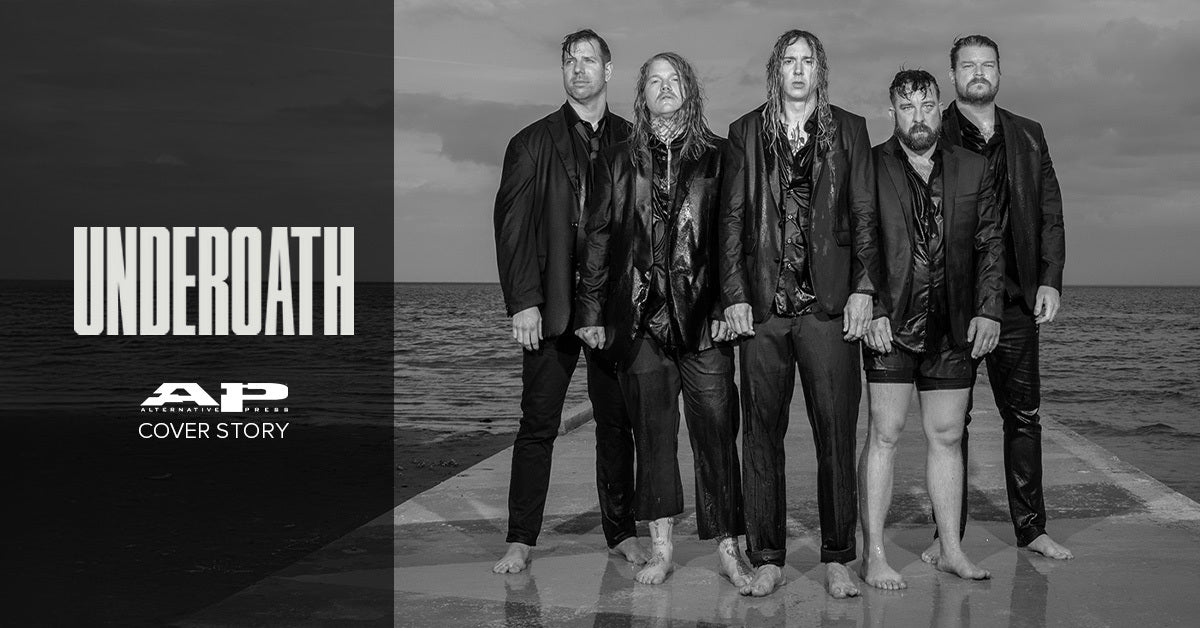
Alternative Press teamed with Underoath for exclusive T-shirts and vinyl of The Place After This One, limited to 300 copies. Head to Veeps to stream the They’re Only Chasing Safety 20th anniversary benefit show.
Underoath’s past and future are in equally sharp focus in 2025. Deep into the final leg of a 20-year anniversary tour for their genre-defining album, They’re Only Chasing Safety, the band are zig-zagging across continents with youthful fervor. And while their classic receives a well-deserved retrospective, Underoath are also in the midst of slow-dripping singles from their forthcoming record: The Place After This One. Kicking off their new era with “Teeth” while on the road, fans have been blessed with both a blast from the past and contemporary Underoath at their most experimental. “At first, I was upset about the idea of doing that,” vocalist Spencer Chamberlain candidly reflects. “But in hindsight, I couldn’t think of a better way to have done it. Looking back at it now, it’s like, what a beautiful thing to be dropping our new songs as we’re closing that chapter.”
Read more: 10 most criminally underrated Circa Survive songs
It’s certainly beautiful how unburdened Underoath are by the weight of past accomplishments like They’re Only Chasing Safety. As guitarist Tim McTague puts it, “There’s something about that record and that time specifically that will never be recreated. And we don’t want to recreate it.” The creative freedom they’re collectively experiencing presently seeps through every new track they’ve released from The Place After This One. See: “Teeth,” a warping Rorschach test of electro-pop and scorching industrial sludge that challenges the notions of what Underoath sound like to those fans caught in the past. Catchy and filthy in equal measure, it pushes the boundaries to the extreme for a band that have spent two decades constantly reinventing themselves — due in part to their genuine blindspot of what their contemporaries are writing, and in turn, not being influenced by trends or pesky expectations.

Sean Murphy
“None of us are really steeped in the scene,” keyboardist Chris Dudley says. “We can do whatever we want because we’re not aware of the variables and the quote-unquote science experiment of success.” And according to McTague, trying to write music with expectations in mind only leads to dead ends anyway. “If you start a song with, ‘I want to write a song in this BPM and this key with two breakdowns,’ you’ve already lost. But if you listen to two or three things, or you talk about a car crash you saw and let the song kind of drive… The songs are the sixth member of the band, and I think if you let that member talk louder than everyone else… it all just comes out of us.”
That laissez-faire attitude has allowed Underoath to follow their material wherever it takes them on The Place After This One. Alongside the saccharine splatter of “Teeth,” the peppy gang-vocal chorus of fellow single “Generation No Surrender” eventually gives way to one of the band’s heaviest moments to date in a catalog with no shortage of punishing stretches. The particular single is accentuated by the shredding screams of Chamberlain, who lives for the challenge to push himself vocally on each record (and indeed bests Underoath’s discography on the band’s newest). “I really look at myself as my competitor,” he says. “I want to outdo what I’ve done. I want to be better than I was the last time I got into the studio. And that’s just a motivation I’ve always kept with myself since I was in my early 20s. It’s like, ‘How do I beat myself? How do I become better at doing this?’”

Sean Murphy
Chamberlain also allowed himself to experiment and evolve as a lyricist throughout the writing process, penning from a place of retrospection rather than working through certain wounds in real-time. “This is the first record for me that any of the trauma I was dealing with, I was actually on the other side of it,” he reveals. “There was something really serendipitous to me about writing this stuff with a clearer mind of what I had experienced over the last handful of years — not necessarily drowning in it.” That sentiment can be sensed throughout The Place After This One, especially on a cut like “Survivor’s Guilt” that dives into the mixed feelings of recovery from addiction — a commendable path to self-actualization — while memorializing those who didn’t make it along the way.
While lyrics like “Seven years, I’m eight down in ’23” are inherently personal, Chamberlain and fellow lyricist, vocalist, and drummer Aaron Gillespie opened up the vulnerable songwriting process to the collective. “We did everything together this time, including all the lyrics and vocals for the most part. For years, that’s been a closed door, not like bad blood, but those things get really personal for the writer. So this was just very different, and to be honest, very uncomfortable at first,” Gillespie says. “Then it opened up to this freeing, wonderful thing. I’m so glad we did it that way, and because of it, I feel like there’s this really special openness to the album.”

Sean Murphy
That ever-evolving openness and camaraderie of Underoath is a common theme while speaking with the band, as their solidified lineup of 22 years has quite literally grown up together. “Twenty years ago, it was like the company Underoath has rules, and nobody’s allowed to break these rules,” McTague says. “It just felt like we were holding each other accountable at a young age with very young minds and young ideals, versus holding each other accountable, or at least being there for each other, in older age with a lot more wisdom.” It’s a perspective that bassist Grant Brandell agrees with, adding, “I think when you’re younger, you’re so passionate about your ideas and what you want to do that you will put other people’s feelings and even creation at risk.” The weighty expectations of 20-somethings thrust into becoming the torchbearers of “core” music were certainly a hurdle for the band. As Chamberlain puts it, “The pressure of a 22-year-old being a leader of Jesus for young kids in the metalcore scene is wild.”
But Underoath are now in their 40s with spouses, children, and families of their own. Priorities change, people change, and collective dynamics change over decades of an inextricable bond together as creative collaborators and friends. These days, Underoath’s focus is on ensuring everyone in the room is content, whether it’s in regard to personal conversations or what’s being created. If everyone is nodding their head in unison, they know they’re onto something.

Sean Murphy
“A band is like a marriage,” Gillespie adds. “You have ups and downs, hot-and-heavy, and absolutely miserable times, and they all interchange on a sliding scale… It’s just a thing that ebbs and flows, and the bands that last are like the marriages that last. Stick with it and it’ll reward you. Give up and you lose.” Underoath have undoubtedly stuck with it, and The Place After This One is the ultimate payoff. In fact, once the record was complete, Chamberlain could only compare his immediate feelings to when Underoath finished their seminal 2006 full-length: Define the Great Line. “When I looked around the room and felt the feelings that I felt, we listened [to tracks] one through 12 and my body hair was standing up, and I’m going, ‘Fuck, we did it. I don’t care if the world hates it. As long as the five of us in this room think this is the best thing we’ve done at this particular moment in time, then we did it.”
As the group prepare to unveil album No. 10 with a collectively shared sense of overwhelming pride, Underoath are also cognizant of the fact that a band still going strong over 20 years into their career is a statistical rarity. And if it all ended tomorrow, the general consensus is one of radical acceptance. “I come at it from a stoic perspective of, if it goes away tomorrow, we should be OK with that. Is that the worst thing ever?” McTague asks rhetorically. “Or if a single comes out and we become the biggest band in the world and we’re selling out arenas, people would go, ‘Oh, that’s great!’ My theory is: We’ll see.”

In line with that attitude, Brandell reflects on his own reckoning with creative mortality: “If it ended, I’m OK with it. I don’t want it to end. I love doing it. Everyone in the band loves doing it. But it’s also the ability to be like, ‘Hey man, we’ve done something great that we strived to do, and I think that we kept those standards up for the existence of the band.’”
But to any concerned Underoath fans, fear not: Brandell goes on to disclose the band are firing on all cylinders creatively after the completion of The Place After This One. Album No. 11 just might be on the way. “Everyone’s so juiced on the process of this record that we’re all in the spot where it’s like, ‘You guys ready to dig back in?’ Which is crazy to say because the album’s not even out yet. But that’s just a testament to how in tune we are with this album and how good it felt to do that. We’re already like, ‘Yo, that was great. The experience was great. We’re very proud of the work. What’s next?’”

Sean Murphy