
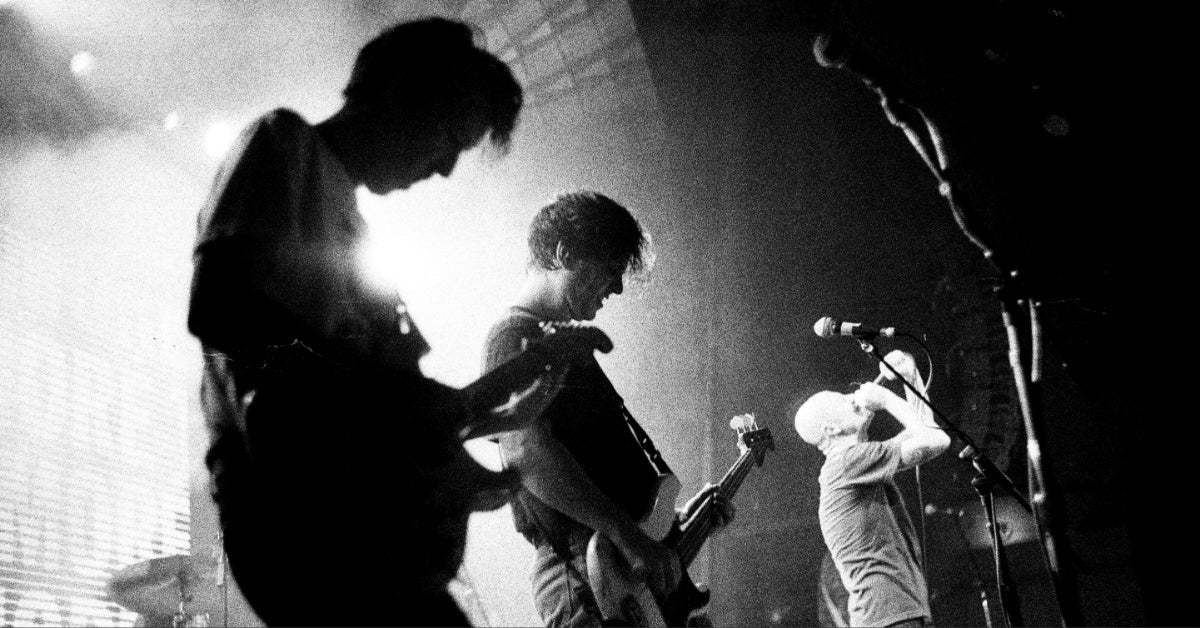
Between November 2023 and May 2024, Los Angeles’ hallowed post-hardcore outfit Touché Amoré once again shouldered the album-making process. For a band like this, it was as much a creative endeavor or collaboration as an exercise in intimacy — and the dynamic invitation of tension, upheaval, and cathartic abreaction. As one Redditor astutely put it, “New Touché Amoré means it’s time to be emotionally distraught again.” With the tactile 11-track LP, titled Spiral in a Straight Line, said fan’s prediction was surely satisfied.
“Personally, it’s probably the heaviest one we’ve made,” guitarist Clayton Stevens says. “It’s easy to just fucking yell something into a microphone, but it’s hard to make something that can actually move somebody, or you can feel something from it.”
Read more: 50 best albums of 2024
As has been true for the previous five albums, Touché Amoré’s latest project side-steps the pervasive tropes of emotional music — any audible pain or purgation has been born of experience, and infused with intention. And though this thoughtfulness is evident throughout their work, and especially in the latest album — what it takes to make the music, put on the performances, or even design the band’s merch truly goes beyond what might initially meet the eye, or the ear. Nick Steinhardt, both one of the band’s guitarists and their creative director, unravels how detailed and holistic the aesthetic journey is to the band, outside of but in conjunction with the sonic landscape. Armed with only Jeremy Bolm’s lyrics and the LP’s tentative title, before the recording even began, Steinhardt had started on a document — which would ultimately clock in at 72 pages — that would serve as both visual cartography of and a companion to Spiral in a Straight Line.

Sean Stout
Drawing on its content, his plan unpacked the album’s themes of contrast, through imagery — dark and light, presence and absence, black and white and Technicolor. We see it in the LP cover, the simple and smart T-shirts, the visualizers on and offstage. But one of the most poignant appendages of the aesthetic experience is the short but dense doc, The Making of Spiral in a Straight Line. Released alongside the album, directed by photographer and videographer Sean Stout, it offers a glimpse in real time of the multifaceted nature of this band, this album. We hear directly from the artists waist-deep in recording, challenging each other, bringing different and equally vital elements to the table. In one shot, Stevens, sitting in the sound booth plucking a guitar, says, “There was no stone left unturned. We looked at all the components of it.”
For the entirety of the album process, Stout — who had previously directed Touché’s enigmatic, memorable “Skyscraper” music video for their fifth LP, Stage Four — stayed close to the band, though like a fly on the wall, the camera remained almost hidden or anonymous, present enough to have captured some of the subtlest, softest, and most pivotal points in the seven-month expedition.
In conversation with Alternative Press, Steinhardt and Stout discuss the ways they cracked open an already blisteringly open record and created a unique and tailored world around it — hoping to allow access to fans who are hungry for more.
How did this collaboration happen?
NICK STEINHARDT: Sean was the first person that cracked the code on a good video for us. You get a lot of treatments that are pretty wacky for the genre, partially due to budget and partially just due to tropes that people think that they’re nailing when they don’t really understand the music. One is choreography, and another is narrative that doesn’t quite make sense in the end, hidden under the guise of, “It’s Lynchian and surreal.” But with “Hal Ashby,” Sean made what’s now one of my favorite videos.
SEAN STOUT: With Touché, you have Jeremy’s lyrics, but musically the sound lends itself to subtler ideas. It suits their music trying to get a little out of the box. The “Skyscraper” video I did for their last album, Stage Four, for example, is just Jeremy pushing an empty wheelchair around New York. But then as you listen to the song, you realize what’s happening. I like trying to think of ideas like that. And where maybe it wouldn’t make sense for others — Touché is one of the bands you can get away with that sort of stuff. They don’t need choreography and strobe lights.
STEINHARDT: There’s a default, too, with videos. If the music is energetic and crazy, the edit and the pacing need to be that way. I almost feel like the opposite complements our band a bit more — leaning back. It’s a little bit more poignant.

Sean Stout
When it comes to the new album — to dig into it, you each have a vital, albeit different, perspective that I’d love to hear. Nick, what was the creative process like for you making it — and Sean, as an observer with a camera?
STEINHARDT: Where I’d start with that is — as the in-house art director, for lack of a better term — I’m in charge of all the visuals for the band. That’s what I literally studied in school, though my focus, even before that, was always on music. As the industry has ebbed and flowed in certain ways — what you need to do to get a record off the ground is much broader now than it was when we started. With that, rather than finding a whole new team or hopping around a lot, I like to go deeper with existing collaborative relationships, like Sean — somebody who really deeply understands the band and has the band’s trust. Our original idea was just like, “Hey, can you come along and document us as we’re demoing and recording and we’ll figure out what to do with it later?” But being in the same space together, the idea of a doc started to evolve in real time. It’s a very tight-knit collaborative atmosphere that was full on for a couple of months — and maybe is still ongoing.
Sean, what was that like for you — it certainly sounds intimate, and potentially intense, being around artists while they’re working on a project of this magnitude, creatively and emotionally.
STOUT: It’s interesting to enter someone else’s creative space. I always try to remember, while I’m there as a collaborator, at the end of the day, I’m still the guy with the camera during pretty intimate discussions and moments. Knowing when to hang back and when to not shoot is just as important as the collaboration itself. It will lend itself to that trust Nick mentioned, at the times when you are shooting during intense conversations — in certain ways, you have to gain that access to really document.

Sean Stout
What about this album, or this moment in time, made you want to document the band so thoroughly?
STEINHARDT: We’d brought Sean in on the last record, but toward the end. There was so much going on that I would find interesting if I liked our band and was into the Ross Robinson lore. So this album, I was like, “Fuck, we should have somebody in here from the real ground stages.” And like I was saying, the breadth of what you need to promote a record these days. I always think back to myself as a music fan, going nuts whenever a band would post something in the studio or a teaser before a record — and that was well before today’s internet age. My approach is asking myself, “How would I serve the kid inside me?”
STOUT: Not many people focus on documentation anymore. Many don’t have the resources to do it, but there’s also a cult around being as anonymous as possible. Being able to do this kind of documentary project and provide all-access, even if it’s only 13 minutes, was appealing to me because I like being around other people’s creative processes, and showcasing that in a way they wouldn’t even think to themselves.

Sean Stout
Anonymity is a fascinating topic. Especially when we’re talking about rollouts and all the things you need to do today. What I see most is either someone is leaning into the anonymous marketing style as their “thing,” or the approach is anonymous in a different way — there’s loads of content, but it’s glossy and super staged. What you’ve done here feels almost nostalgic, in its purity. But it’s also very present and grounded in the moment.
STEINHARDT: I think part of that is us trying to figure out how to embrace what is today, in that way. Previously, we might’ve existed in a “mysterious guy” way. But that’s not how we are as people, and it’s especially not how Jeremy is as a lyricist — it’s quite the opposite. I said to the band, “I would like us to be a lot less precious about everything. I would like to show people the bass riff that got ditched or a guitar lead that is not as prominent in the mix on the final record, but if somebody heard it in isolation, [it] might become an earworm.” All these other little touch points that I think can bring people in, and make it relatable without being austere. Because the way Sean shot it is like a very beautiful art film, classic Blue Note band in the studio, black and white. But we’re supplementing that with these little bits of access, like, “Wait, did you hear that? Wait, did you see that? They showed us that?”

Sean Stout
So what was that process like with this album in terms of how you and Jeremy built the album, and the world around it?
STEINHARDT: I don’t know if this is an exact pattern, so don’t fully quote me, but generally one of the first sets of lyrics he has contains the album title, and it’ll stick out to him. Sometimes it shifts, but he had Spiral in a Straight Line pretty early, and I just dug really far into the meaning of that — needing to move forward while things are crumbling around you. On the last record, we made an art book, where every page has different visual metaphors, iconography, and collages. If you knew that I had annotated all the lyrics and everything had meaning, you could really dive in — otherwise, it just looks like cool art on a page.
As a response to that, I was like, “I want this album to be documented in a way that is engaging.” So I came up with the construct of using the word “separation” as a visual metaphor. Black and white never interact with color. They can touch, but they never overlap. They’re two pieces of a whole that, overlaid, create the full picture, but we’re using them in isolation here. It’s pretty deep and weird. But it did end up giving us guardrails of how we treated everything. Once we got into territory with Sean, it was like we’re going to figure out all these different editing motifs to go back and forth between a black-and-white and a color space, and the merch is going to be a specific way, and I basically laid out a 60-page document of what we were going to do before we did it.

Sean Stout
What the song, or project, means to you and how much you put that out there for the audience to know, versus how much you let them interpret themselves, is an interesting conversation as well. There’s something very poetic about your approaching this visually, too.
STOUT: I think that the 60-page document that Nick is talking about was a little overwhelming at first, but for this, having aesthetic guidelines is super helpful. To me, the doc feels semi-voyeuristic, and part of that is intentional, but then there are things in there, like framings in there that break it a little bit, or shots from the ground or half shots that felt, to me, the most raw. There’s a moment in there where Jeremy, Clayton, and Nick are having a conversation, and it’s one of the only moments where you see the handheldness of the camera. It just moves from Jeremy talking about scrapping some lyrics to Nick saying some semi-spiritual quip about how “sometimes you need to do that, because it makes the work better.” The framings on both angles kind of suck. There’s no edit in between the two. But I realized those clips are what connect back to the overall themes that Nick mentioned, and also the intimacy of Jeremy’s lyrics.
There clearly was a lot of thought and processes and of course, a lengthy document that went into the album. Now, after the release, do you feel differently about the album? I know the relationship with a project can change throughout the process.
STEINHARDT: That’s really the next step, right? You did this thing, you documented it, it’s there, it’s out in the world, and now it’s up for other people to grasp onto. The live performance, the touring, and the rest of whatever we’re promoting is the next challenge. It’s honestly one of my favorite parts about a campaign — how do you evolve it so it’s not just one note, hammering people? It’s not like, “Let’s refer back to the document.” It’s more like, “How can this live and breathe — and maybe even get more interesting as time goes on?”

Sean Stout