
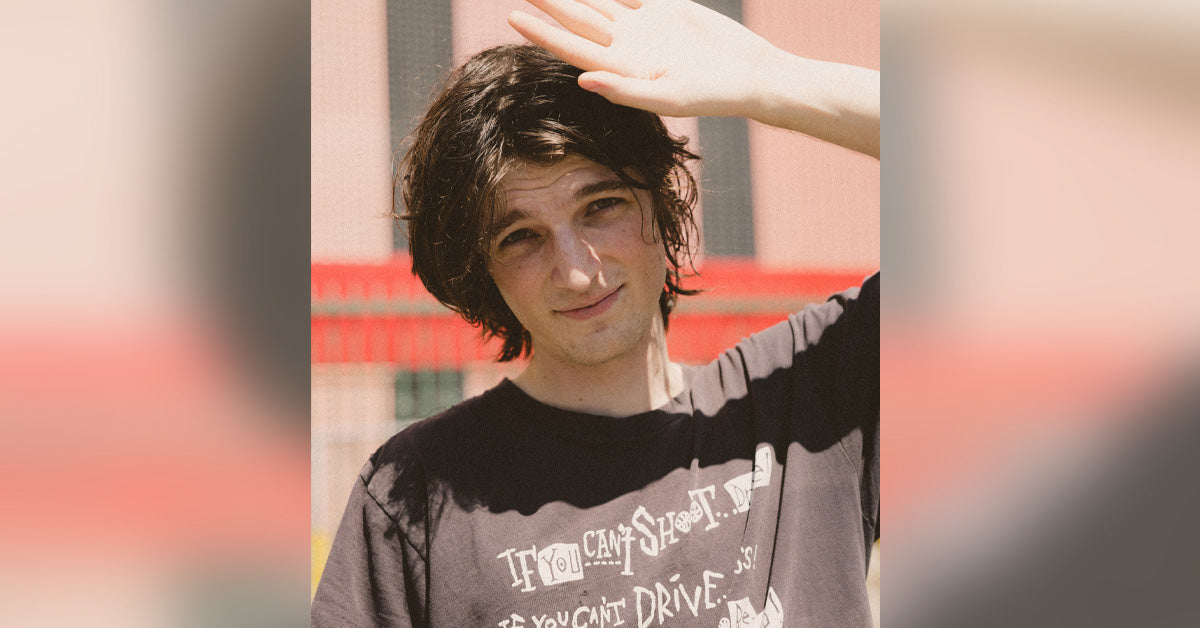
Slow Hollows appears in our Fall 2024 Issue with cover stars Slipknot, Destroy Boys, Pierce the Veil, and beabadoobee. Head to the AP Shop to grab a copy.
There comes a point where discovery is the only way forward. For Austin Feinstein — the introverted mind behind Slow Hollows — that moment arrived when he tumbled into The Smell in the early 2010s. Having picked up the guitar at 7 years old, Feinstein always took music seriously, but it was impossible to foresee the outward ripple that came from walking through its back alley entrance. The experimental, DIY crowds of the downtown LA space became another home, invigorating him to start Slow Hollows — a murky post-punk band that changed up their sound with every release, blurring strains of pop, R&B, and electronic music. Since releasing their 2014 debut album, I’m Just As Bad As You Are, Feinstein has composed a tremendous CV. He’s played Coachella, appeared on the same song as Jonny Greenwood, and worked with like-minded collaborators Tyler, the Creator, Frank Ocean, and Kevin Abstract (who directed the video for their 2018 song “Lessons For Later”).
Read more: Kevin Abstract’s SoCal Network
These days, Slow Hollows operate a lot differently. While the band broke apart in early 2020, Feinstein continued to write songs and, ultimately, decided to relaunch Slow Hollows as a solo joint. The resulting record — this year’s Bullhead, out via Danger Collective — is gorgeous, returning to the bare-bones sound of Slow Hollows’ beginnings through acoustic guitar and piano. Though painful and woozy, Feinstein sounds brand new, guided by the brilliance of Neil Young, Elliott Smith, and the Velvet Underground. “Playing really quietly and letting the guitar take center stage without cramming other things around it was something we were always trying to do,” he says, citing the Loaded demo “I Found a Reason” as a huge inspiration for the tone. Those early days at The Smell inform the reconfigured project in other ways, too. Feinstein performs live with a group of old friends, including Nick Santana — the band’s first drummer, who’s credited on Atelophobia and Romantic — Nick Noneman, and Nick Minor. His former bandmate Aaron Jassenof manages him. When it would’ve been easier to blow it all up, Feinstein fell back on his community, making new meaning out of the past.

Jordan Knight
What bands did you listen to as a teenager that led you to The Smell?
The first “Smell” bands I liked all came from a label called Big Joy — Moses Campbell, Palm Reader, Peter Pants, and Surf Curse, to name a few.
How did getting thrown into that community change your perspective?
I learned a lot about community in general. Having a music community was such a blessing. It feels like I got a crash course in the world of music by the time I was a teenager. Not to mention, I met all of my closest friends through that community.
Going to shows there led to the formation of Slow Hollows in the 2010s. When you think back, what stands out to you about those days?
I mostly remember the enthusiasm. Everything was exciting and felt so important somehow. Meeting people that liked the same music as me or grew up influenced by similar artists always got me excited. I guess my life sort of fell into place and started to make sense when I found this community.

Jordan Knight
I’d love to hear about your favorite memories of going to, or playing, shows at The Smell over the years.
My favorite memory is our first time playing in 2013. At some point, I encouraged the crowd to “start crowdsurfing.” There were probably 15 people watching. Another funny memory is the first time I went to see a show. A friend of ours sent his dad to “reserve tickets” for us because we didn’t know how the tickets at the door system worked. When we showed up, we didn’t even ask the door person if we had “tickets reserved” — we just walked in and saw the show for free. Definitely embarrassing to think about that now.
I read that part of the reason the OG band disbanded was because you were burned out on playing live. How did you revive that love?
I think burnout is natural, but that feeling was new and unfamiliar at the time, so I didn’t know how to handle it except to stop and “take a break.” It did give me a chance to appreciate things more. The band is amazing right now, so it’s not hard to find joy in playing.
It seems like the LA music scene has changed drastically from when you were coming up and playing shows. I’m sure a few have shut down, especially after the pandemic, but which places still feel like home?
The Echo is always great. Zebulon always sounds great when I go. Hollywood Forever Cemetery also has a really great venue called Masonic Lodge. I’m sure there are other amazing DIY spaces I’m forgetting.

Jordan Knight
You seem constantly busy. How often are you able to check out new artists or venues on impulse, as well as go to gigs in general?
Not as often as I would like. The ratio of shows I play to shows I see is probably 30-to-1. My friend and manager, Aaron [Jassenoff], usually invites me to great shows, though.
What advice do you have for younger people who haven’t found their community yet?
It’s easier said than done, but I’d suggest starting your own — even if it’s you and two friends. In my experience, your voice is easier to find in a community of like-minded people.