
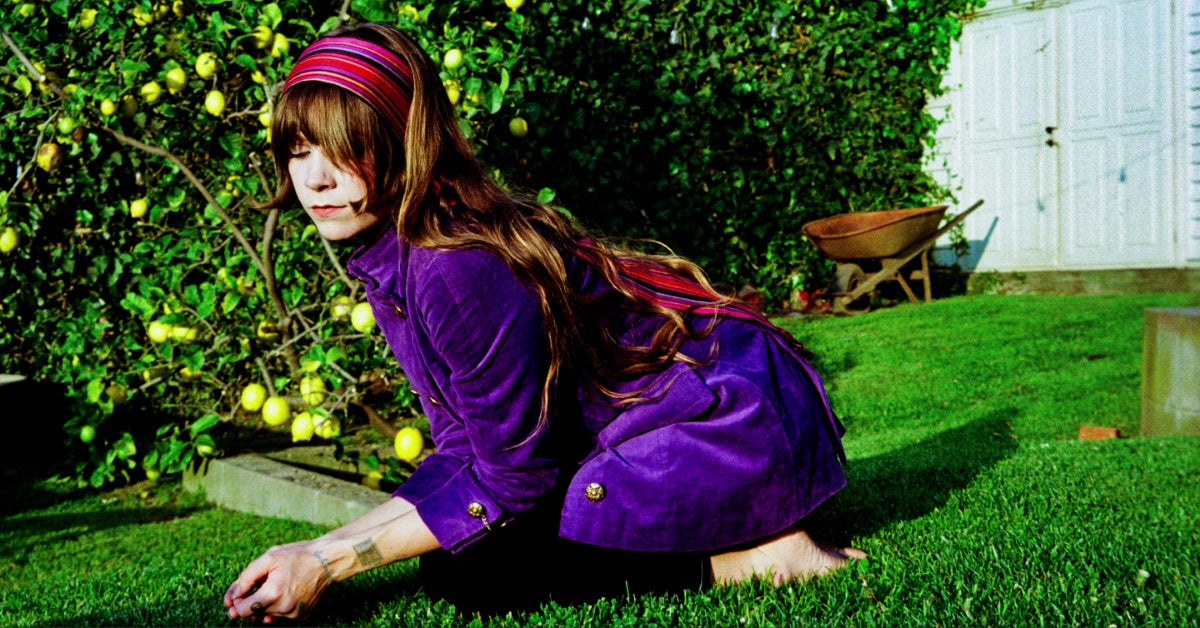
There’s Sad Girl Indie, and then there’s sad girl indie. New Jersey’s quinnie falls into the latter category. Her beloved 2023 breakout album, flounder, stood apart from melancholic musical cliches that often glom to the former on a foundational level. Tender, stripped-down instrumentation and homespun production were the backdrop for an album that drowned listeners in emotional depths, probed with curiosity concepts of personal devolution, femininity, the passage of time, and love. The lead single, “touch tank,” was a viral hit — about which one YouTube account astutely remarked, “This is hands down the most impressive song I’ve ever found on TikTok.” The track tackles the topic of a genuine, gentle sexual relationship, and the feelings of safety and freedom it can allow. Far from social media fluff. As a whole, quinnie’s work has found a way to be hyper relatable, in spite of how incredibly intimate it is. It’s the paradox of prolific, honest lyricism: Rather than overgeneralizing for mass appeal, the closer and more detailed one writes to their reality, the easier it can become for the audience to find themselves in it.
Read more: Soccer Mommy’s grief is bittersweet
This is how I found myself sitting beside a box fan in my sweltering East Village apartment, in tears, while quinnie’s new album, paper doll, played off my shitty computer speakers. To be more specific, I was watching her perform the third single, “hate f*ck (live),” in a living room, beside Jake Weinberg (one of her longtime collaborators, who produced the album alongside Gabe Wax) on acoustic bass, and Hudson Pollock, playing a guitar with a dry paintbrush. Raw, with simple, yet profoundly gutting lyrics, quinnie describes the song, “[It’s] about the lengths we’ll go to for connection — chasing the thrill of acceptance that sometimes masquerades as love,” she says, adding, “The chorus is both a message to the wrong person and a conversation with myself.” It could be argued that the artist’s entire sophomore full-length aims to cover the same ground.

Jaxon Whittington
Where flounder philosophized about time with a dreamy, childlike wistfulness, using sounds of running water, children playing — paper doll wrestles with the challenges of the present, unpacking abuse and toxicity, love and relationships, and the phenomenon of being in a woman’s body — not to mention the expectations that come with all of the above, from society and partners, but also from ourselves. She describes the album’s title track, which traverses, “How being idealized by a partner is fun, until it isn’t,” continuing, “This song is the title track of my record because it encapsulates the thesis of always feeling too messed up to be loved by somebody else.” With lyrics like, “It’s been nice to havе you see/Just how lovable I could be/But I’m not, I’m not,” one could say this project is darker than her previous — but upon a second listen, it just feels deeper. quinnie has cracked wide open, though it feels like the story being told is yet a continuation. Easter eggs hidden in her lyricism tie back to flounder lines, motifs of water and the ocean continue to be peppered throughout. And like the last album, this is sad girl music. While excavating the female experience and all of its incumbent heartbreak, no matter how heavy the subject matter, the music remains almost playful. As she says in flounder’s title track, “Learn to love the simple shit.”
Production-wise, Wax and Weinberg understood the assignment on paper doll. Their thoughtful, bare-bones production reflects quinnie’s growth, and the heftier hand of unfiltered humanity that the album delivers — allowing her voice to shine and warble, in all of its delicate weirdness. And that, carrying her heart-on-sleeve lyrics, is the real gem. With renaissance ballad-like cadence, her voice takes unexpected, wavering twists and turns as it tells the stories track by track — which leads me to this conclusion: At its heart, paper doll is a folk project, handcrafted for our generation.
Speaking to the abstract theme, or concept, of womanhood on this project, I’d love to hear about your album title — what it means to you.
A paper doll is something that is flat and beautiful. It doesn’t speak or feel anything, and you can dress it up and put it wherever you like. It’s this thing I feel like I have to embody to make a relationship work, at least in my most defeated moments.
You’ve said the title track is about how being idealized can eventually feel suffocating. Can you talk more about the emotional arc of that realization, and how it plays out across the album?
Theoretically, there was a chronological order to the songs that shows the transition from overwhelming new love, to feelings of entrapment within idealization, to acceptance of love despite the grief, and then settling in some sort of middle ground where my precious inner world doesn’t need to be sacrificed to be loved. That said, it would be tough for a listener to piece this timeline together because I pulled inspiration from a lot of different phases of my life, and we tracklisted based on what sounded best. I think a few tracks are obvious, though, like “run around the block again” at the loving beginning, “paper doll” at the shifty middle, and “my secret” at this ambiguous end.
What role does vulnerability play in this record compared to flounder? Do you feel like you’re peeling back more layers this time around?
Trust/vulnerability were really big themes on my last record because I was coming into adulthood and trying to navigate the balance between keeping myself safe and still living a rich life. There’s something very childish about that record, like I was almost bashful to be sharing so many intimate details of my life. I don’t feel that way anymore, just because it’s hard to still be bashful when the first song most people have heard from you is about getting head. I’ve accepted the airing my shit out thing as a part of the gig — it’s just how I connect with people. I didn’t think too much about vulnerability when I was writing this record, but it came out in the sense that I wrote a lot about loving despite negative outcomes. I think that’s a certain type of vulnerability.

Jaxon Whittington
Can you talk a little bit about working with Jake and Gabe? What was different, if anything, about the process with them this time?
Jake and Gabe are two of my favorite people, and I’m lucky to have them as friends, let alone collaborators. We had a lot of fun on this record, and it was also a really long and grueling process. We started making it in August of 2022. There was more access to players and awesome gear and whatnot on this record, and both of them have really incredible studios we got to work out of, too. A lot of the last one was recorded in this tiny room in the apartment Jake and I used to live in, and we used one mic for most of it, so there’s definitely a contrast there. We were overindulgent and perfectionistic this time. They both give 100% to my music in so many ways, and I’m really, really grateful.
What’s your songwriting process like?
I used to write a lot of my lyrics first and then find chords and melody. I took a bit of a reverse approach on this album and was playing with open tunings and just singing and seeing what words emerged. I write in my head all the time, though. It’s a very disorganized process, but it comes up in everything I do. There’s this Bob Dylan interview where he says you almost get magically chosen to write the songs you write. It’s something like that.
What was the first thing, experience, sound, or person that made you want to make music — and actually start to?
I really wanted to write songs when I was a kid, and I was pretty enthralled with the ’60s and the Beatles and all that. But embarrassingly, what really did me in was one earth-shattering crush I had in high school. It made the songs start to spill out of me. I think about it a lot, how this person I don’t know or talk to anymore kind of spurred what would become the rest of my life. It’s funny how things go that way.
What were your first projects like, when you started — how has your music changed, and how has it not changed?
I used to work alone for the most part, so I was just stumbling through production and writing with no prior awareness. I don’t think I even knew what a chorus was, just that there was a part of the song that repeated. I pretty much only knew how to write about longing and desperation. I was bad at producing. I knew how I wanted songs to sound, but they would always end up in some other strange sonic realm. There’s something interesting that comes out of that ignorance, though, and I’m not sure you can really get that back — that untethered and nonjudgmental creativity.

Jaxon Whittington
Do you consider the visuals around a project while you’re writing the music?
I’ve never written music to accompany some prior idea for visual stuff, but it comes to me a lot throughout the process. I like to draw alongside my writing. I do all the covers and merch and flyers, and I make video props, etc. I’ve gotten pretty decent with Photoshop. I’m just stubborn and controlling about that stuff. Some of it is outlandish and unnecessary, but it completes the process for me mentally in some way. It can be annoying and burdensome. I spent like three days sewing this long blue coat and making this purse for a few shots in my music video for “baja bird” just because I had this image of it in my head. I look back at that, and I think, “Damn, I didn’t have to do all that.”
What’s your favorite love song of all time?
Up to interpretation, but “An Arc of Doves” by Harold Budd and Brian Eno. It feels like true love itself.
You’ve said you see yourself as an artist first, not just a singer-songwriter. What does that distinction mean to you, and how does it influence the way you make decisions?
It’s funny to hear back things you’ve said and realize how pretentious you sound! But it’s true, mostly just because inspiration is my highest tenet. I care mostly about putting myself in the way of spirit. The songs materialize after that. I don’t care that much about songwriting itself— it’s just how I metabolize things right now.
Last one is a tough one. What’s the best NJ band?
Predictable answer, but probably Pinegrove. Or Yo La Tengo if that counts.