
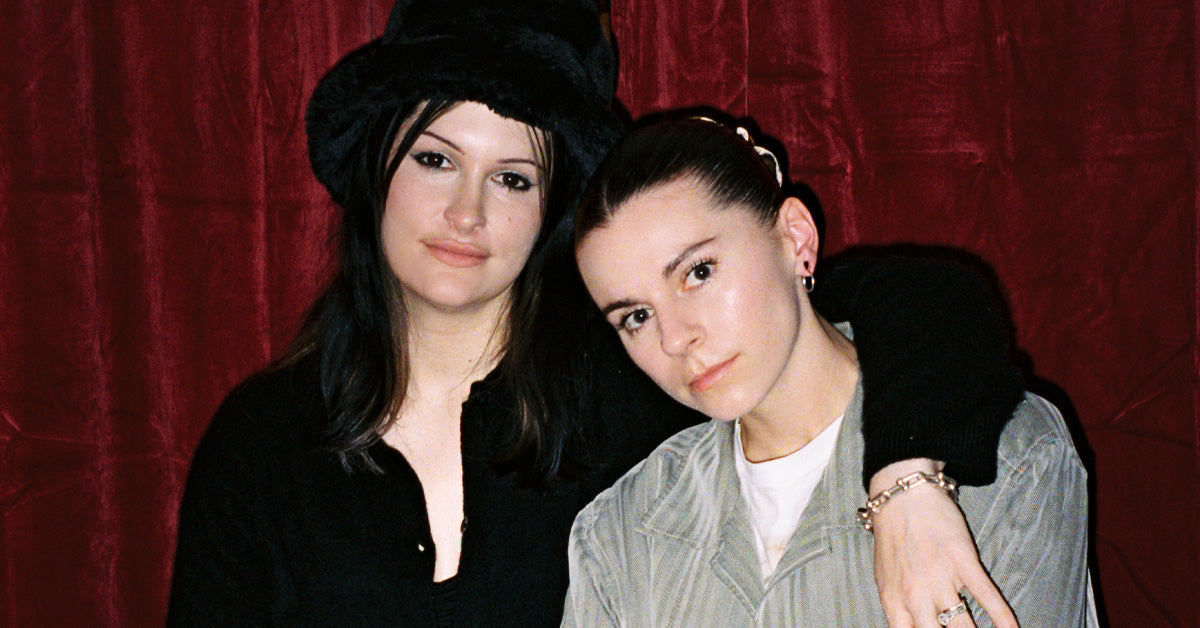
PVRIS and Spiritbox appear in our Winter 2024 Issue with cover stars L.S. Dunes, Wisp, Fall Out Boy x WWWYF, and Chase Atlantic. Head to the AP Shop to grab a copy.
PVRIS’ Lynn Gunn and Spiritbox’s Courtney LaPlante have both charted new territories in their respective corners of rock and metal. There’s Gunn, whose band shapeshifted into a solo effort with the release of her fourth album, 2023’s Evergreen, and whose bold, stadium-sized pop hooks have since eclipsed the heavier sound of PVRIS’ early records. Then there’s LaPlante, whose blend of crushing metal yowls and heavenly melodies shot her band Spiritbox into the stratosphere with 2021’s Eternal Blue. It’s been a hectic year between gearing up for their second record, touring with Korn, and hopping on a song with Megan Thee Stallion. “I just feel like all my days blend into the band,” LaPlante admits.
“It’s still hard to balance it,” Gunn says. “We took a trip to Scotland and Ireland a month ago now, and we’re like, ‘It’s gonna be a vacation. We’re gonna have fun!’ Then we had to edit a music video on the road, and we’re shooting content for new shit. I always wonder if those things should be separated, or if that’s just what being an artist is like — your whole life is the art.”
Read more: 20 greatest Rise Records bands
As Gunn promotes PVRIS’ latest F.I.L.T.H EP and Spiritbox get ready to drop off their sophomore LP, both bands remain at the top of their game. As the year came to a close, the duo sat with each other to discuss their unique rise, navigating Warped Tour culture, and collaborating for a rework of PVRIS’ 2014 song “My House,” which will appear on a deluxe rerelease of their debut, White Noise.
COURTNEY LAPLANTE: I was your age equivalent when you were making [White Noise]. I was just going and recording with the local random guy. I didn’t even know what a click track was at the time. I didn’t know you could do revisions. I went through a small little puberty in that way because I went from just being in my local band to, all of a sudden, being on Warped Tour. I had never had someone do sound for me or had been onstage where anyone gave a shit about the songs I was playing. But I was like 23 when I started going through that, and now I’m 35 going on 36. You go through so many stages of becoming a confident person. You were younger than me having way loftier goals than I ever had until I was like 30. What was your mindset back then?
LYNN GUNN: I think that’s just the delusion of being 18, 19, and you’ve not been humbled by anything yet. I think it’s really good to be humbled. But I also feel like there is a magic delusion.
LAPLANTE: Yeah, I think to be a good artist, you should be slightly self-deprecating and aware and then extremely delusional.
GUNN: Yeah, which is a crazy combination. But I feel like, especially if you’ve been doing it as long as we have, it clicks eventually. I’m no different than anybody else. I’m not shit, but I’m delusional and motivated and resilient to do this weird-ass job.
LAPLANTE: Before you recorded this, did you already have a bigger picture than your friends who were doing music?
GUNN: I think it was a combination. We came up in a hardcore punk local scene, so I never felt like I fully belonged there. When I was in high school and we first started playing local shows, you’re just stoked to be there and for people to even be in front of you. At that time, the goal was to go to an event and play Warped Tour and do all this. We worked our way up to that, and it came through. It was like, “Oh shit, what do we do now?”

Seannie Bryan
LAPLANTE: Did it feel like it happened really fast?
GUNN: I feel like it happened really fast. But in retrospect, it’s taught me everything now, and it’s given me a really good perspective at 30. So, I feel like wouldn’t have changed it. I still don’t feel like it’s where I want PVRIS to be. I would love for it to keep growing, but it is in a really cool spot that I never thought it would be.
LAPLANTE: Imagine going back in time 10 years and telling little baby Lyndsey to even understand the concept of preorders and first-week numbers. I would have been like, “Who gives a shit? What are you talking about?”
GUNN: Yeah, or content. [Laughs.]
LAPLANTE: Are you a vintage nerd?
GUNN: No, I’m so not a gearhead, which I feel like I should be just as far as producing and stuff. I should care about it a little bit more, but I’m also just a happy-accident person, and it’s fun to work with what you have.
LAPLANTE: You know Mk.gee? I was so refreshed. But it caused quite a stir in the guitar community, and remember that Guitar World interview where he’s just like, “I don’t know. I just don’t know anything about this shit.” I love that.
GUNN: I do too. I feel this way about songwriting and music in general. When I was in high school, we had different academies you could do, and one of them was the fine arts, which had music theory, studio art, etc. I took music theory, and there was a bunch of kids in the class that were so militant and smart about it. But then when it came to noodling around on our instruments after school, they couldn’t do anything. And there’s no dumb accidents or creativity to it. It was so by the books. I do see the value in knowing your shit now, but I feel like there has to be a good balance of not knowing your gear and knowing your gear.
LAPLANTE: When did you first do Warped Tour?
GUNN: We did two weeks in 2014, and then we did the full run in 2015.
LAPLANTE: The one that I did in 2012 was stacked. I only knew of Born of Osiris, After the Burial, and Every Time I Die.
GUNN: Which I think is so sick and kind of same. I knew these bands, but by the time we’re doing Warped Tour, I really wasn’t listening to that kind of music anymore. It was such a weird vibe on Warped Tour. Granted, it was extremely fun at the same time. But there was so much ego in it, and I was just really fascinated by it.
LAPLANTE: I call it Warped Tour syndrome. All these people think they’re in a big band because people are just happy to go see the music. They think that they’re untouchable, but really the reality is, there’s not gonna be 5,000 people there watching you play. I feel like that was a really weird era for guys just getting these little God complexes. I was a 23-year-old, and I didn’t know who any of those people were. I look at all these guys and size up their age, and then I turn my head this way and look at the crowd full of teenage girls… I would look back and forth and be like, “I don’t like the math here.”
GUNN: Did you ever feel like a commodity for being one of the few women, especially a woman who’s screaming heavy shit?
LAPLANTE: One thing that’s really irritating that I’m sure you went through is just your existence being novelty somehow.
GUNN: Were you conscious of it at the time — being a commodity?
LAPLANTE: I was so innocent and naive, but I learned quickly because you know how it is. During that time, it was socially acceptable to catcall and heckle. It’s one of those things, too, where you don’t know at the time that you just got sexually assaulted. In broad daylight, publicly, in front of all your friends and a sea of people. As you get older, you’re like, “That is so unacceptable. Why was no one there to help me? Why did I even continue doing the show?” I’ve said this before in an interview, but it took me till I had a barrier in front of me to not feel like…. I hold my microphone in the middle and put each elbow over each boob, because otherwise someone’s gonna grab me. And I wore the most nonsuggestive clothing because I didn’t want anyone to hurt me. It used to make me so mad when I’d see people commenting stuff like, “I like you because you don’t feel like you have to dress like a slut.” And I’m like, “Bitch, I’m not allowed to because someone’s gonna grab me.”
GUNN: Yeah, I’m doing this for my safety and sanity.
LAPLANTE: And so that sucked. I didn’t feel that way headlining with my own fans normally.
GUNN: Yeah, ’cause you’ve curated a good community of people that respect you.

Seannie Bryan
LAPLANTE: But you can quickly go from a neutral environment to a hostile environment just by someone being mad that you’re not a boy… This is a whole separate thing, but you’ll have a guy be your best buddy, and then their wife will come to the show, and the first thing they say is, “This is Courtney, and her husband’s in the band. He’s on tour with her.”
GUNN: So don’t worry about Courtney!
LAPLANTE: I was just like, “Man, that sucks.” I thought that we had an actual friendship, but we can’t because we’re different genders. That’s always been a big struggle for me.
GUNN: You’re like a threat.
LAPLANTE: But in reality, that person treats me great! I just feel like you can’t really connect and network with people because they’re all guys, and they all have to keep a bit of distance from you. I don’t deal with that as much anymore.
GUNN: For me, it might have been a little different because pretty much as soon as we started touring, I was already out as lesbian. But even when we were in high school and we were recording with our friend who was a producer locally, and at this time I was out to my friends and out to the producer, his girlfriend wouldn’t even enter the studio if I was there. There was a time when we were recording really late, and the studio was two hours from where a group of us lived, so we were like, “Can we crash here?” And they were like, “You’re gonna have to sleep in your cars because so-and-so doesn’t feel comfortable with Lyndsey being in the house.”
LAPLANTE: How old were you when you unofficially came out to the fans?
GUNN: Like 19, 20. It was such a weird thing because I was out online, posting with my ex-girlfriend and stuff like that, so it was pretty out there. I assumed everybody had known, and it didn’t need to be a headline.
LAPLANTE: It’s really tiring sometimes. Don’t you feel sometimes it’s so lame that your hair is political? Everything represents something. Do you ever get [frustrated] when people say female-fronted?
GUNN: I used to. Now that I’m older, I think there’s so much more access to information and perspective on being a woman. I think now I’m stoked on it. Because yes, this is led by a woman.
LAPLANTE: I feel very jaded. I think that if I looked at it in a more positive light, it’s probably people that are just really happy to find each other.
GUNN: Yeah, I think that’s where my perspective flipped on it. Because when people would be like, “How does it feel to be a female-fronted band?,” I’d always be like, “We’re just a band.” I think there’s an extra layer for you especially. I don’t know how the heavier scene is now, if it’s as progressive as I feel like our fanbase is.
LAPLANTE: It’s way better… [But] when people ask me that question, they’re unfortunately gonna get an honest answer. I’m like, “It’s awful.” I mean, I can move past it, and my life is awesome, and I love making music. But just focusing on the gender part — it sucks. I feel like you had more of a sense of identity when you were younger than the average musician, and you can hear it in [White Noise] because it feels like someone that understands the listening experience, and you’re not on autopilot recording. Did you feel like that?
GUNN: That’s a really good question. I genuinely just love recording and writing and being in the studio and, at that stage, working with Blake [Harnage], who produced the first two albums. He also came up in the scene [with VersaEmerge]. This was when I was still in high school, but at the time, they were doing something really cool in that space. I really love how they weren’t afraid to mix orchestral elements with rock or synths with rock, especially in this specific scene and world that they were in. At the time when we went into the studio with Blake, I think I got rid of the pop music is cheap [mentality] and really was like, “This is actually so smart and well-crafted.”
LAPLANTE: And recorded right! Well, I’m excited to hear the rerelease. You’re doing what you would do now production-wise, but the one thing. The reason I’ve heard [White Noise] so much is because my husband is the biggest production nerd. He would just listen to some of those songs on repeat being like, “Wow, I love these lyrics, and I love this hooky melody.” He’d also listen because he was like, “This sounds so huge.” And little did I know my now bass player in another timeline, Josh [Gilbert], was doing that same thing — just being so drawn to the production of it. Did you consciously do that, or did it just happen because you were working with awesome people and they were great at mixing?
GUNN: Good question. I feel like it wasn’t a conscious thing, because we literally recorded the album in a room, and the closet was the vocal booth. I would change so much stuff. The biggest thing that we’re actually gonna be changing on the new “My House” is the drums and how they’re produced and recorded. At the time we were making White Noise, there was a very specific drum sound everybody was using, and on the count, there were five main producers that most bands within that world were going to. And there’s a very specific guitar sound and a very specific drum sound. So I think there was a part of, “It has to emulate that or feel familiar,” but now if I was to fast forward, now I’d be like, “Fuck that concern. You can use more hip-hop drums.”
LAPLANTE: Has the identity of the next thing revealed itself to you yet?
GUNN: I’m still exploring, but some elements have shown themselves. I’ve been really drawn to trashy drums and drum and bass — a lot of old-school hip-hop drums where it’s still live-sounding, but they’re chopped up as a sample.
LAPLANTE: Where is the anniversary tour starting — in your hometown?
GUNN: Starting in Boston, which is a little scary for the first show.
LAPLANTE: That’s a big show. Are you just killing yourself rehearsing?

Seannie Bryan
GUNN: I’ll definitely be prepping for it ’cause we’re gonna play the album front to back. A lot of the songs are so high for me now. Two months ago, I had just rerecorded all the vocals for it, and I’m hoping to release a version of that where it’s updated vocals over the same track. I think part of that was just at the time, in music and in the Warped scene, it was a flex to sing high, especially for dudes. Which I think is so hilarious now listening back. Even listening to White Noise, I’ll be like, “Why did I have to sing that?” So I think they probably would have sounded even better if they were actually in a key that was comfortable for me.
LAPLANTE: It’s like that vocalist thing where we don’t prioritize ourselves. I would never even have thought one time to be like, “Hey, I need you guys to put in the time we’re gonna change the key of this song.” That would’ve never even occurred to me. I’m a nerd. I’ll watch Beyoncé compilations like, “She’s doing it in the original key!” That was 20 years ago, and now she’s doing it again! It always goes back to advocating for your vocal health. Which is boring and not rock star feeling, but it’s just the truth
GUNN: I think it’s interesting, too, because, again, all my thinking that I feel like I’ve had to really reprogram, and eliminate for my brain, has been based on the thinking of the bands we came up around — like early touring days. There’s also such a thing around the lead singer, and you can’t be in the photo too much, or you can’t block this person or whatever.
LAPLANTE: I’m the moneymaker here, boys! But you feel really self-conscious about that when you’re the lady.
GUNN: You don’t want to take up space or be, in air quotes, “difficult.”
LAPLANTE: Just imagine when you step out onstage [for the anniversary tour] and they know each song that’s coming. That’s what’s so satisfying about when people do the whole album. Because the crowd knows each song that’s about to come up, and they’re still gonna freak the fuck out. Are you going to play anything after or before you do the album?
GUNN: I don’t know if we’re actually gonna do it, but we’ve been discussing doing the album first, and then there’s a break. Then we’ll do newer stuff after. I don’t know if that’s the right approach. But something I noticed that I think is super fucking cool with what you do in Spiritbox is you have to emulate this Beyoncé energy, and you’re bringing it.
LAPLANTE: Don’t even joke with me about that.
GUNN: Yeah, I’ve noticed you bring a really sick Beyoncé intention into that space, which I think is just really fucking cool. You give a shit, and it’s so noticeable — down to every detail.
LAPLANTE: That’s sometimes where being feminine can be a superpower.