
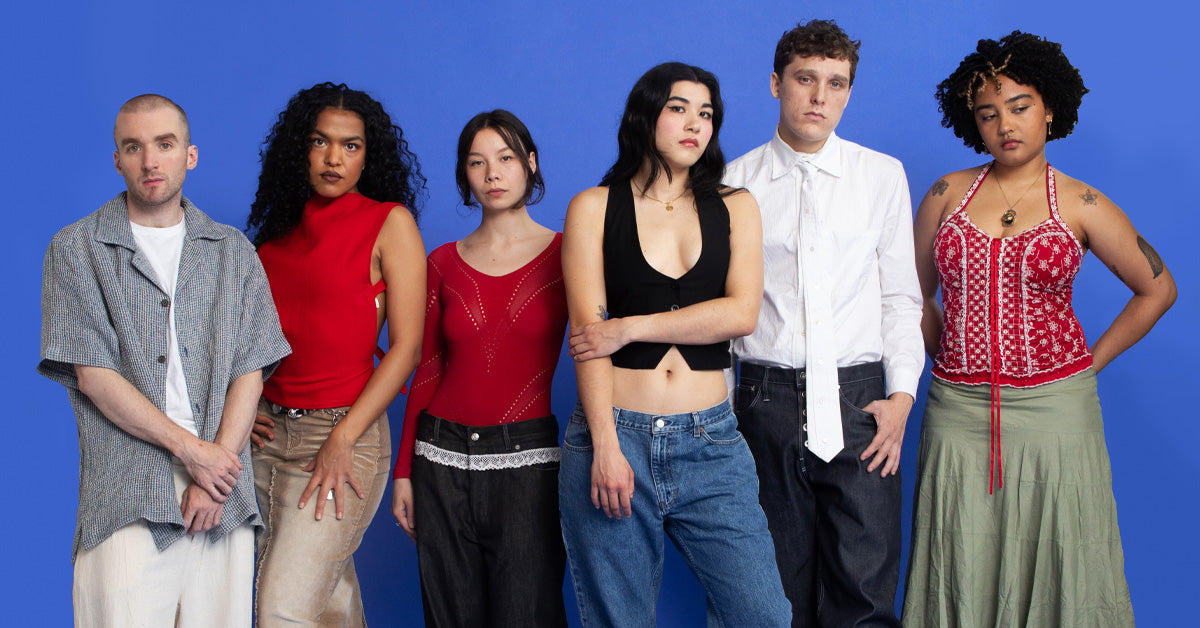
MICHELLE appear in our Fall 2024 Issue with cover stars Slipknot, Destroy Boys, Pierce the Veil, and beabadoobee. Head to the AP Shop to grab a copy.
One by one, the six members of MICHELLE pop onto my screen. Vocalists Sofia D’Angelo, Emma Lee, Layla Ku, and Jamee Lockard answer from their respective New York apartments, each sipping on mugs. Bassist Charlie Kilgore and drummer Julian Kaufman, however, are already on the move. It’s an early Friday morning.
Kaufman apologizes for joining our call from the backseat of an Uber. “It feels like not an appropriate place to take a call, but I had to go to the studio this morning,” he says.
Read more: Arlo Parks’ enduring contradiction
Kilgore, whose phone camera is propped up on the handlebars of his bike as he cycles down the city streets, adds, “And all the singers were filming a music video last night.” “We didn’t get home until, like, 1,” Lockard interjects.
“The plan was for [the shoot] to go less late than last time,” Kilgore says. “But we had so much shit to get done,” Lockard adds, again finishing Kilgore’s thought. “It was a bit involved because we put a bed in the middle of the street.”
These days, it seems that MICHELLE’s schedules are always full. Aside from filming a video and preparing to release their upcoming album, Songs About You Specifically (out Sept. 27), the group are rehearsing for their upcoming tour — their first major headliner.

Raphael Gaultier
While it may have once been unusual for all six members of a band, all located in the same city, to join an interview remotely, it’s a dynamic that works for MICHELLE, who began recording their highly acclaimed freshman release, 2018’s HEATWAVE, before having ever met as a full band. “We either knew Charlie or Julian from grade school or the music scene, but we didn’t all really know each other,” Lee says.
“The inception was in this virtual space, where we brought just a couple of people in to record or write at a time,” Ku says.
Only after the recording of HEATWAVE had been completed did Kilgore and Kaufman assemble the full band, via text message — ready to put a name to the collective. “We ended up in a group chat being like, ‘What should we call this album? What’s the name of the band?’” D’Angelo says. “It was basically between [MICHELLE] and Gertrude, but we decided on MICHELLE.”
After the success of HEATWAVE, the collective decided to keep making music together. “We figured we’d write more and release another body of work within six months or so, but that isn’t how it worked out,” Kilgore says. MICHELLE’s debut release attracted the attention of record labels and promoters, which afforded them the time and resources to take a more intentional approach to songwriting. “There are hundreds of unreleased MICHELLE songs. Some of them deserve to die, and some we’ll come back to and workshop,” D’Angelo says. A longshot from the self-imposed six-month timeline, four years passed before AFTER DINNER WE TALK DREAMS, the group’s sophomore album, dropped.
In those four years between 2018 and 2022, the world saw significant changes, but MICHELLE’s origins left the group poised for COVID-19 lockdown. “We had just gotten signed, so we had a cash flow for the first time ever, and we were gaining access to a bunch of people to work with,” Kaufman says. “It feels like the pandemic came at a time when we were ready for [lockdown].”
The band’s experience with asynchronous collaboration is noticeable. The natural flow in conversation helps to disperse my concern that our interview had interrupted their mornings. Tethered only virtually, the members are in sync, finishing each other’s talking points and commanding the conversation before too-long a lull occurs — a dynamic that parallels their writing process.
“We really don’t write with more than four people at a time. Six [people] is just too many cooks in the kitchen,” Lockard says.
“Every part of the process ends up being very collaborative. Everyone does end up working together, but not everyone just works together,” Kilgore clarifies.
MICHELLE’s upcoming album, however, represents evolution. “Apart from a few songs, everybody is singing on every song,” Lee says.
Sonically, MICHELLE are evolving as well. Their single “Oontz” exemplifies the breadth of the group’s capabilities. From the track’s soulful, R&B-inspired vocals to the groovy, funk-infused basslines and poppy synths, “Oontz” represents just a portion of the vast array of nostalgia-tinged sounds that make MICHELLE the powerhouse they are.
I’m reminded of the group’s careful balance of earnestness and playfulness when Kilgore interrupts, “Oops! The rest of [Songs About You Specifically] doesn’t sound anything like ‘Oontz,’ actually.” It’s an innocent reminder not to assume the band’s next move.
On TikTok, MICHELLE display a similar playful tendency, characteristic of their generation. In recent videos posted while on tour, Ku, Lee, Lockman, and D’Angelo are seen performing their choreography to “Oontz” in various parking lots, laughing as they go. It feels like an authentic scene that doesn’t take itself too seriously.
However, for Lee, who choreographed their live performance herself, these moves are not just a TikTok dance — they’re personal. “It’s been really exciting to learn the choreography that [Lee’s] made, not only for the new songs but also the older songs that we’ve performed over and over,” Lockard says. “The new choreography is breathing new life into these songs.”

Raphael Gaultier
Then again, it seems everything is personal to one member or another — six voices can be a lot of ideas to fit into one record. MICHELLE resemble a patchwork quilt. While genre-bending has become an overused buzzword to define this current era of pop music, MICHELLE truly represent the epitome of what can be created with access to different perspectives and ideas: What stands out in MICHELLE’s forthcoming Songs About You Specifically is the group’s unique ability to mix influences. The album’s opening track, “Mentos and Coke,” a melancholic bubblegum pop track featuring acoustic guitar and cutesy synth runs, pairs seamlessly with the grooving, funk-inspired basslines of “Akira” and the smooth, R&B-influenced “Dropout,” which highlights Ku, Lee, D’Angelo, and Lockard’s vocal prowess.
In a landscape that increasingly looks to electronic music for inspiration, MICHELLE’s sound (which we dubbed as “musicy-music” during our call due to their emphasis on each instrument’s distinct tones) is refreshing. MICHELLE call back to a bygone era of pop music without recreating it, because they don’t need to. But that isn’t to say that they aren’t with the times. “Trackstar,” the album’s closing title, reminds listeners of MICHELLE’s modernity. The song’s twinkling, dreamy instrumentals and airy vocals are reminiscent of more contemporary artists like Porches or Arlo Parks.
Before we hang up, D’Angelo compliments my shirt — it was made by one of her friends — and for the first time in our hour-long interview, we make small talk. I’m, once again, grounded by the group’s ability to oscillate between moods, not unlike their ability to flow between nostalgic pop rhythms and bossa nova grooves. After getting to know the collective, I’m not surprised by the juxtaposition. MICHELLE are determined to create something new, inspired by the past. In that way, it can be said that MICHELLE represent the sounds of their generation — a generation of people looking to the past for the answers of the future. Philosopher Slavoj Zizek says that we live in a time in which “the old world is dying, and the new world struggles to be born.” This might be true about the zeitgeist at large, but MICHELLE represent the cohort that has found a way to blend the two together.