
Preorder your copy of Linkin Park’s FROM ZERO deluxe edition in the AP Shop.
It was September of 2024 when Mike Shinoda stood onstage at Warner Brothers Studios and announced the return of Linkin Park. The crowd was buzzing, and the internet — avidly watching via livestream around the globe — had a lot to say.
It’s their unique, dynamic fusion of heavy rock and hip-hop as much as the harrowing, and hopeful, lyricism of Linkin Park that’s held fans captive for decades. The band fearlessly tore into uncomfortable feelings and experiences like depression and abuse with rabid vulnerability — in an iconic, warm tenor that spanned the emotional spectrum as much as the words themselves. From the beginning, the band had formed a connection with listeners that hit on a visceral level. On a shaky YouTube clip of the September announcement, one comment reads, “This is what LP created for us.”
Read more: How Linkin Park’s “In The End” became a worldwide smash hit
The heart of the band, regardless of the time, the lineup, the sound, Shinoda says, has always been their fanbase. And as time has passed since FROM ZERO and new characters have been introduced, it’s evident the band are dedicated to keeping that heartbeat steady. Not only this, but they’re building out a new chapter — telling stories reflective of what is, and what’s to come. “We talked about how we were looking forward to the set being more muscle memory,” Shinoda explains. “That’s when we’re not thinking about what we’re playing, just focusing on having a connection with people. I feel like we’ve got it now.”

Jimmy Fontaine
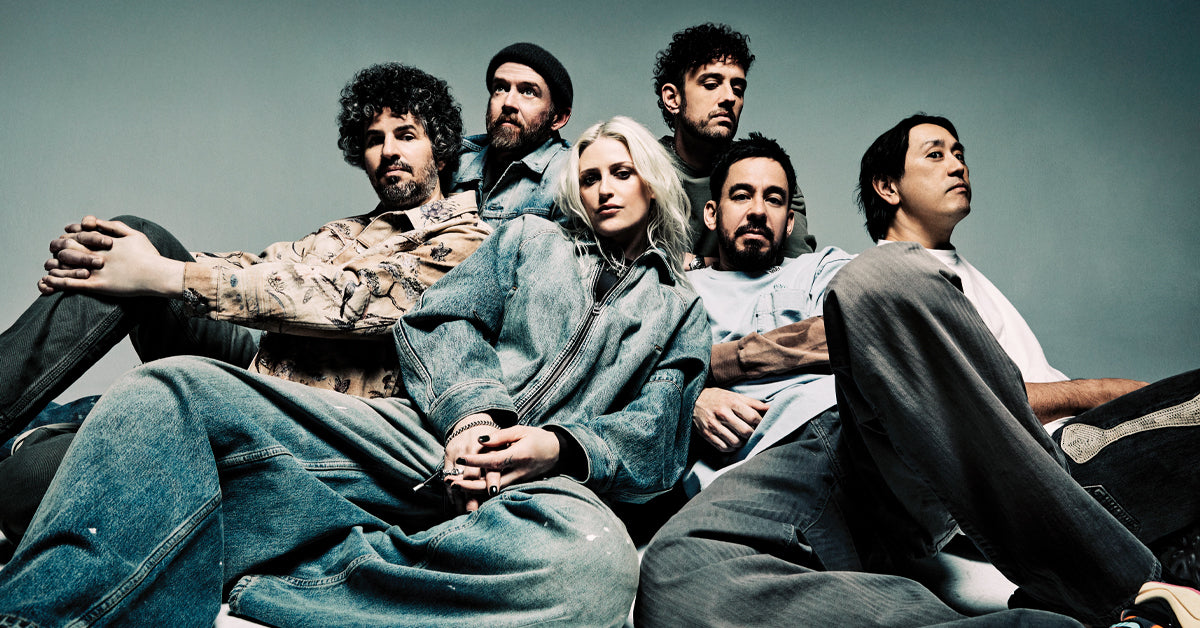
Sitting down with AP, Shinoda, along with bassist Dave Farrell and new lead vocalist Emily Armstrong, unraveled the meaning of legacy — what it means to be a part of one, and to join one along the way — while also looking forward, and forging ahead. We talk about what’s at the very core of Linkin Park — a band as much as a community, built on connection, catharsis, and unabashedly big feelings. “It’s just about the shared experience,” Shinoda says, through a wide-eyed grin. “Once you’ve recorded the song, people have heard it, and they have an attachment to it — then getting together with them and experiencing that… that’s what it’s about. It’s not about the song at that point.”
His words aren’t platitudes. Walking out the doors of Barclays Center in Brooklyn after Linkin Park’s second show upon announcing their return, I was amazed by a rare sight — crowds spilled out onto the streets of New York City, extending into the subway lines below — united in song. Shrugging off jadedness in favor of the joyful moment, people removed both their Airpods and shelved their attitudes, screaming at the top of their lungs, “In the end, it doesn’t even matter.”
Farrell and Joe Hahn, familiar faces who’d joined the band (then called “Xero”) in their formative years, stood shoulder-to-shoulder with Shinoda that night in September. But from there, this iteration of Linkin Park was unknown to longtime fans. Not only were the band announcing a new album and world tour, they revealed Colin Brittain, new blood on the drum throne, and Armstrong of Dead Sara on lead vocals. And it was the latter, even before the announcement had been made, that incited a virtual riot across the alt-rock web, and opinions formed around every possible outcome.
The past, it appears, remains as such. Armstrong’s delivery leans on her remarkable scream and guttural, raspy belt. The dynamic between her and Shinoda is kinetic, with a vocal back and forth that packs a punch. The result is pummeling, at times unexpected and massively bright — making the album, which is essentially a string of expansive anthems, a textural, though easy, ride. Live, their energy is razor-focused, the arc of new members crystalizing with more shows under their belt. Brittain has fallen into place alongside the rhythm of Farrell’s signature basslines, against scratching and throbbing synths. Armstrong, a strong performer in all rights, has grown within the group, and with each gig shows more personality onstage. Speaking with the polite, playful singer, it’s easy to see that she’s put much thought and time into feeling out her place in the band — finding a way to respect the space that’s been left, while fillling and dominating her own.

In person, however, the bandmates giggle and tease like siblings, flipping each other off goofily and challenging each other to Rubik’s Cube contests when the camera isn’t looking. As a listener, it’s refreshing to see their unity as a group exists beyond the stage lights, a challenge for any band at their level of success, and especially one that barely pause for breath. “All of it was new for me,” Armstrong gushes. “You can’t really speed up the process. You just have to go through it. You have to play the shows, and we’ve gotten to that point now where we’re able to throw in new songs and not have it be a complete whirlwind of just being like, ‘Oh, my God, could we just have one set where it’s the same so I could just feel normal?’ But we got to that point, which is great.”
From the moment they announced their rearrival, it has been a whirlwind, though the new and old guard are thriving in the eye of the storm, eager as ever to share what they’ve actualized, together, with their audience. And that’s why, only months after their album’s debut, on the precipice of another massive tour leg, they’re giving us even more. The deluxe edition of FROM ZERO arrives with three new tracks in tow. Each takes threads of Linkin Park’s longstanding legacy, and finds a way to weave them into the fabric of the band’s present. From the nü-metal kick in “Up From the Bottom” and the rap-rock cut “Unshatter” to “Let You Fade,” which finds itself probing into personal growth and emotional depths, the deluxe gives us a larger map with which to navigate the new Linkin Park — to understand where we’ve been, and where we’re going.
Artists can feel very differently when it comes to the post-album release experience. Sometimes once it’s out and they’ve toured with it, they’re over it and don’t even want to listen to it again. How do you feel, almost six months after FROM ZERO arrived?
EMILY ARMSTRONG: We haven’t played all of the songs live yet, so I’m definitely not over it. We’re going to be having some rehearsals here [in LA] and playing the new songs soon. I’m excited to see if I love the songs more than I actually do, or if I don’t like them as much, and won’t want to listen to them again. We’ll see.
MIKE SHINODA: On my Spotify Wrapped at the end of the year, seeing what songs I listened to the most — a couple of ours showed up, because of rehearsals. I was like, “Why did this have to take up a spot?” I was mad. No. 1 was “New Divide.”
DAVE FARRELL: It’s because I play a bassline part on that, and Mike’s playing a left-hand bassline on the keyboard — we’re constantly messing it up.
SHINODA: We’re supposed to be playing the same notes. But the song, there’s a lot of little nuances, changes that happen, and we were doing the wrong nuances over top of each other. To my ear — to our ears — it’s very obvious when that would happen.
FARRELL: It became a thing. I don’t know if we have it quite figured out.
SHINODA: Just imagine how much of a thing it became, that it was my No. 1 song of the year.
ARMSTRONG: We’re all professionals around here!
Let’s talk about the new songs that are on the deluxe album. Did you write those on tour?
SHINODA: Well, “Up From the Bottom” is entirely new, written in between show dates. “Unshatter” was written entirely during our FROM ZERO sessions, and “Let You Fade” was both… The melodies and chords and words were written during the FROM ZERO sessions, and then we completely changed the shape of it and rewrote all the music in December, between shows.
FARRELL: I think certain songs just take longer than others to get to a place where you feel like you want to share it. Early on, “Let You Fade” was a song for me where I knew there was something there. I remember the first time I played the first version of it. I knew there was something special that I was connecting with, but it took a while, a couple different versions of it, to get it to a spot where you’re like, “We’re now ready to share it with the world.” Other songs came together a lot quicker.

I’m sure that actively playing shows, having the new album out, really living in it — that changes your relationship with the music and creative process.
SHINODA: That’s right. Historically, we’re not a band that does a lot of jumping back and forth between studio and shows. It’s usually a longer chunk of one and then the other. But once in a while, it happens. Right now, with tour dates coming up, it just felt like we wanted to put some extra songs out, to provide something fresh for the fans to talk about, to listen to and to play.
With this iteration of Linkin Park, what does your collaborative process look like? What form does it take in the studio, live, generally?
SHINODA: It’s hard to describe. It changes a lot. There isn’t one way of doing things — and I think that’s because we’ve done so many songs in so many different ways, and a lot of our fans make fun of me because I always talk about the “tools in the toolbox.” We’ve got a lot of ways to do the thing, and so what keeps it interesting for me is continuing to switch it up, use different ones, and also having new blood in the band is a lot of fun, because Colin [Brittain] and Emily do things their own way. They do things slightly differently — or different enough from what I’ve ever experienced with our band that it’s fun to see what they pull out and bring to the table.
ARMSTRONG: I show up, and I see where the song’s at, and if I need to interject or not. At the beginning, it’s like, everything’s worked for them, so what am I going to bring to the table that would be like, “Hey, I’m going to take this to a new level.” I don’t have hits. So it was nice to see and understand how they worked together. I just felt like this is a winning team already. And I want to learn.
SHINODA: You can imagine she’s the world’s best house guest. [Laughs.]
ARMSTRONG: You know, it’s very exciting to be there! Obviously, I definitely was part of the process.
SHINODA: What I love — and I said this before specifically — there are certain moments where she can turn off her mental filter and just words come out, and she does that very easily and very well. There’s a version of that, that when people are able to do that, cool, weird random stuff pops out, and there are some real great little lyrical moments and vocal moments on the record. On “Casualty,” there’s this part — “Let’s get out alive!”
ARMSTRONG: Yeah, weird thing.
SHINODA: She just said those words, during the song, and I was like, “What is that?” I would never have written that. Those words had nothing to do with the song, really. And we kept that! There were different moments like that, where it’s like, “Oh, that’s a cool, weird thing to say.” We needed a little more weird in the band.
“A little weird” — Emily, do you feel like that’s how you operate when you’re working on Dead Sara?
ARMSTRONG: Yeah, it’s more of just a stream of consciousness. Let’s take the biggest hit, “Weatherman.” That was just what came out. There’s no thought behind it, and we just thought it sounded cool. I said, “I don’t know about ‘Weatherman’” — and everybody was like, “No! Just keep it.” I was like, “OK, whatever.” So I just kept it.
It’s really impressive to find this middle ground, to be able to enter a new space and, like you said, turn that mental filter on and off, especially if it’s not how you’re used to working.
SHINODA: I went to school for visual art, and there’s fine art and illustration, which are completely different majors. Illustration tends to be more of an organized, thoughtful type of thing. Fine art tends to be wilder, and so that’s a thing that I love here. We can have both in our music. We can have the stuff that’s very organized, conceptual and left brain, and the super creative right brain side as well.
ARMSTRONG: Well, I dropped out of high school.
SHINODA: So no brain. [Laughs.] But that’s what I’m getting at — that’s what I want more of. I truly think that’s what we stumbled on 15 years ago. I remember when we were working with Rick Rubin, that was a thing that we were really trying to get better at, looking for the more intuitive. I call it weird, but it’s not that it’s weird. It’s almost abstract. Some of the records that he’s made with the Chili Peppers get made fun of because of the nonsensical lyrics, the words that aren’t real words, but when you hear it, you’re like, “That’s cool. What did they just do? Who does that?”
ARMSTRONG: It sticks, for sure. You can’t change it after. Even if it makes no sense and you try to change it, it just doesn’t have the same feeling. I love that so much. Just the randomness of things that can’t be recreated.
SHINODA: It also happens in performance, too. Not even just the words, but you’ll sing a strange thing where the voice will come out a weird way, and sometimes those are the best performances.
FARRELL: There’s a space between underthinking and overthinking where it’s just in the zone. It’s just thinking. You don’t want to lean too heavily on either side, but everybody has a tendency toward where they land. I think the balance is impossible, but that’s what we’re going for.
I’ve heard it said, “‘I don’t know’ is one of the most powerful sentences.” It definitely feels right when we’re talking about a unique creative journey like this. I’ve also listened to the episodes of Rubin’s Broken Record podcast where he breaks down the Chili Peppers’ records with the band, and talks about his process with them. Unlike their other producers, he’s all about stepping back.
SHINODA: I love when he did the episodes with John Frusciante. That was a good one because John really lives in that space — and he’s very humble about it. And Rick, to his credit, because he doesn’t play instruments or get in the nitty gritty of recording, one of the things I think we all learned the most from him was to be in tune with where the song wants to go. Being in tune with what feels natural. It’s weird because it almost asks, “What’s the universe channeling through the song?” It’s one of those types of things. When I can hear it, I get a feeling from a song. When it’s becoming special, there’s a sensation, and I don’t really know how to describe it, but those moments are what I chase the most when we’re in the studio.

Does that phenomenon happen during live shows — do you ever have those moments experiencing the music in that way?
FARRELL: It definitely lives in the same zip code, but in a different house. The live thing, for me, it’s special — the shared experience, the connection. I think what Mike’s talking about, at least my version of it. I’m trying to describe in words the feeling that you get when you get goosebumps, but it’s something you can’t encapsulate. In the studio, we’re searching for those moments where you can play something for each other or have an idea, and when it starts to work, you just feel like, “Oh, that’s a thing,” or “There’s something special in that. We need to figure out how to water that and make that grow,” as opposed to the other side of that. We’re trying to avoid hearing stuff and feeling like, “Oh boy, this feels really labored. It’s already exhausted.” The live experience, for me, has always been one of the coolest things about music — because performing or playing live is an experience you can’t have without somebody else there. We can’t go have a rehearsal and have the experience that we have in a live show. You’ve got to have a give and a take. You’ve got to share it together — and even that is hard to communicate or talk about. It is its own thing.
Mike, you talked about this as a chapter of your “continuing journey,” and I have a few questions about that. What do you think has been the heart of Linkin Park, through it all? And what makes this chapter its own, aside from the obvious new additions?
SHINODA: To me, part of that is the community. It’s the culture of the band, which is not the band. It’s bigger than the band. It exists whether or not the band is there. It’s the people on the subway — we’re not there. We didn’t start that. We didn’t instigate. They’re having a shared experience, and our music’s part of it. To me, that’s the thing that travels all the way through from the beginning to the end.
In our very beginning days, we were sending out stickers and demos and CDs and whatever to spread the word about our band, and the thing that started to happen was that people connected with each other over it. Then they connected with us, once we finally showed up to their town for the first time. Then we did it together. That whole thing is the same thing that’s happening right now, and what’s really fun and exciting is that it’s because the band looks different now, and the music is made by this group of people. Then there’s a little bit of a cultural shift. There are elements of it that are the same, and elements of it that are not, and so the type of person that is now coming to the show has adjusted accordingly, too.
If you weren’t musicians, what do you think you’d be doing?
FARRELL: I’d be playing professional basketball. LeBron wouldn’t be at the Lakers. I’d also be a foot taller.
SHINODA: Only a foot.
FARRELL: If I’m playing a guard, yes, I’d be 7’4” instead of 6’4”.
SHINODA: But wait, you’re not 6’4”! [Laughs.]
FARRELL: I actually went to school pre-med, and realized in my first year there that I absolutely hate the sight of blood. So I knew that med school was not a good career path at that point… Then when music started working, I never changed lanes into a different space, so I don’t know where or what I would be doing if not for the band.
ARMSTRONG: I’d be a professional dancer. Because of the gifts that I have, of me dancing onstage, apparently. [Laughs.] No, but I really love sports, so I feel like I would’ve definitely gone that way. Even in high school, a coach was like, “I want you to set you up with some universities…”
SHINODA: Wait, what was first? Was it basketball?
ARMSTRONG: First was basketball, then skateboarding for a while. In high school, I had to really choose one, and I was pretty good at it, but then… That’s when I started Dead Sara, and then I dropped out. I already knew what I wanted to do.
SHINODA: I like how decisive that is. Some kids are lucky to be able to know what they want. Oh, this is my calling. This is my thing.
ARMSTRONG: I know. I realize how lucky that is.
SHINODA: I was drawing and painting. That’s probably my thing. Mine’s easy. That’s where I was already going, and even with that, I always thought that was my calling. That was what I was going to do, and then our weekend shows at The Roxy ended up getting bigger and bigger, and I was like, “Wait, am I not the thing that I’ve been pointing my whole life at for 10 years? Is that not what I’m doing? That’s weird.” My mom basically said, “Please tell me you’re going to finish college. Just please don’t leave. We are so close. You just have to stay in for three more months.” I was like, “We just signed a record deal, but OK, I will stay in school for three more months to finish it.”

How do you stay grounded? It seems like you’re always doing something, traveling, in the studio…
SHINODA: We make fun of each other, if anybody starts acting up.
You just shame them.
SHINODA: Shame them, yes. That’s great. We shame them.
FARRELL: Bringing shaming back.
SHINODA: There’s not enough shaming in the world — that’s also the pullout quote. God, we’re bad at this.
Let’s talk about the openers you play with. What’s that process like?
SHINODA: We put a wishlist together. The whole band threw names into a pot. Then it becomes, “Who is almost the right size for the venues?” Because in some cases, we had Sleep Token open on a show last year, and that was a stretch because they’ve gotten so popular now that they’re moving out of that opener realm. They’re a headliner. Then you’ve got other artists — my No. 1 on my list was Jean Dawson. I just love his music and wanted him on as many shows as possible. He’s a perfect opener. But he’s also on the smaller side, so on some of those shows, you had to have another artist in between — and sometimes not. We’ve got some more coming with Jean. Architects are on shows. PVRIS on some shows. grandson, of course, doing a lot of shows. Spiritbox and then JPEGMAFIA. Very excited about those shows. We have one with ONE OK ROCK.
That seems fun but also stressful. It feels like they always complement you pretty well. What would this chapter be called? What’s its thesis statement?
FARRELL: Part of my personality is like, “You either win or you learn, but you don’t lose until you quit.” You don’t lose until you give up. And I’m not just talking about the craziest stuff, but even simple things. I feel like with my wife or family, if it didn’t go how we wanted it to, or if somebody’s bummed on an experience or a thing, there’s always a chance to fix that or to at least redo it or to change the shape or the direction of how it went. So for this, there’s a stall period where we were all recalibrating, figuring out where we’re at. But then at the end of that, it was more us coming back together and just saying, “Moving forward, what does that look like? What does that chapter feel like? What do we want it to be? How can we imagine it?” But even just going through that process, regardless of what comes out of it, having to have to do it was really important to me.
I didn’t want or have an option of not trying to figure out what our next step is. Not only as Linkin Park, but even as close friends. This is a huge thing that we’ve spent a large chunk of our life and identity and hard work and whatever blood, sweat, and tears that we’ve put into it. What does that look like moving forward? What [have] those friendships and relationships become? Right? Then adding in and finding Emily and Colin and all the different twists and turns just add so much color and life to all that. It’s really special.
ARMSTRONG: At the beginning of it, if I thought about it too much, it was very overwhelming. As you can imagine, there’s this legacy, so to sit and ponder about it was just way too daunting. Being in the moment of what was happening was something that I had to lead with — that momentum and that spark, the feeling that was in that room with everybody. It was something that I definitely wanted to be great for fans as well. I was just like, “I don’t want to let everybody down” — and I felt like somebody’s got to do it right — at some point, I could feel that it wasn’t over. Even when I was coming in, knowing I wasn’t the only one coming in — I just thought, “Who could it be?” Honestly, taking myself out of the equation.
SHINODA: Yeah, anybody who came in and sang on anything, we pretty much didn’t tell them about anybody else. The only exception was, I remember later in the process, we had a song that Teddy Swims sang on, and Emily heard, and she’s like, “Who’s that?” He’s a great example, because he’s a sweet dude and a super talented singer — and it wasn’t about those things. We get along great with him. It’s not about that. When we got in the room with Emily and Colin, it just felt right, and we were making great stuff together. That was reassuring.
If the fans had heard like the whole album, and said, “This is trash. You guys are horrible. This is the worst thing I’ve ever heard,” and everybody abandoned us completely — we wouldn’t have felt like complete idiots, because we still knew that we got in the room and enjoyed ourselves. We knew that part was right, and it felt good. Even if the rest of it didn’t work, I would’ve felt fine.
ARMSTRONG: Could have gone many ways, and we did think that. There are so many ways.
Seems like it worked out.
ARMSTRONG: I think so.
SHINODA: So far, so good.