
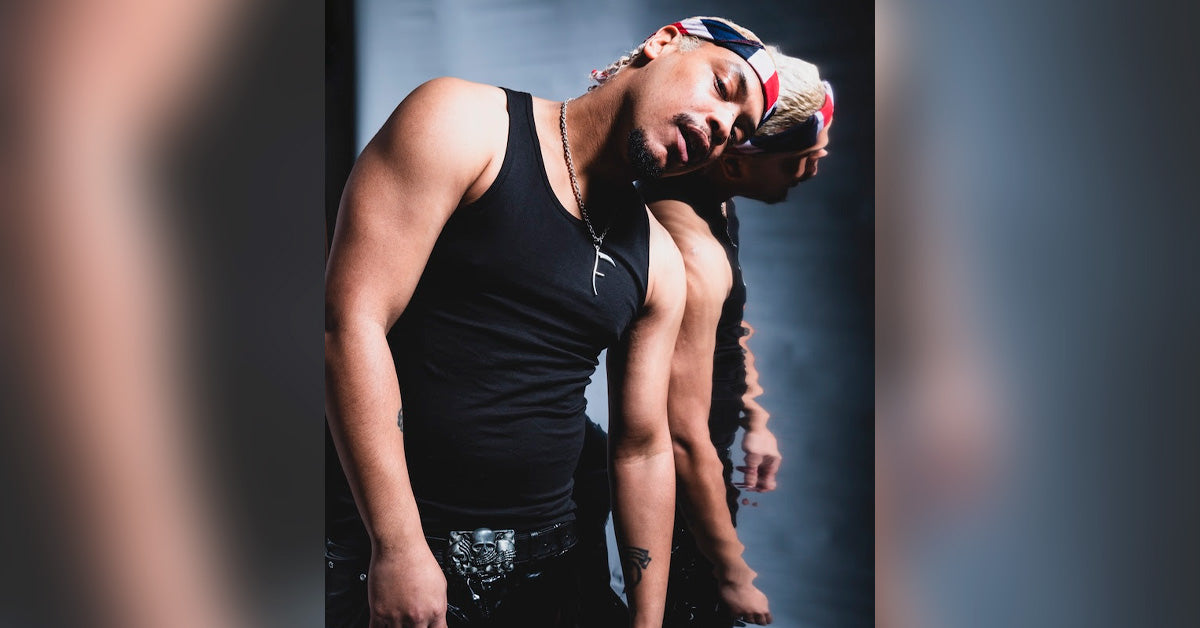
On Friday, subversive U.K. artist Kid Bookie released his third studio album, Songs For The Living // Songs For The Dead. Bookie is no stranger to brash, explosive sonics — thrashing through a unique blend of metal, rap, rock, and beyond since his first mixtape dropped in 2016. Heaviness is his bread and butter — and as a result, Bookie has collaborated closely with Slipknot frontman Corey Taylor, Tech N9ne, and Good Charlotte’s Billy Martin. But on this new album, against a sonic landscape more disruptive than ever, we see a new side of Bookie. One who bares himself, unabashedly.
Across 11 tracks we get a taste of Bookie, completely vulnerable, detailing the desperation of heartbreak, self-doubt, a macabre mindset, and the struggles he faced growing up in London. And the powerful backdrop to these diaristic bars? Deliriously sticky riffage, an unexpected and addictive flow between incendiary metalcore and raw acoustic moments, trap verses that take us into triumphantly guttural growls. The album swerves in ways that are at times jarring, but that’s Bookie. He doesn’t refuse to be boxed in — the boxes have been torched, and ashes buried 6 feet deep.
Read more: Fan poll: 5 best Slipknot songs of all time
AltPress spent time chatting with Kid Bookie about the ever-changing human condition, the power of a “good ole bag of weed” in the studio, and how to relish the cloudy days.
Firstly, I saw you in Cheltenham, and it blew me away. I had seen you before, but that performance was a punch in the gut, in the best way. That being said, I’m really excited to talk about the new project and what’s happening going forward for you.
Honest to fuck? That means more to me than you could potentially ever fathom… I feel I’m neglected quite heavily in the live circuit due to the notion I might not fit into the brackets of what people think “rock” is or the perspective that I don’t put on what’s familiar to a live show in rock music, so to feel seen is quite a triumph for me. Feels people are beginning to give a fuck within that space I want to occupy… Thank you, I’m intrigued to find out what you wanna know.
Going from your first to second and now third album — what do you feel like has been the biggest shift between each?
I guess the understanding of myself, the music, and the music industry through each chronology, from the raw, rugged piece of shit without a care in the world to the more empathetic, patient, abrasive, talk-your-shit type prowess, you know? Each facet of my being put on display in its most authentic form I can give at the time, but it just gets better during each project cycle because I fucking care. I care so fucking much about the challenge of music, the study of how to make it sound even palatable because that’s a skill in itself, and you can’t go full-ego and just sniff your own shit thinking it smells amazing and expect everyone is to be sniffing the same scent, especially if it’s shit.
What is the Kid Bookie ethos — the core element of your project that’s been steady throughout your whole discography? Genre feels irrelevant, but how would you describe a Kid Bookie project?
The ethos has always been to transcend feelings past the physical, especially when it’s captured in audio form. A song is more than just a popularity spike for your next moment — it’s something to outlive you. It’s something to put literature across in nuanced ways. It’s a stamp of your identity that can reflect yours and the general human condition in the timeline you’re in. I think it’s sacrilegious to enter this realm of music to just embody a false identity to perpetuate a slow-growing ego or one that can only be prevalent through popularity. I will literally tear your foundations from the root and say get the fuck outta here.
On the new album, there’s a truly expansive span of sounds, angst, and technique. What were your goals on the new album going into it? What was the ethos?
To just be myself and see where my “sound” fits in the world. I’m a student of a game we’ve all grown up in. I can only draw from the familiar, which is what we learn from. Also, to get across my actual feelings — the things that are shared through life, pain, heartbreak, vulnerability, the hopeless feeling of inadequacy, but also lighter moods to show that there is fun in gray clouds. It just depends how much fun you wanna have dancing in the rain.
What is your process — conception of a song, the message, sound, and the songwriting? Do you have any rituals around it?
Most songs come to you, and you don’t need to think too hard about it. If your subconscious is giving you a stream of thought, carry on sailing. You’ll find your destination once you arrive at it. I can be quite thematic to things that are relative, so I always expand on that. Most of my songs, no matter the direction they go, mostly start on acoustic guitar and then build up from there, and a good ole bag of weed doesn’t do to much damage in the studio space, either. The message is just current feelings or ideas that revolve around shared thoughts. It’s endless.
Is there anything specific you’re drawn to — a place, thing, sound, person, piece of art — that you were creatively inspired by in making this project?
Well, it started with a breakup song with purgatory, and I’m finishing the album with the same breakup. I guess there’s a metaphor in there, but also a linger for hope. I don’t really know which one I wanna grasp because they both fucking hurt, and I’ve changed a lot from the whole process. With change comes a lot of growth, and I’m still trying to work out what parts I need to cut off or just sew back on to heal. How can I define the ever-changing human condition? Fuck it.
Let’s talk about the album title. It’s heavy. What’s the story behind that?
I have a weird attachment to death. I’m kind of obsessed with it because it’s something we’re all going to do once, but we won’t be able to interpret or understand it fully, not just that it’s the end of all physical happenings for you. Still, a lot of what you do can outlive you for a period of time, especially music. It’s a set of songs for everybody alive in the world today but also ones for myself that exist for me and possibly others when I’m gone and also everybody that dies with these songs/moments in memory — a journey through time, track one until the end, the death of this era, this time, this person I was to who I can become. There are many ways to explain death, not just for mortality.
If you had to sum up the album in a sentence, what would you say?
Brave, because being in this industry, I’ve learned I come with being under the microscope a lot, and people have already made up their minds about me sometimes, so I guess this is as close to being “un-pigeonholed” as possible, whether in my favor or not.
Favorite song on the album, and why?
“Purgatory” or “AI.” They are both songs I feel. “Purgatory” will hit me wherever and however I am due to the fact it’s a song I’ll remember forever due to feeling and memory when I listen. It’s almost like genuinely grabbing glass and cutting yourself when I hear that song sometimes. “AI” is a massive anthem, modern and new. I think it’s got legs to grow. I’m proud of that song.
Finally, how would you describe your relationship with music?
Cynical. It brought me the best moments of my life and made me who I am, but I have also caused a lot of damage pursuing this dream relentlessly that when you decide to finally look up from your tunnel vision, there are a lot of things in your life you need to fix. The balance of them both makes it the perfect, tortured artist story. Ultimately, I love it. It’s who I am. I can’t change that. I can just be myself.