
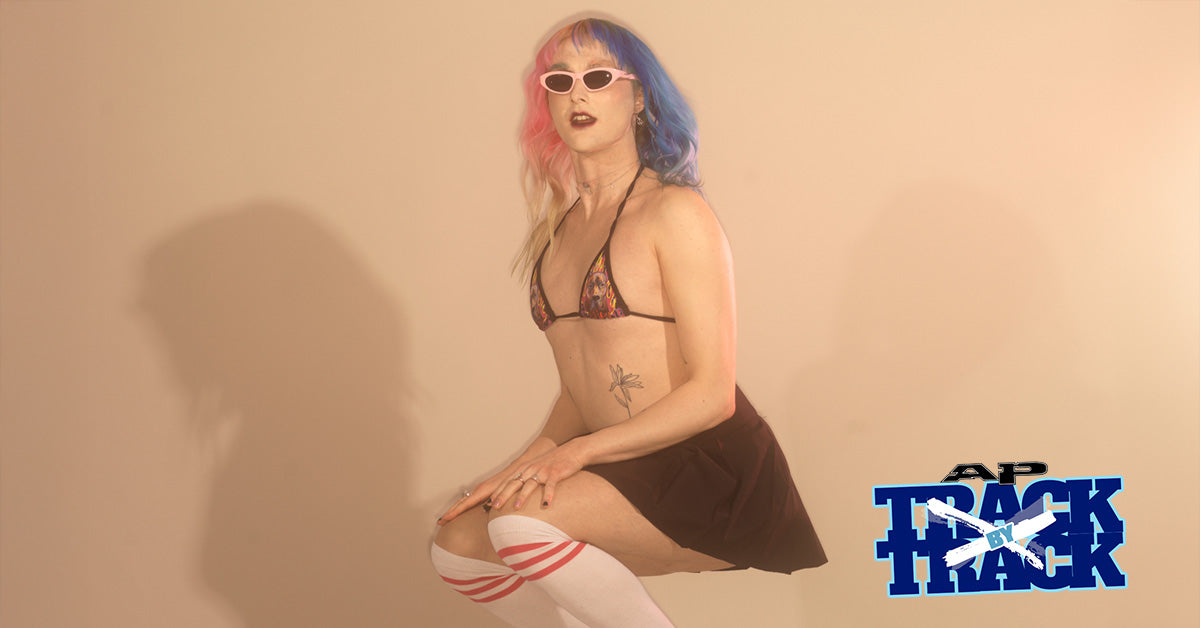
Jasmine Cruickshank came up playing in punk bands around Bristol and self-releasing songs on Breakfast Records, the indie label she co-founded in 2016. But the piercingly raw indie rock she records under jasmine.4.t brings starker realities to the fore. The songs were so potent that they caught the attention of Lucy Dacus, who invited her to open a handful of shows in the U.K. while she was touring Historian. During those gigs, the early sketches of Cruickshank’s debut album, You Are The Morning, out today, began to take form. She reluctantly sent demos to Dacus, who then played them for her boygenius bandmate Phoebe Bridgers. It was only a matter of time before the Manchester trans artist was signed to her Saddest Factory imprint.
The resulting LP is nothing short of vulnerable. Recorded at Sound City Studios in LA and produced by boygenius, jasmine.4.t travels through the harsh truths of queerness, documenting stretches of homelessness, PTSD, and harassment. Each member of boygenius lends their insight, but all of the songs are unmissably jasmine.4.t and her abundance of lived experiences. “Guy Fawkes Tesco Dissociation” calls back to being triggered by fireworks, whereas “Highfield” details being met with transphobic slurs while trying to find peace in nature. “Often I would come home crying… Street violence and harassment are such a daily experience for trans women, and one I think many people are ignorant of,” she tells AP. Yet, there are still moments of light that break through the cracks. “Skin On Skin,” recalling Big Thief’s Adrianne Lenker, celebrates the joy of trans love. The title track details the healing power of friendship and chosen family while reflecting the ethos of the album as a whole — “queer power and hope.”
Read more: How boygenius are breaking big
To ring in its release, jasmine.4.t took us through the immense meaning behind every song on You Are The Morning.
“Kitchen”
When I came out as trans, my life in Bristol fell apart. My marriage ended terribly, and I had to escape north to Manchester. I was staying on friends’ floors and sofas. I was deeply traumatized and delusional — I believed I had died in a pool of blood on my kitchen floor back in Bristol and was experiencing a sort of afterlife. This delusion took a long time to shake. I started searching for my community, and soon I fell in love with a trans person for the first time. I was in no place to start a relationship and nor were they, so we decided to just be friends. We loved spending time together. But I felt useless just hanging around their house for days at a time, and writing this song is how I processed that feeling. It was the first song I recorded when I got to LA, and Phoebe, Lucy, and Julien all agreed it should be the opener, as a simply arranged acoustic track.
“Skin On Skin”
Trying to be just friends didn’t work out for me and my first trans love — after some time I became their girlfriend. I found so much joy and peace in being loved by a trans person. For the first time, I felt like I could be myself in a relationship, which was what I had always wanted. I went to stay in rural Scotland with a friend that summer, and, while there, I wanted to write a song that was a celebration of T4T love. I am a huge fan of Big Thief, as well as Adrianne Lenker’s solo work, and I decided to put explicit references to her writing into the song. My favorite Big Thief song is “Real Love,” a song about domestic violence, in which Adrianne sings “Real love makes your lungs black/Real love is a heart attack.”
I wanted to reply to this, from a perspective of T4T love healing me from the marriage that ended so horribly when I came out. Sitting by a river that ran past the cottage, thinking about my lover, I wrote “Real love is a gift/Real love is the sweat on your back/Real love ain’t a heart attack/It’s just what you want.” I recorded a demo with my friend that night and sent it to Lucy Dacus, who I was close with since touring together pre-transition. Lucy replied, “My secret wish is that I could produce your music sometime.” So when Phoebe wanted to produce the record, too, and Julien was in LA at the same time, Phoebe suggested that all three produce it together. I love Julien’s guitar work on this — the two solos really make the track. It’s a dream come true for me, as I’ve long been a fan of Julien. However, the first mixes we heard still felt quite acoustic-led. So, alongside filming a lip-sync for the visualizer, I overdubbed some baritone guitars fed through a Big Muff fuzz pedal back in my bedroom in Manchester. This helped bolster the track and give it the heavier energy I wanted so that now listening to it reminds me of the heady feeling of T4T desire.
“Highfield”
During the winter of the first year of my transition, after a period of homelessness, I got a two-month lease in a room near Highfield Country Park. Highfield is a large, quiet, beautiful nature reserve in South Manchester. I tried to go for a walk there every morning before work, but between my front door and the entrance to the park was a 100-meter stretch of a busy road where I was met with transphobic slurs from passing traffic. Earlier that year, I had been violently assaulted — and so these experiences of hateful street harassment terrified me. Often I would come home crying. I wrote this song about it. Street violence and harassment are such a daily experience for trans women, and one I think many people are ignorant of.
When we recorded this in the studio in LA with the boys, Phoebe let me play it on her iconic rubber-bridge baritone that she plays on songs, including “Emily I’m Sorry.” There was a beautiful harpsichord in the communal area that Phoenix [Rousiamani] played, improvising over the top of the instrumental part. She then added violin layers, creating a magical texture. At Sound City Studios there is an echo chamber, a dark concrete room with speakers and microphones that is used to add natural reverb to tracks. After I recorded my lead vocals, the boys went into the echo chamber and recorded ghostly backing vocals together. It was so beautiful hearing them through the control room monitors. I feel like their part holds the track together and lends a sense of progression. It was really healing to sing about trans issues with the support of all these incredible musicians.
“Breaking In Reverse”
While I was in the room near Highfield, I wrote this song about my first trans love. It’s about the stop-start way our relationship began, and how healing it was to be understood and loved by another trans person. I recorded a demo of it in that room late one night. The landlady was in the next room, so I sang and played it as quietly as I could. This is the origin of the very gentle plucking throughout this track. When we recorded it in LA, the boys recorded harmonies together in the live room. It was so cool to watch them work together to arrange them on the fly. I love how their voices soar at the end, over my and Julien’s erratic guitar solos.
“You Are The Morning”
I wrote this song about my best friend, Han, whose floor I stayed on when I first came to Manchester. I had just come out, my marriage was ending, and I was homeless. Han helped convince me that this was not an ending, but a beginning. She was the ray of hope that I needed. She helped me find the strength and meaning I needed to carry on living and start my transition. The song is about her, about how healing her friendship has been, and the world that opened up to me when the curtains were drawn and the light let in. It is about queer people’s capacity for solidarity and change. It is about how we change ourselves and the world around us. The demo version I recorded was longer and wordier than the album version. In the studio, Lucy suggested removing some parts, leaving the vital parts of the song intact. Lucy has an incredible talent for editing. We recorded it onto tape at a fast tempo on an acoustic guitar, then slowed the tape down, resulting in a lower, warm, woody tone. Eden [O’Brien] layered percussion including body percussion, Vixen’s Diary added upright bass, and Phoenix added key and violin layers, as well as the iconic whistling part at the end of the solo. We decided that this should be the title track, as it represents the core sentiments of the record — queer power and hope.
“Best Friend’s House”
Homelessness is a crisis experienced by many trans people, myself included. When I came out, my marriage ended terribly, and it wasn’t safe for me to stay in my home. Staying with my birth family wasn’t an option. I was lucky enough not to need to resort to rough sleeping, and spent a winter on the sofas and floors and in the spare rooms of Manchester’s queer community. I wrote this song about the times I stayed in my best friends’ beds and how happy I was to be there. I borrowed a guitar from Han that only had three strings left, and recorded a demo in my first trans love’s spare room while they, and all my friends, had gone home for Christmas and I was alone. It was such a healing experience to then go to LA and record this with my new trans bandmates with additional backing vocals from the boys, Becca Mancari, ER Fightmaster, and my labelmate Claud.
“Guy Fawkes Tesco Dissociation”
While staying on Han’s floor, I was experiencing very severe PTSD symptoms, including hallucinations, delusions, suicidal planning, dissociation, and constant terror. These kinds of horrors are something that a lot of trans women face. On Guy Fawkes night, the fireworks were setting me off, so Han took me outside to watch them and show me I was safe. While we were outside a supermarket on the main road, someone set off some fireworks nearby, and I blacked out. My next memory is slipping up on Han’s doormat. Apparently, we had done some shopping in the supermarket that I could not remember. Later, I started a type of therapy called eye movement desensitization and reprocessing (EMDR), which, over a long period, helped me. But, as I was starting this therapy, things got worse for me, as it brought up so much from my childhood. I also experienced some violent hate crimes on the street around that time that set me back.
It was around then that I wrote this song about my experience in the supermarket, my divorce that was happening at the time, and my ongoing struggles with suicidal thoughts. I recorded it on a four-track cassette recorder and used two separate vocal tracks singing alternate lines, one on the left side and one on the right side. This represented the bilateral stimulation of EMDR therapy. This was one of the demos I sent to Phoebe before she signed me, and I was overjoyed when Phoebe agreed to sing the second voice when we recorded it. I wanted this song to have a really sinister upbeat kind of feel, despite the harrowing lyrics of the chorus. However, I feel a lot of joy when I think about the lyrics to the second verse. I wrote about a future in which I was healed, and recording this song in LA with my favorite musicians was the healing experience I needed.
“Tall Girl”
Han wrote a song about me when we were at university together, which refers to me as a “tall boy.” She never told me it was about me, but I always pretended that it was. We became very close friends, but it was only when I moved to Manchester, eight years later, that she confessed it was about me. So I wrote this song about her, but I had to rewrite history so she could sing about a “tall girl.” This is a surprisingly difficult song to play, and took a fair few takes with Eden and me performing simultaneously. I really wanted to get Julien’s voice on this, and I was so happy when it happened. It’s a fun bop, and the backing vocals really add to it.
“New Shoes”
This is a favorite of Lucy’s from when we toured together before I transitioned, and it’s the only song on the album that predates my transition. I wrote it at the beginning of the relationship that became my marriage, and it was one of the songs on my debut EP Worn Through. Lucy suggested to Phoebe we record it, but I was initially against it, as I was processing my divorce and was not in a good place. However, with time, I came around to the idea, since I would now be singing “Let’s make a family” about my chosen family. When it came to it and I was recording the vocals in the studio, I couldn’t stop crying. During the final take, I broke down in the vocal booth. You can hear my bandmates and the boys coming into the vocal booth and comforting me at the end of the song. We left this sound in because it represents the queer family that I have now formed. This is reflected in the arrangement of the song as well: Lucy added a vocal harmony under my voice, which lifts my voice just at the point it is breaking down.
“Roan”
One night, when I was sad at a party, a very attractive trans person in black lipstick sat next to me and told me stories about interspecies transformation in medieval Irish literature. After everyone had left, we spent the night together on the floor of the house party’s back room. Roan accepted me in a way I had never been accepted before. More than accepted — needed. Ze is my home. I am dictating this to zir at zir house with my head on zir shoulder right now. I demoed the song in my bedroom two years ago, and we actually used a pitched-up version of the electronics from the demo track in the studio version. Phoenix added beautiful, improvised piano and ambiance layers. This is an ode to trans lust.
“Elephant”
The first time I fell in love with another trans person, I was not in a good place to start a relationship. I had recently been homeless and was struggling with PTSD. We decided to try to just be friends, and this song is about that feeling. When I first demoed it, I wanted to make something referential to Elliott Smith, who has always been an inspiration to me. I used a thin double-tracked guitar layer and added a very simple, repeating vocal melody over the top, barely whispering into the microphone. In my first video call with Phoebe, she told me she had heard the Elliott reference, and that meant so much to me because I know that Elliott is a shared love of ours.
When we recorded the song, it ended up much larger, with several guitar tracks and two drum layers, played by Bobby Gruska and Eden O’Brien, but the drums use an on-beat snare at the end that took inspiration from Elliott’s recording of “Christian Brothers.” The boys and Vixen arranged the bass part, which really defines the structure of a song that might otherwise be jarringly repetitive. Phoenix added violins and arranged a choral part that was sung by the Trans Chorus of Los Angeles. The choir came in on the last day of recording. We had otherwise been using Studio B, but for the choir, we booked out Studio A, the largest live room at Sound City, where so many iconic albums have been recorded. Filling that space with trans people felt like making history.
“Transition”
We wanted the choir to connect the final two tracks on the album, “Elephant” and “Woman.” Phoenix, who was arranging the choral part, took two lyrics from “Woman”: “What do you call woman” and “Breath of gin/softer skin.” She set them to this beautiful original composition that she wrote in the studio. Hearing the trans voices fill the room when we were recording this was incredibly emotional for everyone present. I remember turning to Lucy when the choir started singing and saw that she had tears in her eyes.
“Woman”
This is the first song I wrote immediately after coming out to my ex-spouse. The song describes the devastation I felt following the conversation, which I had gone into with vain optimism. However, I remained true to myself. I had known I was a girl since I was a child, and I tried to come out as a teenager, but it went so badly I forgot it even happened. I got very sick at university and was debilitated by myalgic encephalomyelitis (ME), followed by long COVID, an experience described in my debut EP, Worn Through. While I was bed-bound during lockdown, I had plenty of time to think about transition in the absence of societal expectations. When a postie called me a “lucky man” one day, I broke down and cried and realized I needed to transition. That evening, I came out, which led to the events I have described above with their ensuing psychological damage and homelessness. That was the evening I wrote this song. With this as the backdrop, It feels triumphant to end the album backed by the Trans Chorus of Los Angeles, singing about my womanhood.