
Watch out for a drop at 10 a.m. ET at the AP Shop
Sitting on the floor, somewhere sunny in Tennessee, I ask a question I’ve asked artists before, though it’s reserved for those whose hearts are fixed to their sleeve, even when broken. “Do you think that great art requires pain?”
Cupping a mug of tea — grown by David Byrne’s wife — and wrapped in a thick sweater, my yellow-haired friend pauses. “No. I really can’t believe that, because then I feel like I will continue to sabotage… I think great art actually comes from the willingness to be taught and molded and grow, and to be wrong. I think a lot of times when we’re wrong or really limited in something, it forces innovation — and that is creativity. So I don’t think it has to be pain.”
Read more: The best gifts for music lovers
I first met Hayley Williams years ago. She is tough, loyal, and sensitive, both in spite of and because of the world that’s raised her, and all of its inconsistent nurturing — throwing her to the wolves, then embracing her tightly. Though I haven’t known her from the start, while life wields its relentless lessons, with each song, show, Substack post, Williams has grown and actualized — and it seems parts of that young woman are emerging from the bunker. This fervent, wise, funny, caring human is making peace with her past, as she processes the present. For me, and likely for you, I’m taking that uncomfortable journey myself. I can only feel lucky that someone like Williams has handed over just the right soundtrack for me to sing, sob, sway along to.

Today, we’re in the parlor of Williams’ house, which has been gutted and is under construction. For Williams, it seems everything has meaning — though, she admits, many times she doesn’t realize until after the fact. However many layers our set might have today, the glaring one is the desire to feel safe and “cozy,” as she describes. Self-care. Self-love, even. She’s brought her own kettle, mugs, the aforementioned special teabags, and something for us to sip at: a burgundy writing table, which her mother, Cristi, had brought back from a trip to Japan when Williams was young. Only a foot or so off the ground, it seems to carry a spiritual, energetic weight that has far usurped its small stature. Later, as we pack up, Williams casually mentions that many now-gold-certified Paramore songs were written at that very desk.
It’s been a busy year for Williams, to say the least. She’s sung and danced on stages across the country with artists ranging from Deftones to Rico Nasty, collaborated with artists like Byrne, Turnstile, Jay Som, and released a full-length, Ego Death at a Bachelorette Party, “at the last minute.” Having just fulfilled her deal with Atlantic, after releasing Paramore’s This is Why, and armed with a bounty of anger, grief, and pain — Williams had to move forward, using what she had on hand. Putting pen to paper, alongside producer and friend Daniel James, EDAABP was born. It was triage, medicinal and immediate at first — released as a collection of seemingly disparate singles. However, with the eager reception from fans, who molded the songs into an album of their own, it was set on a new path. A path tread not only by Williams, and her fans, but her “huddle” as well: the tightly knit group of friends — like Elise Joseph James, Zachary Gray, Brian O’Connor — who came together around her creatively and emotionally, over a year that brought immense tragedy, and immense triumph.
A few days after our tea party, I woke up to a message from Williams. She’d been mulling over my favorite question and needed to share new insight: “I had to tell you, I changed my mind. I do think you need pain to make art — pain is the only promise we have in the whole world. And art is the transmutation of it. Making music is joy and the resilience that, for me, comes out of it, and then flies in the face of it.” She continued, “I’m just rewatching Sinners, and it reminded me of this. I think you can be happy and still make great art. But happiness and pain aren’t mutually exclusive. I am happier than l’ve ever been in a lot of ways. But l’ve felt and seen more pain this last year than most of the years of my life. Maybe the older I get, the greater capacity I have to embody paradoxes like that.”
Where are we? What’s the story of this house we’re in?
I got this house right after the contract ended. I felt like there needed to be some type of place to put energy into, which would essentially hold music and hold people when they need a place to crash. Maybe it could serve as a different kind of home for me than I’ve really known before, with more of an open door. Just the energy of the house, when I found it, felt very communal, and I’m excited. Like how the American Football guys helped to buy back their place and now it can be a community effort. I think it’s really important for artists to feel supported by other artists. If this can turn into that, that would be the ultimate goal. But I’m open to other things. We have to see how it unfolds.

Is this artist commune, or Dischord house situation, something you’ve always wanted? Or do you feel like that’s kind of where you’ve arrived at or opened up to now?
Probably both. I don’t know if I would’ve thought about how possible or how much of a reality that could have been, but I do think I’ve always really valued the idea of chosen family and people being able to pull together with whatever they’re good at, whatever they love, and gives them a sense of purpose. I mean, that’s probably been in my head in one form or another since I was a kid and my parents split. I really think it all goes back to just wanting to keep family close.
I’m sure the definition of “chosen family” changes over time for you. Sometimes it’s [Paramore]… and sometimes that morphs?
The band has been the chosen family. It’s the vehicle — van — that everybody piled into, and we went along and learned all the lessons that we needed to learn. Now, it does feel like when you can put your purpose next to somebody or the thing that you’re passionate about, and it’s greater than the sum of its parts.

I can see you living that, just this year, in the amount of collabs and onstage appearances you’ve done. You’re definitely reaching out to that wider network. How did that happen — were you just more open, or did you seek people out?
I’m more open than I was. When I go through anything emotional or I’m holding a lot of grief, I tend to try to keep myself busy, and I think that’s a good and a bad thing — but this time I’ve found it to be healthier than any other time in my life where I’ve thrown myself into work. I mean, I’m still learning in real time with this album promo cycle that there’s more I could do to edit and take care of myself, and give myself more rest. But the part of it where I’m going to shows and supporting friends, or singing onstage with them, or jumping in the studio with them, that’s been really healing for me.
What I’ve done this year with friends really started this time last year. I went to LA, and I was staying with Dan and Elise, and that was kind of the beginning of me thinking about making music. I wasn’t sure how yet — and then David Byrne reached out and wanted me to help write a song for The Twits movie. I was in such a lost place at the time, not really understanding what to do — I’ve worked since I was a kid — do I want to just fuck off and not work, not even think about work or public-facing stuff? But when David Byrne, someone that has been your hero, comes out of the blue to offer you something… I feel like there was a universal thread pulling me toward it. And if I hadn’t done that, I really don’t know how much of the last year would’ve happened. It gave me a lot of courage and set me on the path of, “I probably need to say yes a little bit more than I have and leave my house a little bit more than I have.” It’s been great. Shows are so fulfilling to me. Even just watching them, I don’t have to be onstage. Just to go to a show and stand in the back and feel incredibly normal is so healing.

It really is. The thing about shows that I love the most and can detach from “work,” aside from even the music itself, is just seeing fans really engage with the work, singing along or moshing. That is the craziest thing to witness, if you think about it. It’s like a spiritual thing.
Exactly. I’ve been using that word for it so much. I think it’s the most spiritual thing I’ve experienced — and I grew up in the church. It’s very connected, and I also just think sound is so good for us. The literal science of it. It’s great for us to experience that in tandem with other people. It really changes the air around us. I don’t think I will ever get tired of going to shows, but I do think I go through seasons of my life where I lose a part of myself — and it might be from the job that we do. Maybe I get burnt out. The way this year has felt has been a lot healthier for me. It feels like I’m finding footing, and maybe that’s age. I don’t know, but it’s been fun.
What would you say is the biggest thing you’ve learned from David Byrne?
He’s so curious — about a sound on the street when he is riding his bike in the middle of the night, or a culture… Learning about Talking Heads when I was younger, and especially when I really did the deeper dive while we were making After Laughter, I read about how he was really influenced by this one recording of a preacher that was doing that thing where you kind of sound angry, but you’re speaking a word, and [Byrne] does that in “Once in a Lifetime.” That inspired how my delivery for “Hard Times” happened. And I think really that just boils down to [the fact that] he’s interested, and he stays interested in people and what he doesn’t know. That’s a really humble place to live your life from, and I’ve learned a lot about that this year.
Especially being the youngest one in the room growing up, you had to have the posture of knowing what you’re talking about all the time, and it’s amazing how that can stick in the blood, in the bones. There’s so much that got set in, that left a bitter taste or a negative impression of being open, being vulnerable, staying open, or allowing yourself to be completely molded and changed by your experiences, versus always having armor up. He’s just so ready for the world to do or show him anything. And I love that. It makes me more excited about getting older as an artist, too — I hope that I can just get weirder and make more. I love his career.

They talk about that idea in self-help spaces. The most powerful thing is acknowledging, “I don’t know.” So getting older and just knowing less, maybe that’s the whole goal.
There’s an Operation Ivy [lyric that goes], “All I know is that I don’t know nothing.” I was probably 19 when I got into them, and [“Knowledge”] was my favorite song, and I feel like it is because I enjoy when people admit to not knowing things. I love the thought of you asking me a question and me being like, “I don’t know.” Yeah, I’m not good at that. I’m still learning how to do that.
You said working with David sort of kicked things off [this year] for you — how do you think that curiosity and “not knowing” ended up playing into EDAABP?
It meant that I could write and make stuff very in the moment, just for the joy of it or for the necessity of the exercise, without thinking, “What am I going to do with this? Am I going to take this on the road? Is this going to be an album?” I really didn’t answer most of those questions until we got close to everything being done in the studio, and that’s why so many things were last-minute. I’ve never done an album like that, and the “not knowing” is the magic of it. It’s why every song is kind of different from each other. It’s really a journey, but I think what keeps it the most cohesive is the openness to like, “Well, where are we going today?” Then you get “Negative Self Talk” and “Ice in My OJ” on the same album. That’s fun.
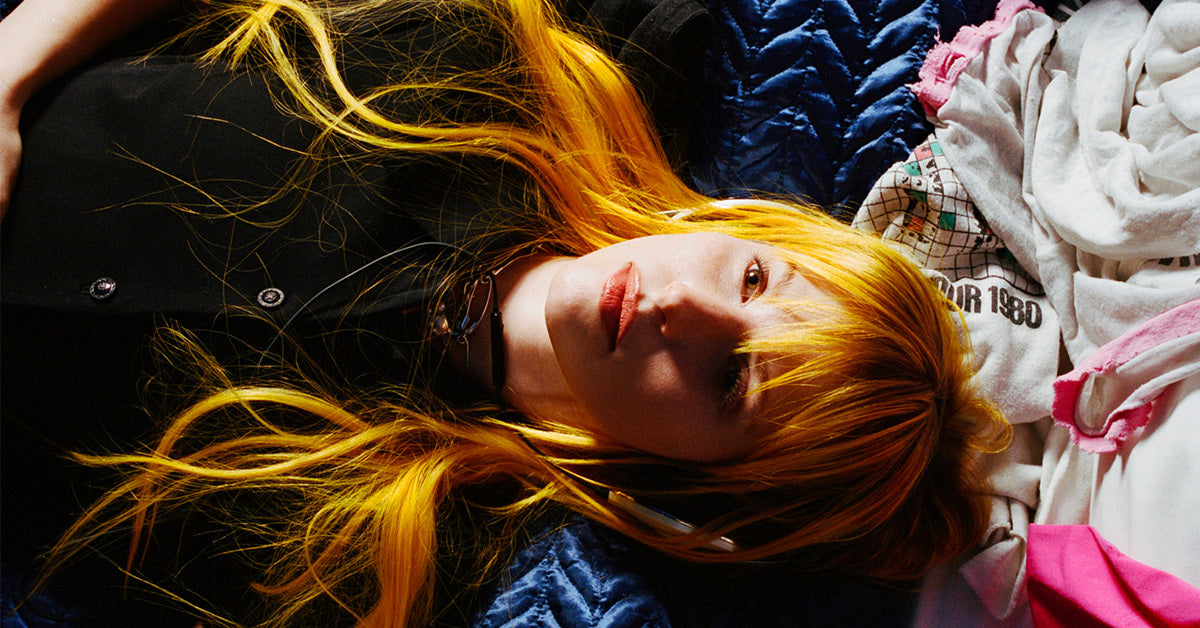
It’s amazing. I feel like it represents the full spectrum of emotion, which goes back to what you mentioned earlier — how sound affects everything, especially the brain and our psychology. You and Dan did such a good job. And I know you are close, so I’m sure that felt safer. Just working on the AP shoot with you and your choice to self-style, with Elise helping you… it just felt like everybody in your huddle supports each other to be themselves. Even the direction your style has gone, generally — you always looked awesome — it really feels like you’re doing you.
Thank you. I’m cozy. And that means a lot, because it’s kind of a mindfuck to grow up the way we did. That was one of my biggest struggles growing up in any form of the public eye. There were times where we were more popular, and there were times where not as many people may have been paying attention, but I always struggled the same with it. I just felt like, “Please don’t define me.” It is really uncomfortable. Yet we live a career and a lifestyle that is defined by “eras,” where you look at an album and you think, “That’s who I was for a couple of years, and these are all the lessons I was learning.” The only one I couldn’t really do that with for a long time was This is Why — until two weeks ago — when I was like, “Oh, that’s what this album is about.”

Really? Will you tell me about that?
Well, leading up to everything that essentially made EDAABP possible, and to be an independent artist, that last six months on Atlantic and that last six months with This is Why, it was hard. It was hard, and it wasn’t just me, but I was having my own experience of what his life has been, in this way, and I knew it was coming to a close, and I was so ready for it, but because of that, I wasn’t really present to where we were in the moment. I think that’s why I couldn’t fully embody, “What am I saying, and what am I really actually talking about in this song?” “Thick Skull” was always my favorite song on the record, because I think it really shows the best of each of us. But I was like, “This is a really sad song. Why is this my favorite one?” It’s an honest struggle of a song, and I’ve just had to learn the same lesson over and over and over again, and in the industry and relationships, friend groups, I think it’s just really hard to learn to advocate for yourself. I think back on that record, and I’m like, “I was learning things that I didn’t like about myself and trying to work through that” — like “Running Out of Time” — but I just had a lot of anger in me that didn’t come out.
Then fast forward to being an independent artist that can do whatever, whenever, and these are the songs that came out. When “Showbiz” came out the other day, it felt like the final purge, and I was like, “Oh, please be ready to move forward.” But then I’ve got to do the thing again where I make sure I’m staying present and I’m not trying to just skip ahead to find out what happens next. I think the curiosity part has to come back into play, with what’s right around me, right now. Björk has this great quote about how falling in love can make the same streets you walk down a million times feel like brand new, and I feel like surely we can find that all the time. I don’t think we necessarily have to have those particular chemicals going on to see romance and magic and all the cheesy words.
Coming back to Nashville forced me into that, too. I was like, “I wanted to be in California. Now I’m back here, and I grew up here, and it doesn’t feel magical, and it feels like everyone’s losing their rights, and I’m here behind enemy lines, essentially.” Then I started to see what I grew up loving about it here, and it helps to go to shows and to see the local scene at play. It helps to get involved and understand what’s going on locally, politically. That’s the kind of stuff that’s grounding me enough to not try to skip ahead too far.

Wow. There’s a lot there. I love that. Well, I have to say, I did note the breadcrumbs in This is Why that tie to the new album. “C’est Comme Ça” is a big one, “Thick Skull,” like you mentioned…
Wow, OK. So I’m not crazy.
Not at all. Lyrically, you can see the motifs that go through all of your work, like water, but the more recent projects dig more into feelings, and anger, like you said. I do remember, when I talked to you [and the guys] around This is Why, and you said, “This is the first time we’re getting so [lyrically] political and touching on these other new themes.” So it totally makes sense to me. You were getting there. Also, I’m interested in your coming back to Nashville, and that shift of perspective — as someone who has also moved to LA and home a few times.
It is tough. I kept thinking the last time I was in [LA], “This is me trying to go back to someone that I know is not good for me.” That’s what LA feels like. I mean, I’m going to work there if I’m doing music, probably a lot, but I think I wanted to stake a claim there and be like, “This is home. This is me, independent from everything I grew up around.” I think it held a lot of amazing memories, but I know in my gut it’s not home, and Nashville is. I’m open to looking elsewhere as the world fucking falls apart. But I really think that places like Nashville and the surrounding areas also need locals to stay and to try to pitch in more or just be part of it.

To your point about being behind enemy lines, I can imagine that’s also a place where you might feel your voice is needed, or appreciated, more so than in the LA bubble?
Right. I thought about that a lot actually, during touring for This is Why. I would say things onstage and be like, “Well, most of the people here probably agree with me.” I mean, if it’s going to go out in front of people that disagree, it’s probably going to be a video from someone’s phone. But at the same time, I’m tired of talking about stuff, and I’ve felt that ever since I moved back here and knew this is where I’m going to be. I just want my hands a little dirtier, and I want to be more face to face. I think the internet, the fatigue of social media, is just… I’m really gearing up to quit it. Team is going to kill me, but I don’t think it’s doing what we need it to do. In terms of the activism piece, I’m just more interested in what actually I can get done than what I can say from a stage to, again, probably mostly people that agree with me — but solidarity is also important.
So what kind of things have you been doing or are looking to participate in?
I’m really interested in food justice, and this comes after years of working with support and feed and feeling like they really understand many sides to that struggle, and it just feels like I’m going to have to study it, but Representative Justin Jones, who’s from here, is also doing work in agriculture. He told me something about doing work around agriculture here, and all I know is that it just pinged something in me. It’s not clear yet, and I honestly haven’t been home enough to dig in, but I’m excited to figure that out. I’m also just really passionate in trying to point people to local shows or venues that they can support in their area, and that’s kind of why I want to do smaller venues as well. I want to encourage that you don’t have to play the biggest places in the world and what Jack White and André 3000 said [at] the Rock and Roll Hall of Fame [induction]: Great things start in little rooms. I think being able to point young people to those spaces or point older people who have resources that might want to be a part of that and plug back in. Maybe they loved music when they were younger, and they feel disconnected. This is a chance for people to learn what community is like, boots on the ground through music. So those two issues, I think, are the ones that stay with me. Obviously, racism is a really big one for me, but that’s so intersectional with every issue, mental health, all of it. It’s all kinds of seeds right now that have been planted, and I don’t really care about becoming a bigger and bigger artist. I care about trying to figure out how to live a real life as an artist, and the rest is like, “What can I do in person to make my community cooler?”

Even what you were talking about with this house is part of that. It was mentioned earlier, but I wanted to talk about the tour. Do you feel more excited about this than usual?
Yeah, I do. I mean, I can’t tell if it’s because I’m also really nervous, and it’s just an anxious buzz that’s going on in me all the time right now. But I am excited to play instruments again. I’m excited to feel like I am in a constant collaboration — and maybe the [songs] evolve over the tour. We just don’t know yet. This is where I get to go be an artist. The difference for me that I’m nervous but I’m excited about is I don’t really want to show up as the person that fronts Paramore. I want to show up a little bit more myself, however that looks. And I think it’s the question mark that makes me nervous — what does that actually feel like?
Also, just gaining a little more confidence in playing every day. Just playing a guitar, standing up, singing behind a microphone stand is completely different than how I’ve grown up performing. The last time I played guitar with Paramore, we all just sat on stools together and played. Most of my career has been about projecting all this energy out, and I want to bring the energy back this way, so hopefully the people that come to the show are down to let me watch them dance and hang. I feel like it’ll still be a party, but the thing that I am challenging myself to [do] is to not perform… [Laughs.] If this can’t be the album of my life that lets me learn what it feels like to break the people pleasing, I don’t know what will do it for me…
Part of me would be very happy just singing at a bar and going home every night. And that’s an idealistic thing. Also the amount of privilege it takes for me to even be able to say that is crazy, but I like a romantic life, and I do worry sometimes that with Paramore, I was like, “Well, what else can we fucking do?” Literally, the band keeps growing, and I don’t know what to do about that. Does it feel like pressure? Yes and no. It’s exciting because you want to leave behind a legacy of all are welcome and it’s a good time, but I don’t know. With my music, there’s a lot of truth in me saying, “I would like this to be the last Hayley Williams album.” I’m not really interested in continuing to see my name in lights. I’m more interested in the stuff that happens behind the scenes, even with other artists, being more creative in that way, and getting to help in that way. There’s so much more that can be done and so much more fulfillment that happens behind the spotlight of it all.

That’s just making me think about your leaving LA, coming back to Nashville, trying to, like you said, get your hands dirty and engage in community. That’s not necessarily making your world smaller, but maybe it’s more like being in the world and not your world.
Totally. That’s a great way to put it. I really do feel like I’ve been the most outside since I was in my early 20s, and I do think it’s been going and singing onstage with friends. That is not really a work trip for me. It’s like I get to let out this teenage version of me that just loved going to shows. I got on Substack earlier this year. I posted these photos I randomly found of being 14 or 15 at church camp, and I was like, “This year is for her — because this was probably the last normal year of this person’s life.” The shows and all that extra being outside stuff really has fueled the work and made the work feel… it takes the sting out of the bad days of a job that can be hard.
Something about the term inner child makes me nauseous, but I do feel like going to shows is when I feel the closest to my younger self. It seems like there are a lot of actualizing moments happening [for you]. In my experience, going through a lot of pain is usually the way we get there.
Grief teaches you like nothing else.

Pain is the greatest motivator.
It is. And also anger. Unfortunately for me, I’m someone that when I get really hurt or when anything gets to that abandonment thing in your body, anger, from me, is usually what would come first, because it’s trying to protect me, and I don’t know how to. That’s why I sing so much about wanting to keep learning what softness means. I don’t think it’s simple, and also, so many people talk like that on podcasts that it starts to mean nothing, but for me, it’s been such a long lesson that I’m like, “When do I get to the end of this?” Because anger has also caused some of the best moments in my life, where I was motivated enough to do something that I thought could help make a difference, whether that be activism or even just writing music for myself, for grief, pain, anger, all those things. I have to find my way to real vulnerability underneath all that stuff first. I’d love to get there faster… Actually, I’m going to give myself that. I think that this album would sound a lot different if I hadn’t learned to look beneath anger.

I feel like that’s pretty evident as a listener, or maybe it’s because I know you well.
Thank you. That’s affirming. It’s been such a big part of my own story as a writer because people know me as… There’s an image of me with a microphone, and I got a mad face on. If you looked me up in the dictionary, that’s what it would be. That also comes with being a
woman. You can’t show any emotion without it being hysterical — but you know what? Every time I’ve had a very revealing moment with myself that involved my anger, like Brand New Eyes or my first solo album, it actually changed the chemistry of what was going on in the moment. Without that anger, I don’t know what Paramore would’ve done during Brand New Eyes if I hadn’t been able to write that and get through it, and us actually have conversations about it. So it’s a push and pull of learning the value of [anger] and learning to not be ashamed of it — and then also learning to move through it. Maybe quicker, hopefully.
And learning to use it, it sounds like.
It really is kind of like when you have to learn to wield a power. If you’re born with a superpower, let’s say, and you don’t just know how to use it right out of the gate, it takes time, and — more to the point of us talking about curiosity and staying open — it’s about letting life teach you as you go along. I still don’t think I fully understand the depth or the root of why the anger and the passion, and the passion about injustice and all that stuff, is so big, but I’m not shutting it down either.

I have to say something. We’ve talked [before] about your feeling uncomfortable talking about yourself, being used to talking about “the band” and speaking from the perspective of Paramore as a unit. I think you’ve done a really good job [today].
Oh, my God. It’s really hard. I mean, how many times have I said in an interview, “We just took some time off to get our identities untangled from the band.” That shit has possessed me. I need an exorcism, yesterday.
I need to really be able to look in a mirror when I’m out at a restaurant and washing my hands without thinking, “Is this going to be a photo on the internet later?” And even if it’s not about the internet… Paramore has been my only story since I was 13. That is insane to think about, and it’s a huge gift. I mean, damn, I feel like I’m so lucky I got to be in one of my favorite bands for my whole life.
I’m never going to not be the singer of Paramore — but I really need to understand what other stories I’m about, and what life looks like when I’m not hinging everything to that vehicle. I think about the “Thick Skull” video all the time lately. I just can’t stop thinking it, and I think it was a perfect picture of what needed to happen, for me to fall apart enough to open up again. I mean, I’m still not untangled.
Photography: Zachary Gray
Interview/Editor-in-Chief: Anna Zanes
HMU: Brian O’Connor
Production: Josh Beech
Editorial Director: Josh Madden
Content Editor: Neville Hardman
Lead Designer: Rob Ortenzi