
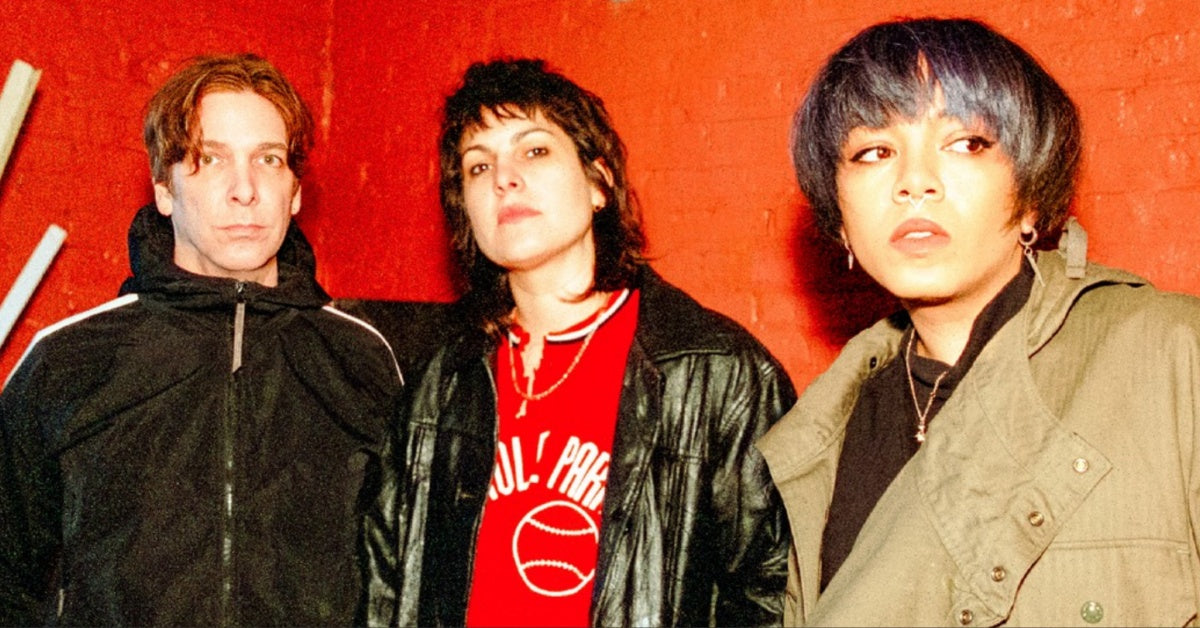
In September of 2021, Ganser played a midday slot at Chicago’s Riot Fest that doubled as a hometown show. Even in burning sunlight, they were disarming. The vocals were snarling and wry, punctuated by prescient quips written pre-pandemic but fit for post-pandemic times. The low end carried a steady, dark swirl of rhythm. There was enough tension in the air to stay alert, eliminating temptation to peek at the schedule to map out the next destination, but the grooves weren’t angular enough to make them undanceable. By the end of their set, they worked a miracle, turning the anxiety of the last 15 months into a release.
They’re not the same band that sailed through that performance, growing and changing like any other living organism. Last year, they added Sophie Sputnik to their permanent lineup, whose blazing vocals — informed by a childhood of singing 12-bar blues and making up lyrics on the spot — meld with the band’s apocalyptic bent so brilliantly, it feels fated. They’ve formed a partnership with Liars’ Angus Andrew, who helmed 2022’s Nothing You Do Matters EP and this year’s Animal Hospital, released through felte. Their longtime guitarist wanted a break from playing music, so they’ve been entertaining a rotating guitar spot while touring, including recent shows with Maruja and Viagra Boys.
Read more: Spiritual Cramp: Growing up punk
What has remained, though, is the way they filter anxiety, turning out a collection of rattling post-punk that pairs panic with an intrinsic cool. There’s a lingering sense of unease that permeates Animal Hospital, not unlike the albums — Tago Mago, Geogaddi, Kid A — that bassist/co-vocalist Alicia Gaines often posts online in diverse 5x5s. With that in mind, Ganser have also cracked open their musical palette, tapping into unexpected moods and sounds, like the indica ambience of “Dig Until I Reach the Moon” or the slicked-out menace of “Discount Diamonds,” that makes the dread easier to work through.
Yet for all its rhythmic disquiet and thick noise, they only sound like themselves, built from their city’s sprawling indie community. “The DIY scene, especially in Chicago, is so diverse and so eclectic,” Gaines says, reflecting on their early days. “We were playing with bands like ONO, who’s legendary here in Chicago, but also throughout the Midwest. The first couple of years were very much spent playing basement shows and figuring out how to do everything. Something that was a huge through line for us was not only are we going to write the music, but also we’re going to produce it, and then also we’re going to be making our own artwork and filming our own videos and directing and editing those. It’s always been something that’s a whole encompassing idea, as opposed to trying to get out of the DIY scene. I really think that was a fruitful place for us to start.”
As one year has blurred into the next, it’s clear that an underground POV continues to guide everything that they do. Gaines directed the video for “Black Sand,” highlighting surveillance overtop dense guitars. The band design and ship out their own merch (a particularly prophetic line from “Projector” appears on one of their tees). A pair of 2022 visuals, “People Watching” and “What Me Worry?,” employed the same LED backdrop display system found on The Mandalorian — which they still managed to film on a budget. The welcoming attitude of those spaces persists, too. Even though hundreds of miles separate us, there’s an unalloyed warmth that radiates through the call as they elaborate on their shift in sound, the allure of repetition, and laughing at their own dread.

Kennedy Cottrell
Well, I feel like we definitely have to talk about the introduction of Sophie to the band. What did those early practices look like when you were figuring out if you had creative chemistry?
ALICIA GAINES: Sophie and I were co-workers originally. We met through traditional labor, and those first practices, it was quite a rush. Right, Soph? We only had a couple, and then there was a show, so it was very, very fast, but she’s a fast learner.
BRIAN CUNDIFF: Trial by fire.
SOPHIE SPUTNIK: I had never really been in someone else’s band before, so I was very nervous. Sometimes it can be like, “I am going to write stuff that feels important to me, and I’m going to perform how it feels comfortable for me.” That was what I had been building upon for so long, so then to [move] into what is best for everybody in the band, it was a big transition, but it was a challenge that I was welcoming. I wanted to learn how to do that, and they were patient with me, and really, we were just ramming it in. The best way for me to practice is usually if I know there’s a show coming up. It just helps — I need that energy. And so we did. Also, I was a huge fan of the band beforehand, so I was just so excited to try out performing these songs that I had been listening to in my car.
GAINES: The timing was really good, too, because we all have a background in DIY, and so we were finding out at the same time where our music overlap was and then experiencing some new things together. Our second show together was opening for Otoboke Beaver here in Chicago, and that was a really cool way to open up the kind of energy that can be around at a show because that band is just so talented and so intense. Then right after that was Bikini Kill. That really informed the company that we were keeping, and then we got to experience new things together, opening for Mclusky and IDLES. I don’t ever really feel bored in this project, constantly having to learn how to do new things at new levels, and it’s always been pretty exciting.
Something I was really excited to talk to you about is how Ganser tap from krautrock and post-punk. What do you think draws you to that repetition, and what makes it so attractive?
GAINES: That’s a really good question. I think a lot of our songs are meditations on a certain kind of a feeling. We don’t have songs that are extremely story-driven or autobiographical. It tends to be mulling over a certain emotion, whether it is that you’re late or whether it is that you hate that you procrastinate. A lot of our songs started out with ruminating over feeling a certain way, whether that’s a good feeling or a bad feeling, making fun of yourself for how that feeling feels, really exercising it. That lends itself to a certain kind of repetition. I mean, the band name is about talking to yourself. When you have that repetitive inner self-talk to have that then be reflective in the music, as a natural progression, I think post-punk is a word that has gotten really diluted over time, especially as of late. I feel like it’s just a lot of dudes shouting, but there’s so much variety in that genre, and there’s so many different colors in palettes, but a lot of it, to your point, does have a fair amount of repetition. For us, it is about that inner monologue that you tell yourself, and with this new record, that inner monologue is now seen outward.

Kennedy Cottrell
What I really like about that kind of music is the perpetual motion to it. I saw Michael Rother earlier this year, which was just magic, and I think one of the most incredible things about being at that show was looking around. It felt like everyone was moving in some way, whether they were nodding their heads or flicking their wrist. Something about that kind of music just makes it so easy to engage and ultimately spreads a little bit of joy.
CUNDIFF: I think some of that for us comes from the way our songs are written. A lot of our songs start with a bassline and drums, as opposed to some sort of guitar thing. We’re starting with this rhythm, and then we’re layering on top of it. It’s almost secondary to the rhythm, and I think that the krautrock connection to post-punk, they’re very rhythm-oriented genres. Psych a little bit, too, and the repetition that comes from the way our songs start, with the rhythm being so important, and trying to have a rhythm that’s a little different. It’s not just a straight four-on-the-floor thing, although we do do that.
GAINES: We’ll laugh about it when stuff comes up, but a lot of it’s so stiff and so angular, and I think coming from that kind of rhythm section and writing from bass upward, we always want to make sure that it feels somewhat danceable. Especially having a longer time with this record writing, we had more opportunity to really dig into what makes certain rhythms that we’re working with in these songs dancey. For a song like “Discount Diamonds,” it’s those extra little percussive syncopated percussion hits on top of everything that really jell everything together.
That was the song I was going to bring up. I love the contradiction of “The kids don’t dance anymore,” but inherently, you have to move to it. I know you said that hook is about “someone up top saying what the kids are doing wrong, always a voice telling you the party’s over,” but is that also an observation you’ve made from being at shows in recent years, where people are a little stiff?
GAINES: Yeah, I think we’re all very keenly aware of how we’re being perceived, and sometimes that can lock you up — and I think what we try to do is unlock that. I know that I’m always flabbergasted when we look out and there’s a pit. [Laughs.] That always gets me. We were opening for IDLES in Denver, and it was one of the largest shows that we’d ever played. We went into “Half Plastic” at the end of the set, and I’m half-watching Sophie and then half-looking out into the crowd, and she’s just whipping them into a circle. I was like, “Oh shit, here we go.”
SPUTNIK: I am so over going to shows and standing at them, and my feet hurt. I really like putting on shows and going to shows where you were saying, Neville, there’s movement, and you can tell people in the audience are having their own experience, and it’s not necessarily about just showcasing the band. It’s the people that are around you, and it’s just so much more of a fun night. IDLES was such a cool experience because still some of the best shows I’ve ever been to, whether we were touring with them or just going to see them, is just the way that they work the crowd. It really feels like everybody’s there, and they are together, all that cheesy stuff.
GAINES: That’s something new, for sure. Playing DIY shows and whatnot, that’s a great way to get your chops up and learn how to play a show. When you’re on the road with a band like IDLES or Mclusky or Ted Leo and observing how they do what they do, everybody is gonna have their own thing, but it becomes enlightening to see how a band interacts with audiences in different cities night after night and how that can evolve or change or what stays the same. It’s been really heartening for us to see these other bands and learn our own path, but also watch theirs.

Kennedy Cottrell
Sometimes I’ll catch myself being a little stiff at a show, and I’ll try to make sure I’m engaging. I was recently at MSPAINT and Lip Critic, and both of those bands, they just make it so easy to move. We’re also in an era where everyone is constantly filming, and they might post you on TikTok.
GAINES: No, that’s so relatable. This was the first time that we were playing shows out, and the next day somebody would put “Untitled Ganser” track on YouTube, and I’m like, “It’s not baked yet. We’re literally trying it out for you guys. Let us cook!”
A lot of these songs seem to reflect anxiety — being suffocated by your environment, corporate greed, your own circumstances. What are you all doing right now to keep yourself grounded?
GAINES: Right now, I have a lot of notes that I’ve made myself over the past five years making the record, and I have to remind myself how I felt at different times. That’s a great way to ground myself, and then I do my typical thing and just escape into other art — a lot of movies, activities where you have to put down your phone, essentially. Front-to-back albums, going to the Music Box Theater here in Chicago, and watching something at a repertory theater. That kind of stuff has been essential.
CUNDIFF: Same. Get distracted by some films. We’ve been so busy with this album cycle that it sort of keeps us from getting distracted, so it’s good. I think next year we’re going to be busy, too, so for me, I just like to have some fruit come from the labor of this.
SPUTNIK: It’s always changing. I’m trying to figure out how to stay grounded in today’s world, but lately the focus has been just trying to get enough sleep, right?
GAINES: Forgot about that part.
SPUTNIK: I got one of these stupid Owala water bottles. Everybody has one, but I get it, and it is helping me drink more water.
GAINES: I like how you’re purely at the bottom of Maslow’s hierarchy of needs. You’re like, “Do I have shelter? Do I have food? Do I have water? Am I sleeping?”
SPUTNIK: Honestly, it’s so easy to forget that stuff.
GAINES: It’s important. That’s where the bottom can fall out, for sure.
SPUTNIK: I really like listening to ambient music. I feel like sometimes, especially when you’re putting out a record, I just get overwhelmed by content, and listening to little beeps and boops helps me. Anxiety definitely shows up in this record, and I think it’s something that shows up because a lot of us feel it in this band in our own ways.
GAINES: Our record does have a fair amount of anxiety on it, but hopefully, I think for folks, they’re gonna find that it’s metabolizing anxiety. It’s a way to laugh at your anxiety. It’s a way to realize that there’s the you, and then there’s also another version of you, Animal Hospital being just a title that we saw here. I don’t know what they call a veterinarian’s clinic in Ohio. That’s what I grew up with, but in Chicago, I’ll see all these signs that say Animal Hospital. It’s an interesting mental image. You’ve got a really wild feeling on one side and then something that’s very controlled, and neither side is correct. I think it’s just worth circling that feeling over and over again because, to me, the title could be literally animals running amok in a hospital. There’s so many different ways in which that title evokes images, but in the end, hopefully this record is taking those anxious feelings and giving people a way to work through it, whether it be putting it to a dance beat or whether it be having lyrics that speak to specifically making fun of oneself when they’re anxious or running away from that anxiety.

Kennedy Cottrell
Especially all the build and release — finding calm in the chaos. Even thinking about “10 Miles Tall,” it just felt like, instrumentally, everything was splintering apart, but then the vocal delivery is very assured and collected.
GAINES: It’s our Cormac McCarthy cowboy song. It’s very riding horses in the desert kind of a feel, and it’s cool to look into the eye of the storm. That’s the feeling that I get when I listen to Sophie’s vocals on that one.
SPUTNIK: Yeah, I think a lot of times, it’s like, “Oh, the song has a driving thing,” and it’s almost like naturally I want to respond to that and perform something chaotic or something big and something that I feel like I’m learning. That song was a way to experiment with those feelings being in the arrangement, but being really steady with my vocals, and it was really fun to work that out in the studio and have that conversation between me, Alicia, Brian, and Angus. I like that feeling a lot.
GAINES: When we’re splitting up vocals, it’s like whoever’s voice is the right tool for the job. Obviously, my voice is lower, Sophie’s is higher, so I always go, “Do you want a fork, or do you want a spoon?” We’re starting to sing more together, which is interesting in figuring out how our vocals combine. That’s a good example actually with “10 Miles Tall” because the vocal melody is me, but the lyrics are both of us, and then Sophie’s singing it.
Even with that last song, “Left to Chance,” in the last 10 seconds, I think there’s a sample. I didn’t pick it up until I listened on headphones.
CUNDIFF: That’s actually a plugin called Reactor, and it was just processing something from the song. It sounds like the end of a record where it’s just rotating and you can hear the static, and I thought that’d be a cool way to actually have the record end with that noise. That’s something that you probably wouldn’t pick up if you weren’t listening close, so it’s a cool little Easter egg.
GAINES: That was fun. Those gang vocals at the end of that one, we were in the studio recording in surround, and that’s everyone, including Angus.
What made you think to do that?
CUNDIFF: We just wanted it to get really big at the end and blown out, and I think the gang vocals might’ve been your idea, Alicia. All of us sing at some point in the verses, and then there’s a part where me and Sophie are actually doubling each other. If you can’t hear me, that’s sort of the point. We wanted to sound blended together.
GAINES: We’re all just dissolving into the collective unconscious at the end of the record, really.