
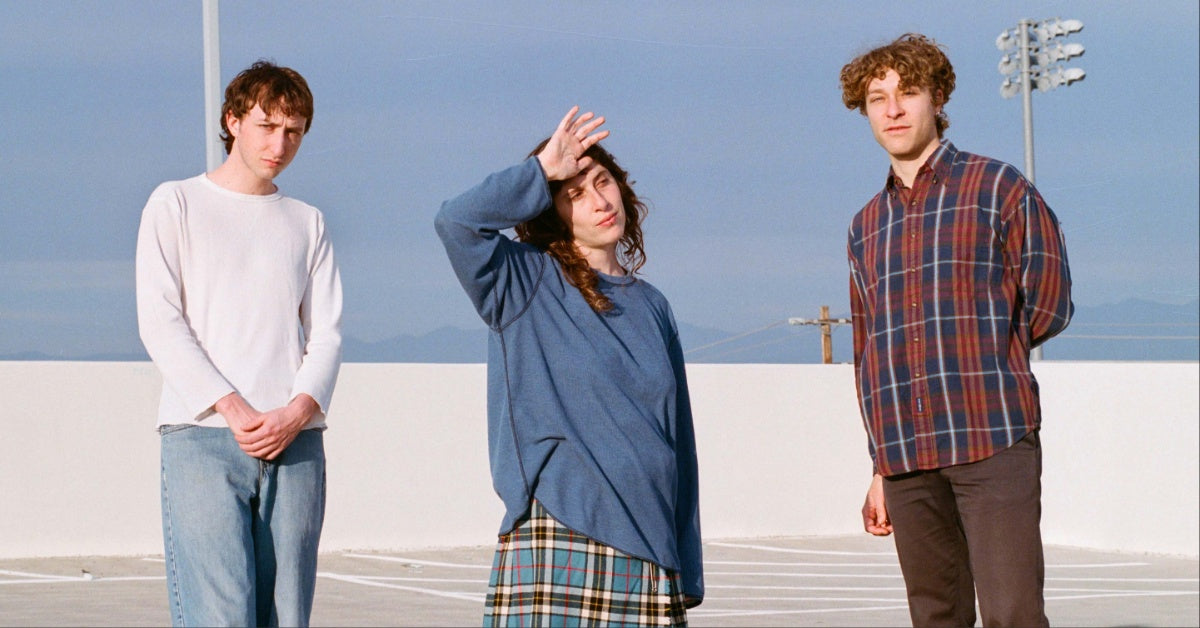
It’s been four years since Cryogeyser’s last release, and six since their debut album. To emerge back on the scene with a revised lineup, and Cryogeyser, the album in hand — it’s a self-assured move on frontperson Shawn Marom’s part. And it’s no act. “I’m not ever read as shy, not even onstage,” Marom tells me, as we pore over the band’s triumphant self-produced album — a thoughtful amalgamation of indie rock, dream pop, grunge, and shoegaze with far more depth, weight, and facets than those three classifiers can evoke. Cryogeyser’s debut LP, Glitch, captured the anxious, shaky tension between foreboding slowcore and lush, romantic dreaminess, broaching the gap between love and loss. Marom’s heart, the album made clear, was a pumping, spurting muscle, worn on their sleeve.
Read more: The Smashing Pumpkins albums ranked: From worst to best
It’s easily assumed that while they aren’t releasing new music, a band might recalibrate. Take a break. Not Cryogeyser — three weeks after their last record was released, Marom had penned the second track on their self-titled, “Stargirl,” a meditation on the idea that, perhaps, the only way out of grief is through. Seeking further catharsis, they’ve spent the following few years tirelessly crafting this new album, alongside the group’s newer members, bassist Samson Klitsner, and drummer/producer Zach CapittiFenton. Themes of temporality, urgency, are approached with new perspective — their shimmering self-titled sound is larger, cinematic. Enveloping Marom’s ever-tender vocals, the sound draws on hyper-specific moments of the Smashing Pumpkins’ Siamese Dream and Death Cab for Cutie’s Transatlanticism, polished and amplified by poppier references like Frou Frou and Ivy. While lyrically, the album is painfully personal to Marom, on this project, they’ve found far more room for collaboration — the grunge-infused “Mountain,” with harrowing harmonies from Wednesday’s Karly Hartzman, is easily one of the album’s crown jewels. Not only is there an air of maturation at play on Cryogeyser’s sophomore album, but there’s also a newfound whisper of hope.
Though the project encapsulates emotions, and life experience spanning years, months, and its diaristic style delves in headfirst — Marom can sum it up. It’s about “heat,” they say, explaining, “Capturing ice and holding it forever — even as it melts — knowing you’re burning but staying in orbit.”

Marlon Lenoble
Where do you draw from? What does collaboration look like with Cryogeyser?
SHAWN MAROM: This album was my first experience of really trusting anyone enough to really collaborate. It’s not like I wasn’t open to it, but to be honest, I’ve always felt a bit inadequate when it came time to talk any kind of technical music language. I’ve gotten away for most of my life with making up chords, taking chances, guessing around, and shifting my vocal melody to fit any note I would land on. A very new-school kind of process. I didn’t really have access to the mastery I thought I needed. But then Zach spoke my language and fully just became a goated engineer overnight. Working closely with Zach and Samson in the room, playing the songs a million times, and sometimes even on tour before recording them… that’s where our collaboration started, and where I started to see the value and excitement in hearing other people change and elevate my message. Once it came down to demoing, I really loved watching Zach become impassioned with production and engineering. It took over him. I’ve never seen someone learn things that quickly on TikTok and YouTube. This, in turn, taught all of us a lot about what collaboration could look like, without label support. Especially when one of us is a freak gamer who is really good at following instructions.
What’s something people don’t know about you?
ZACH CAPITTIFENTON: I am really good at the game Rust…
MAROM: I did figure skating as a kid and had a routine to “Get the Party Started” by Pink.
SAMSON KLITSNER: I work as a freelance web developer and creative coder, and last year, I taught a summer web course at UCLA. On the last day of class, I wrapped up the last day of class by showing my students the newly released Sorry music video. Later, when reviewing the teacher evaluation forms, I came across one that read: “Some of the videos we watched felt a little off-topic from what we were doing, but overall a good class experience.”
As an album about growth, grief, transformation, it definitely feels like there’s a conceptual maturation happening in your work. If we look back at Cryogeyser’s previous releases, how does this album fit in?
MAROM: It wasn’t my intention to have any sort of concept with this album. Looking back, those things came through to me once we started actually recording the record. Everything leading up to that took so much time, some of the songs having been written years before, that maturity was an inherent result of the process of this album. I keep saying that the album is about metamorphosis and change — and how often you can’t feel it happening while you’re in it. The artwork and story and self-titled-ness of the album transformed out of this appreciation that grew for me in finally getting these songs structured and recorded, and knowing it couldn’t have happened without Zach and Samson.
I remember when we were on tour with Wednesday, we had stopped off in a year-round Xmas village in Michigan, and Zach had just finished mixing the demo of “Livia” — all of our favorite song, I think. He was playing it over his computer speakers. Unbeknownst to him, I sat silently crying next to Samson; it sounded like what it felt like to feel that so long ago. It felt like grief encapsulated, old but rich with new perspective, felt only for the lifespan of the song. Looking at my grief objectively, and the maturity and gratitude that came with that, became the philosophy of this album. The alchemy of it.
This album certainly has depth and weight, and the feeling of life experience, lived. How diaristic is Cryogeyser?
MAROM: It is my diary laid out flat. But a poetry teacher in college once told me that “the more specific, the more relatable.” So yeah, I am bearing it all, but honestly, there is a lot of protection in that. The people I love and I always have had our own secret languages, and I think that’s how I allow myself to put so much of that in my music. That’s what I like about how Liz Fraser writes. Everyone thinks it’s just nonsense and vibe… but I like to think of it as incredibly moving statements of human existence, mixed with very deliberate inside jokes, happenings, life experience that only she knows the true core of.
What’s the writing process?
MAROM: I write almost all my songs in the Notes app on my phone, in bed, on an acoustic guitar that my best friend Doron let me “borrow” in college. I don’t think I’ve ever changed the strings, or wrote down any chords. It’s perfect. It’s harder to play things on it, so I always feel really accomplished. I think it informs a lot of how I write vocal melodies, the resonance of an acoustic in absence of bass and drums at that moment. Writing alone is incredibly important to my process, but opening myself up to collaboration at the right times is vital. I also write in a really fragmented way, sometimes finishing a song in four minutes flat, other times finishing it years later.
Who are your favorite writers?
MAROM: Kathy Acker, Joan Didion, Clarice Lispector, Miss Karly Hartzman, the homies in Draag. I love every MILLY song (I’m a real-ass stan), every Cocteau Twins lyric, Toni Morrison. Beloved might be my favorite book. I love Ursula Lequin and love reading music biographies — just finished Miki Berenyi’s book (from Lush).
What were you trying to achieve technically and sonically on this album?
MAROM: I wanted to make an album that somehow encapsulated the long period of time between my last record and this one, but in the elevated way I had always imagined the songs sounding in my head. I realized, mostly through talking with Sonny DiPerri and Zach, that what I was looking for was less reverb, more padding, and some structural changes. These might be the only Cryo songs with bridges or instrumental parts that were intentional. [Laughs.] Sonically, I really wanted a fuller, bigger sound that still showcased my vocals, but leaned away from the expressive releases I’ve had in the past.
I noticed you credited Transatlanticism as a reference for the padding techniques on the new album. What is it about that sound, and also that album, that moves you?
CAPITTIFENTON: I just think that the record as a whole blends perfect/emotional songwriting with instrumentation that suits the songs so well. We can tell the amount of thought that went behind each sound when listening attentively, but without that level of focus, it just flows so seamlessly and works so well. That’s what we were really trying to achieve with this record. All the little nuances that keep us coming back for another listen. It allows for a unique experience each time.

Marlon Lenoble
Favorite album of all time?
CAPITTIFENTON: Siamese Dream – The Smashing Pumpkins
MAROM: This question is unfair. I am picking a few. Apartment Life – Ivy, Four-Calendar Cafe – Cocteau Twins, and A Triumph for Man – Mew.
KLITSNER: Leaves Turn Inside You – Unwound. Shawn and I saw Unwound play a couple of years ago, and it was one of the greatest shows I’ve ever seen.
What do you hope people feel listening to this?
MAROM: I hope they hear my willingness to surrender to the process. A move away from longing and towards acceptance. I hope people feel the nuance of the growth in my lyricism and self-messaging. But honestly, I hope they feel proud. I feel really proud. It’s been a while since I released a record, and I’ve never worked this hard, or put this much of myself into something before. I think it’s a record that transcends a clear genre. I’ve never worked this closely with someone I loved on something either. I got to defeat all my past selves’ expectations of what love could be or should be or was, of what creation could feel like. I was so in love recording this record. I am forever indebted to that experience. It was a psychedelic experience. Every part of it. Even the hard parts.
I hope people feel that classic Cryogeyser desire that burns icy through each track, but I also hope that listeners new and old really find something of themselves in the music, something that reflects back to them, something like love. Honestly, I wanted an album of anthems. I wanted to feel how I feel when I listen to a perfect album top to bottom; less concerned with the story of who what where and when, and more like what Zach said. I am interested in making music that makes me come back around to listen again. That’s how my favorite albums pull me in. I once described small-sounding songs and big-sounding songs to Sonny as “full car” or “dashboard.” Thankfully, he understood what the hell I meant. Thanks to Samson, Zach, Sonny, and Warren for trusting my crazy ass. We definitely created a full car album. Immersive. Put it on and let me know if you agree.