
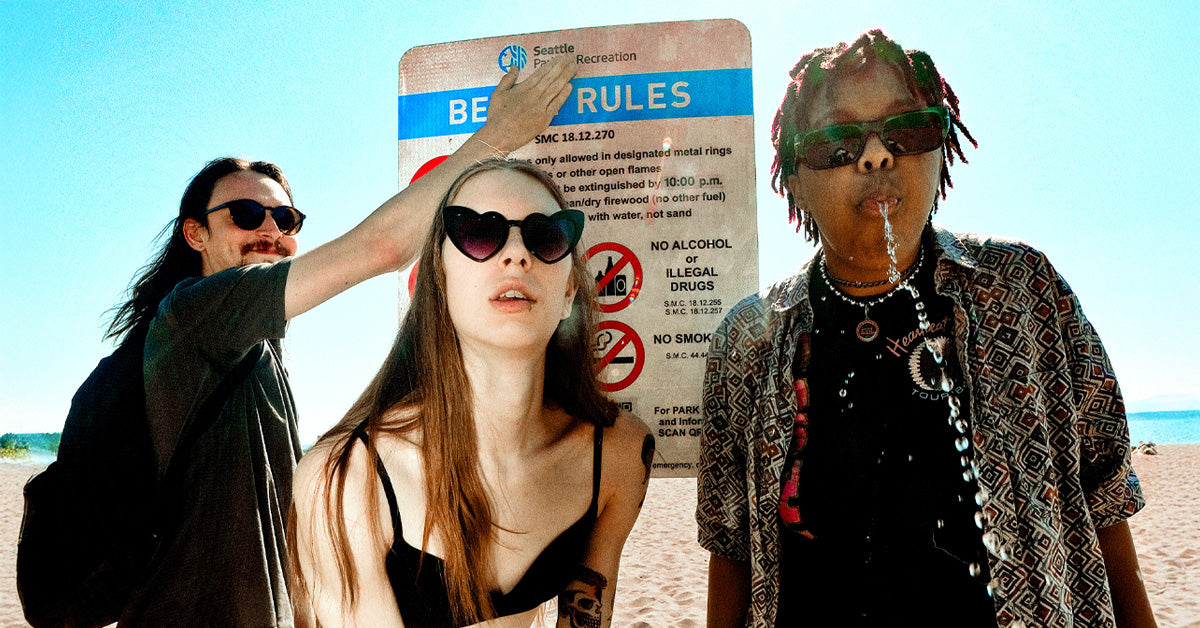
Black Ends appear in our Winter 2024 Issue with cover stars L.S. Dunes, Wisp, Fall Out Boy x WWWYF, and Chase Atlantic. Head to the AP Shop to grab a copy.
It doesn’t rain as much as you think, but dozens of other stereotypes about Seattle ring true. People really do drive Subarus so they can handle the snow. Vitamin D deficiencies exist. “A lot of people are really into the outdoors, and they look like they’re going hiking every day,” bassist Ben Swanson says, who was born and brought up in the city.
Read more: Nirvana’s 1992 cover captures a band breaking into the mainstream
But nothing can prepare you for the Seattle Freeze. On a Wednesday afternoon in October, the members of Black Ends reflect on the aloof, sometimes unwelcoming nature of their city, where most people are locked into their friend groups, making them hard to infiltrate. Vocalist/guitarist Nicolle Swims, who grew up in Federal Way, Washington, and moved to Seattle after laying down roots in Alabama for several years, largely credits the DIY scene for their way in, but the crowds that flock to their gigs are still unpredictable. “You don’t really know what people are feeling. They’re just standing there with a drink. Then after, they’re like, ‘That was the best thing I’ve ever seen,’” Swims laughs, recalling a show they played recently. “Like, I saw you out there! You looked bored.”
“Sometimes if the crowd is not as into it, we’re just like, ‘We don’t care. We’re going to go even harder and make it good,’” Swanson adds. Other times, mosh pits make the energy of the room swell into a feverish blur. “Especially all-ages shows, they really go off,” Swims says.
“I’m a very competitive motherfucker, and it definitely leaks into the music and live shows, where there’s a part of me that wants to be the best drummer in the best band on every bill that we play on,” Billie Jessica Paine says. “Trying to really show out motivates me in a weird way.”
Dubbing themselves “gunk pop” — a term they coined because there’s “an edge to it, some anger, and some not giving a fuck at all” — Black Ends have been ripping up Seattle’s underground since 2018. The music is innately tethered to a sense of place, melding ’90s alt-rock with scuffed melodies in a way that makes you feel time. Steered by Swims’ molten drawl, their style mirrors all of the singers — Jeff Buckley, Kurt Cobain, Nina Simone, and, for a time, Julian Casablancas — that they studied in their bedroom, striving to replicate their rhythm and conviction. “I’d sing their music for hours on end just trying to hit those highs and lows,” they remember. The other end of the gunkiness is their guitar tone, which almost sounds out of tune despite being classically trained. As the band move through queer love, mental health, race, and trauma, the music strikes a balance between gritty and bright, off-kilter but well-intentioned — as if they’re just shy of tipping over.

Anya Kochis
That intention permeates everything they do, which gushes to the fore on their debut album, Psychotic Spew, released this past October via local label Youth Riot Records. Made in Jack Endino’s Soundhouse Studio in Seattle throughout February 2024, the LP was a long time coming. Murky and brooding, the band’s livewire urgency ripples across every track. “My Own Dead,” a song about faking your death so you can become someone new, captures their bluesy bent, feeling tied to Swims’ days in the Deep South. It ends with a sample from Spanish guitarist Andrés Segovia — a player who Swims admires — adding freshness to a track they’ve been playing live for over a year.
Most often, though, they’re scuzzy and blown out. About halfway through “Red Worry,” Paine steps away from the drum kit to rip a guitar solo — a cut that ended up becoming their most collaborative, as they all shared a writing credit. By its end, all three members, plus engineer Evan Applebaum and photographer Luciano Ratto, contribute screams. Elsewhere, the band experimented with a wider range of instruments — including French horns, Baroque guitars, and cellos (the latter played by Lori Goldston, who toured with Nirvana in the early ’90s). It all builds upon their breakout 2020 Stay Evil EP — dedicated to the memory of George Floyd — in a way that reveals greater depth and maturity. “I just don’t want that to be the only thing people remember. We have way better songs than that,” Swims says of the EP.
Always moving, Black Ends are already looking toward their next project. At the end of October, the trio headed to a farm in Quilcene, Washington to work on new music for a few weeks. “It was just music and coffee and cigarettes all day, and we could play as loud and as long as we wanted to,” Swims details over email upon returning home. The band banged out four songs that they might throw into an EP before starting on their next record. “Just a really fun experience I hope all musicians get to experience in their lives. No one needs to strain themselves with a dead-end job.” For the trio, music remains the only choice — a salve from listless 9-to-5s that threaten their creativity.
“The thing that I’ve always heard older musicians tell me is, ‘If you want to make it in music, you can’t have any other option in your life. It’s got to be music or nothing else.’ I feel like I’d probably be dead in a ditch somewhere [if it weren’t for bands],” Paine explains. Swims agrees. “I don’t see myself doing anything else,” they say. “Music is… That’s it for me, really. I need to do it.”