
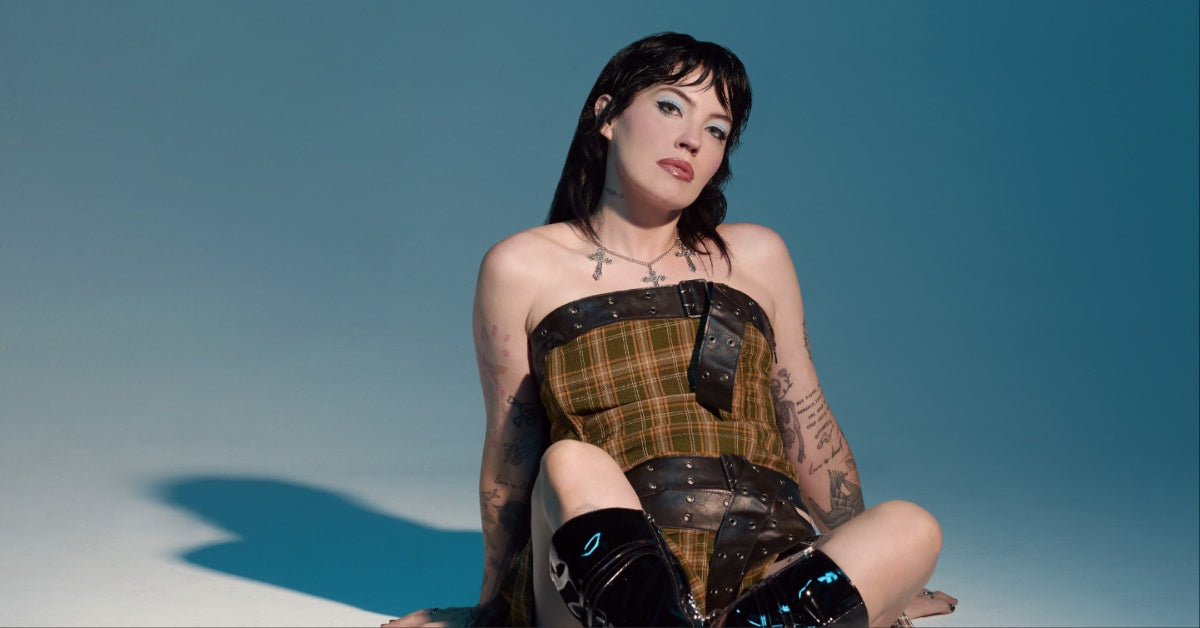
Today, unapologetic alt-pop darling Bishop Briggs releases her first full-length in five years. Ceremoniously unpacking what’s happened since, Tell My Therapist I’m Fine is both a triumph and a tapestry — laying bare everything from the birth of her son to the tragic death of her sister and manager. Like the album title alludes, it’s been a time of pain, growth, and overwhelming exhaustion. Musically, it matches that experience. Briggs worked with Travis Barker on the track “Isolated Love” — a rousing combustion of pop punk, a sound Briggs’ late sister first introduced her to. Briggs’ raw vocal performance on the track is one of her best, and most impactful to date. The entire tracklist, like that song, trembles with a fusion of tangible catharsis and yearning memorialism. It sways between pure, empowered pop and darker, emotive alternative soundscapes, sprinkled in her R&B background. The result truly reflects the project’s purpose — telling Briggs’ own story, how the last few years’ trauma has changed her, and the path she’s taking to accept that fact.
It’s a bright and powerful dichotomy, the kind that is far more likely to hit home — at least for this writer. Pop music has long since been created, literally, for the general populace. Tracks are stripped of any personal POV, custom-made for mass appeal. But Briggs not only toes this line; she is often drawn to test the waters and cross it. A breakup song is anything but just that. “Mona Lisa on a Mattress” paints a far more vivid picture of lessons on love and heartbreak, learned the hard way. “Hurt Me Now” carries a message of empowerment and strength through the vehicle of a deeply diaristic moment in time. “A stage of grief with defiance and resilience and fearlessness, where the No. 1 thing to hurt me had happened…So, what could happen now?” she shares.
Read more: 9 bands commonly mistaken as emo who really aren’t
In summation, with every sentiment, Briggs has a shovel, ready to dig deeper. The foundation of Tell My Therapist I’m Fine stands upon that motivation, sonically, lyrically, vocally. A week before the album was released, I sat down with Briggs in a loud Midtown hotel lobby to talk about My Chemical Romance, therapy, and how the artist was able to crack herself so wide open.
In this track-by-track, it’s as important for me to understand the story behind the song, and as it is to hear your process. Shall we dive in?
BISHOP BRIGGS: So, first, “My Serotonin” was written the last time I was in New York, and I had a whole 24 hours without the baby. In a very dramatic way, I found myself singing this verse while I was walking down the street, just feeling in an utter state of longing. After my sister passed away, I never knew if I would be able to love again, and then to be away for such a short amount of time and realize I fully loved again, it was such a beautiful feeling. It was also this understanding that my genetic makeup that has officially completely altered and changed, and I’m different from who I was before, and I think I prefer that. But there’s also this part of “My Serotonin” that’s realizing that the relationships around you are changing, too. They’re either growing with you, or they’re not. If you listen to it, you’ll notice little lines that you can tell are about a little baby. It’s a love song, [but] in a different way.
Interesting. It seems deep and a lot of work and thought goes into a song like that, but then I’m sure there’s also stuff that comes after you’ve created the song that you realize about it too, right?
BRIGGS: Yes. Well, I brought it into the studio, and I had a session with Skyler Stonestreet, who happens to be a mom. When I was describing this feeling, she understood leaving that old self behind. I think it depends on who your old self was. I think a lot of moms have a difficult time grieving who they used to be, but in a very dark way, the person I was after I lost my sister and before I got pregnant, I don’t miss her at all. The existence of living the same life just without my sister is so painful, so the song took a whole new meaning when I was sitting with another mom, and then all of a sudden, we were sharing our experiences, and it’s where the album title came from. There’s the lyric, “Tell my therapist, I’m fine/I’m done lying every time, not fucking fine,” and that was a bad habit I got into of going to therapy and not divulging everything, which does nothing. It only wastes your money, of course, but it’s sometimes hard to accept the truth or even see it or have the energy to talk about it.
So in the context of all this change and you feeling like you’re a different person, what has stayed the same in the core?
BRIGGS: Lyrically, I grew up listening to a lot of Motown music, and then as I got older, I got into My Chemical Romance, Janice Joplin, and Good Charlotte.
I love that.
BRIGGS: Yes. It is the path. That’s something that stayed consistent, seeking influence from those, and hopefully maintaining the soul that I was raised with — Etta James, Aretha Franklin — and then finding that truthfulness in the lyrics, and that darkness has always remained there. Whether I like it or not, it has always been an outlet for me.
It’s a catharsis thing. I have a friend who’s a musician, and he’s struggling right now. It’s this idea that you have this unique blessing and curse where the thing that is providing your livelihood and your stability on a very literal level is also the thing that you’re passionate about and that you use as a therapeutic tool. Having that all in one bucket is dangerous.
BRIGGS: That’s part of why a lot of artists feel disappointed because they put everything into the bucket, and they won’t necessarily get anything back. And thus the trappings of modern life. I know we haven’t gotten to it yet, but one of the songs on the album is called “Good for Me,” and the origin of it began when I was in the hospital with my sister, and it was when there was lockdown. So the whole world had shut down, and it was this bizarre feeling because she managed me, and we were partners in this, and every show has been canceled. There’s no session to go to. It all just went away. We’d been chasing this dream, and what really matters? Who are you wanting to call during that time? Who are you doing these weird Zoom dates with? It was this concept of, “Was any of this good for me?” And the truth is, yes, so much of it. It brings me so much joy, and it is my dream. But when you’re sitting with your sister and best friend in the hospital, none of it matters except that relationship with the person in front of you.
The DNA of the dream changes the more experiences you have with trauma. I have my dream job, too, but it doesn’t feel like I thought it would, and it doesn’t feel like it would have 10 years ago. I’ve also realized as I get older and go through more stuff, I need to have other dreams, too. You were saying you need to have love and to have a connection with people.
BRIGGS: Which is a new concept, by the way. [Laughs.] That’s something that’s being introduced now that was never introduced before.
Well, I think you have to go through stuff.
BRIGGS: We watched this amazing Oprah interview. She was saying that she has her dream job, but there are still things that she’s not the biggest fan of. That doesn’t mean you walk away from it. Maybe it does mean you walk away from it, depending on the gravity of it. But that was a very liberating statement to hear. It’s still a job at the end of the day.
It’s separating identity from that, which I didn’t when I was in my 20s. I couldn’t do that. My identity was wrapped up in everything I did.
BRIGGS: Which is part of what gets you that delirium — that beautiful delirium.
Yeah, it motivates you.
BRIGGS: If you understood the reality of the situation, I don’t think anyone would leave their house, but I think everyone has a different background. And every artist has a different background. I do walk with a certain gratitude for this job for a lot of reasons but on a very surface level. I’ve worked terrible jobs before. Name it, I’ve done it.
I think you have to have them to understand gratitude. I know you worked with Travis Barker on this. He was a trash man in the beginning when he was playing music. He always talks about how much he loved it. All right, let’s go to “Hurt Me Now.”
BRIGGS: I found this bizarre stage of grief was this defiance and resilience and fearlessness where the No. 1 thing to hurt me had happened, and so it was this idea of shouting to the sky, “Try to hurt me now… What could happen now?” I will say, now that I have a baby, I’m like, “Don’t hurt me. I’m good.” As if we have control over anything. But that was where the origin came from.
When did you start writing again, in the context of all of this happening?
BRIGGS: The first song that was written was right before lockdown, so right before my sister’s diagnosis, which was “Isolated Love” featuring Travis Barker. It’s been years in the making.
That’s also fascinating. A lot has happened in that process.
BRIGGS: I’m grateful that I got to show Kate that song, and she was obsessed with it and was freaking out. Even in her sickness, she mustered up the energy to show me a genuine reaction to it. I know we’re not on that track, but when I left that session, I was like, “Wow, I’ve never sung like that at all.” So there was a rawness to it that I hadn’t touched yet in my music. Part of that was the vocal delivery, interestingly. Then I showed Kate the song, and when she passed away, I found myself subconsciously chasing that feeling because she was the one that introduced me to all of those bands. She went to Warped Tour every year, Summer Sonic. Even working with Benji and Joel [Madden], it was our dream when they asked to meet. We freaked out. Still to this day, they’re the kindest people I’ve ever known.
Next up, “I’m Not A Machine.”
BRIGGS: I wrote this after walking out of the Barbie movie. I wanted to write a song if there was ever a Barbie 2, not even necessarily from a work angle. Part of that was what I’ve experienced as a woman in music and as a woman living in life. I feel like there’s still so much social conditioning that I am tearing at myself to undo, and so that became the song, the unraveling of self.
OK, “Good For Me.”
BRIGGS: The origin of it was the world had shut down and realizing the only thing that matters is this person in front of me. That was a big reason why we connected with the Madden brothers because their relationship was so similar to Kate and I. We saw a lot of ourselves and them.
What about “Mona Lisa On A Mattress”?
BRIGGS: Well, a big part of this album was the lessons that my sister taught me along the way and the journey of girlhood and being a human. Part of that, and I didn’t want to admit it, but it’s that lethal situationship. “Mona Lisa On A Mattress” was acknowledging that that happened and that desperation. I remember coming home from the studio playing that for my husband, and he was very disappointed to learn that it was about the situationship, but I wanted to describe that moment in time because I learned a lot from it. It was someone who liked the glittery parts of me. He wasn’t in the industry and appeared to be kind to me during the glittery moments, and then the moments when it wasn’t a show day, he was very different. That taught me so much about self-worth and not chasing that. Just because someone’s different doesn’t mean that it’s the right person.
Do you think that great art could exist without pain?
BRIGGS: I definitely do not think that you have to be a narcissist, alcoholic, or drug addict to write or create incredible art. There’s so much in our history that has led us to believe that that is the fact. But I do think that this generation is acknowledging mental health in a different way than ever before. Even just using music as a therapy tool to work through anything big or small has made a huge difference in this idea of needing to have pain to make art. I have to push myself to write different music. Even writing “Mona Lisa On A Mattress,” I had to push myself to lean into the lightness, because that did bring me a lot of joy. The good brought me so much joy, and I want to acknowledge it, but my instinct is not that at all.
It wouldn’t be mine, either. OK, “Here Comes The Flood.” You wrote that with John Feldmann?
BRIGGS: Yes, I’m obsessed with him. This was part of the leaning into joy and feeling the discomfort doing it and trying to think of this whole situation as something that would completely flood me in every single way, and it would cleanse me. I’m still waiting for that to happen, but I hope I can manifest this healthy baptism of sorts.
[Feldmann] is someone who lives with radical optimism. Before my sister passed away, that’s how my sister and I walked through life. I had a difficult time seeing a future for myself after that. I was definitely in a disassociative state and very suicidal. And so then to meet Feldmann, it felt like I got to see even just 1% of the old me, and I wanted to continue following that light.
Even when you’re ending a relationship, the idea of closure is sort of a myth. Whether you’re fully cleansed ever or not, I think a big part of that is recognizing that you’re uniquely qualified to help people going through similar things.
BRIGGS: Not to get too earthy with it, but even things like a cleanse they say are so bad for your body. You’re supposed to have certain bacteria in your body. I know we’re veering off, but that could be a great metaphor.
All right, “Growing Pains.”
BRIGGS: I would say “Growing Pains” is the theme of the whole album. A friend once [asked] me, “We’re always chasing the American dream, but what if life is supposed to be a classroom where we are all students, and some people we meet are teachers?” There are lessons and hardships, but we continue moving on. Perhaps we would be living happier lives if that’s how we perceived life to be, that it wasn’t meant to be this only high, happy, joyful life. It was meant to have these pits and downfalls that taught us things along the way, whether we wanted to learn the lesson or not. And that doesn’t mean everything happens for a reason at all. I don’t believe that. But “Growing Pains” was supposed to symbolize that. I wrote it when I was nine months pregnant, and the vocal is from that day, too. I climbed a fence to get into that session because the fence wouldn’t open. So just imagine that. The way you see those models that have a little belly, and they’re like, “I’m eight months.” That wasn’t me. It was like, “She was there.”
That’s amazing. What’s next? “Shut It Off.”
BRIGGS: I’ve always wanted to possess the energy of someone who is completely unapologetic, and I wanted to call out the men in my life from my past. I’m thankfully surrounded by feminists now, but for a long time, I wasn’t. And the Me Too movement changed the trajectory of my whole life. I had no idea that I was in systemic abusive and verbally abusive situations — multiple — I had no idea of that. And so “Shut It Off” was trying to be apologetic and powerful.
I agree with all of that. It was a crazy time. It also let a lot of people know that they weren’t alone in what was going on. How about “Isolated Love”?
BRIGGS: I tried to keep my fan girl self at the door, and then when Travis started playing, he came out of the booth, and one single tear came down my cheek, and I couldn’t pretend anymore. Thankfully, I’d already recorded vocals, and the session was ending, but it was the most surreal experience to be in there with an idol of mine. In those situations, where you don’t know how or why you were there, it’s best to not think about it too much. I’m super grateful that he’s on this record. It also represents that time that I was describing to you, the Warped Tour time frame of the music that my sister introduced me to.
The last one is “Undone.”
BRIGGS: “Undone” was the last song that was written for the record, and it was that radical self-acceptance of undoing the things that were no longer serving me and letting go of relationships that were no longer serving me. I don’t know if it’s part of becoming a mom, but you definitely look at the people you’re around, and you look at the things that are working in your life and the things that aren’t awesome. So this song is saying, “I’m on the edge of a meltdown if I’m being honest.” But some of the most life-changing moments have been when I’ve been on the edge of a meltdown. When you’re in the midst of a meltdown, like, “OK, it’s done. We’re out of here.” But on the edge of it can offer so much perspective, and you see who’s showing up for you — who are you reaching to call?
If you’re someone who’s able to recognize when you’re on the edge, that is a very evolved state. It took me a long time to get to that point. I would either be fine or full-blown meltdown. I remember the last time I was in that space, I was debating a breakup, and someone said to me, “I’m so jealous of where you’re at right now.” I was like, “What the fuck are you talking about?” And they’re like, “Because, after this, you’re going to feel so good.” There is another side, even though it doesn’t feel like it, and you’re going to feel good, and you’re going to know new things.
BRIGGS: 100%. That’s the spirit of girlhood and humanhood to me. I feel I’ll forever be a work in progress, and my hope for my baby is to understand that messiness is OK and sloppiness is OK, and that doesn’t define who you are. That is actually a way that can help you connect with others. It’s a way you can connect with yourself. It’s a way that your body can tell you something’s wrong, listening to your gut and not just pushing through the discomfort.