
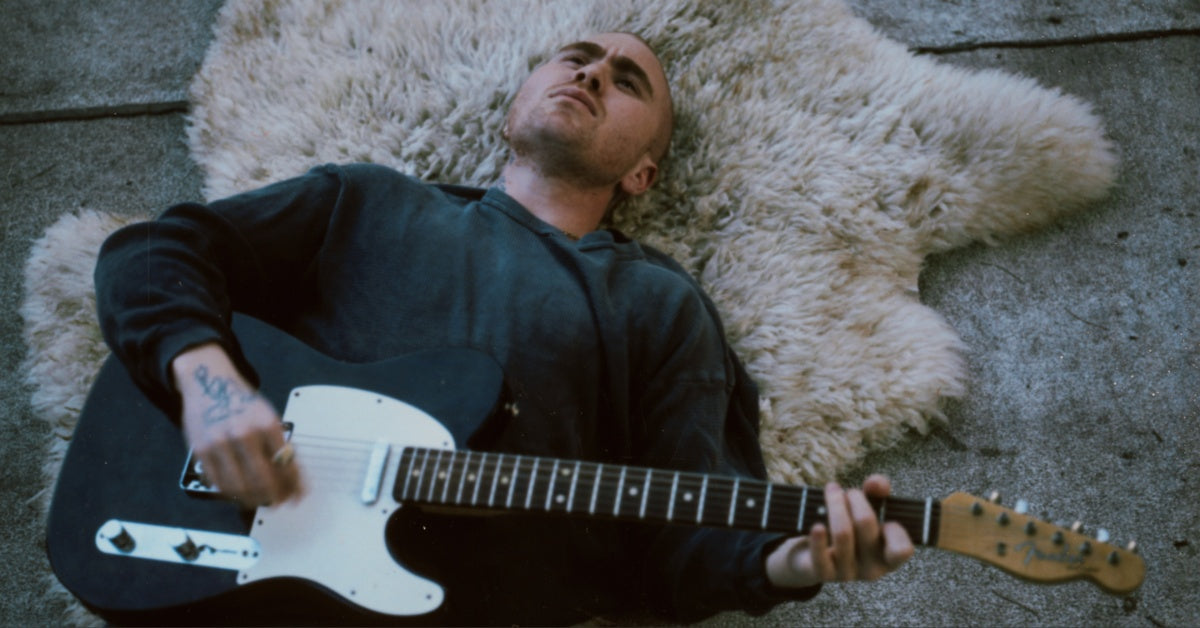
To surrender means to cease resistance to an enemy or opponent, but what happens if the enemy is yourself? For Avery Tucker, learning to surrender — to himself and to his music — was stepping into the unknown, especially after a decade as one-half of Girlpool. “Breaking up the band really threw me,” Tucker says, reflecting on their dissolution in 2022. “It was such a leap of faith and felt vulnerable, like I was doing something scary that I felt pulled to do. I was confronting a deep sense of the unknown, not even about the band itself, but about following a feeling that was scary yet necessary.”
The result of stepping away from a project that defined his 20s meant that he had to reconnect with experimenting and letting go. That concept flickers throughout Paw, Tucker’s debut solo album, out now via Sunkiss Records. Rather than trying to swim upstream and dress up his songs in arrangements, Tucker opted to return to how he made music when he was younger, giving himself to the current of creativity and the unknown of life after the band. “Writing the album, I was processing letting go of Girlpool and listening to myself. I didn’t really know what it was going to look like,” Tucker says. “I just let the album illuminate itself to me.”
Read more: Folk Bitch Trio balance rage and introspection
Paw resists overproduction, trading layered arrangements for clarity and space. Across the album, Tucker explores Earth elements extensively — imagery of tides, moonlight, and the sky, and how they are always changing and moving. The songs all trace the slow unraveling of identity, attachment, and self-understanding.
It mirrors the transformative experience Tucker had while making the record alongside collaborator and friend Alaska Reid. Working closely with Reid, he relearned how to approach recording not as construction but as discovery: setting up a mic, playing live, and allowing imperfection to become part of the truth. Recorded across Livingston, Montana and Encino, California, together, they stripped things back to something essential: songwriting in its rawest form. Branching out as a solo artist, after having another person in Girlpool for so long, was scary, but Reid’s presence was affirming. “I was so used to having a counterpart with Harmony, I definitely wanted someone on the ground with me,” Tucker says.
Following the release of Paw, Tucker opens up about rediscovering simplicity and honesty in his sound post-Girlpool, the role of live performance in his sound, and how his dog’s paw became the crux of the record.

Avery Tucker
When you think back to your childhood, was there a specific album or artist that inspired you to become a songwriter?
I was raised listening to a lot of acoustic songwriters, like Neil Young and James Taylor, then the Beatles. They really inspired me. I remember my parents would play the Live at Massey Hall Neil Young album a lot. That was the first time I heard live music recorded like that. His approach to songwriting and the energy he harnessed in a live space were so innovative. I’d never heard anything like that. The tension between the audience felt really charged, focused, and raw.
I wanted to learn electric guitar because I was obsessed with Tom Petty as a kid, and he played a Strat in all the posters I had in my room. I think he was playing a red Strat, and I always wanted one. But my parents wanted me to learn acoustic before electric, which is funny. They weren’t strict, but for some reason, they were adamant that I learn acoustic first. Looking back, it doesn’t really make sense, but it was probably a noise thing. I was pretty excited when I got an electric guitar. It was an offshoot Strat, an independent company that made one that looked like it. It was turquoise, and I was so excited to upgrade.
Touching back on that live record, how much does performing live translate into production? Is that something you’re actively thinking about when writing, recording, and releasing music?
I think it’s interesting. I started recording music by writing a song in my room and then recording it as soon as possible. Drums in my bedroom, one mic, whatever. That felt really live because it was so unedited and in the spirit of the moment — that demo spirit that’s just so undeniably special. I love demos. There’s so much in a demo. It’s such a loaded term. Those recordings felt very live.
Then, in making albums with Girlpool, another thing I discovered was that we’d write a song, record it, and then go on tour and play it live for the first time. I’d discover new things I liked about the song, wanting to play a part differently, sing a section another way, and discovering new dynamics through playing live. I remember talking with Harmony, saying, “We should play new songs on tour before we record them.” There’s so much to discover there.
As far as this record goes, I did play a lot of the songs live before recording them. I think it depends on the song because some need different things. Some I write and record in the moment and have never played live, which is great, but others I need to get to know more live. Now it’s weird going backward when playing the album live. I don’t really know if I want to play it the way it is on the album.
With approaching your solo work versus the band, I wanted to ask where your mindset was at, because I know the band broke up in 2022. At what point did you feel compelled to pursue a solo career?
I wrote some of the songs before the band split up and just had them. Breaking up the band really threw me. It was such a leap of faith and felt vulnerable, like I was doing something scary that I felt pulled to do, but also I’d never not had this. It had been my career since high school. I was confronting a deep sense of the unknown, not even about the band itself, but about following a feeling that was scary yet necessary.
Writing the album, I was processing letting go of Girlpool and listening to myself. I didn’t really know what it was going to look like. I just let the album illuminate itself to me. I recorded with different friends, eventually found a good place to work it out, and spent a lot of time experimenting, exploring, and letting it unravel.

Julian Klincewicz
I know Alaska Reid was a big, integral part of that process. I love her work with Witch Post. I read that she encouraged you not to self-censor or overly dress up your productions. I don’t know if that came from a place of being scared of being vulnerable, so you’d layer songs heavily in production, but how did that process come about?
Yeah, I don’t even know if it was a conscious desire to hide, but I think I was used to being in studios on the last Girlpool record, where we had session musicians come in and play on stuff. We spent a lot of time on arrangements and sound, which was really cool and fun, but I was longing for a record that wasn’t about that at all.
The first couple of Girlpool albums were just about the songs. It was really just getting the songs down. There was some weird, fun experimentation, but it was very much “it is what it is.” I felt like I needed to unwind my idea of making an album and not overcomplicate the sound.
I had these songs, and I felt really good playing them on my couch with my guitar. I just wanted to record that, but still have fun with it. Recording is strange because the more I do it, the more I just want to set up a mic and play it live. I’m craving the spirit of the performance and the song. I think production is so cool, and I really respect it, but for me, right now, I just want the songs to do the talking. Of course, that’ll evolve and change. Who knows where it’ll go?
I want to talk to you about “Knots,” because I know Alaska is featured on that. It was one song I really gravitated toward.
I went to Alaska’s show. We’d never met before. I don’t usually go to shows much. My friend was going, so I went, and it felt really serendipitous. I loved her show, and afterward we talked, then decided to get lunch later that week. We just clicked immediately. It felt really aligned. We were laughing about how we’d never met before, even though we knew a lot of the same people. Then we were like, “We should write a song together.”
A couple of days later, she came over. Girlpool was all about lyric collaboration — that’s how I really got immersed in lyricism and songwriting. I’d explored a lot of that with Harmony, and then I started writing alone. This solo project was meant to be me really doing that on my own, but I was also letting the album illuminate itself to me. I was down to just write with this new friend and see what happened.
It was pretty seamless. We were both in awe, saying, “This doesn’t happen. This is too easy.” We wrote it in a day, and then, just for fun, went to record it at a friend of Alaska’s studio. Her friend engineered it, and we produced it ourselves. It was super chill and really fun. We were completely in sync, saying, “Let’s get this down. I’ll sing this part,” back and forth. Being in a room with her was so creatively stimulating. We were both feeding off each other’s energy.
Then she said, “If you want me to help with the rest of the album, I’m down.” That was never the intention. We weren’t meeting to make a record together. At the time, I was working with a few other producers and still figuring things out, but she suggested, “What if we just did it together?” That felt really exciting, because it meant we’d be equally in the dirt co-creating, not me working under someone else’s vision. It felt collaborative in a way that was really equal and natural.

Julian Klincewicz
The album title comes from a game you were playing, asking what type of paw or hoof you’d have if you were an animal. The album artwork is your dog’s paw, too. How do visuals play a role in your songwriting or creative process?
It’s funny: I’ve written a lot about elemental things, like water, the sky, and the moon. I’ve written a lot about Earth elements. On this record, I talk a lot about that, like on “Malibu,” “The waves pull in and cover you/I’m the moon, you’re Malibu.” The person I’m talking about is literally the coast; the moon pulls the water and floods it. There’s a lot of moon imagery in there.
There’s also moon stuff in “Big Drops”: “I can feel her now in this house/With all of her things around/On that super moon/And I still got her cowgirl jeans in my room.” And in “Rust,” it’s also about water on land; the way I imagine it, rust forming from contact, water constantly shaping the surface. That song has a line, “When water’s wandering, feel it think, then let it pull you ahead.” There’s this recurring water theme of tides, motion, and surrendering to the current. And then, “When I look at the rocky bed, I see that it’s changed again/Why can’t I too?” That’s the idea — the riverbed changes because the water keeps moving over it.
Even in “Baby Broke,” it’s the same: “It’s not like she feels good about it/She’s dying just to know why/Sometimes when the moonlight pulls, the water just won’t go/And she’s not fine when wild waters lie.” If she’s not feeling intensity or passion, she’s not fine. Those waters are supposed to be wild. So, there’s a lot of nature as reflection.
Yeah, a lot of earthy elements. Even on “My Life Isn’t Leaving You,” the line about braiding someone’s hair is not exactly earthy, but it feels very tactile and grounded, like touch or connection. What was the writing process behind it, and what made you want to close the album with it?
That song was really intense to get out. It’s so much about my relationship to not letting go — this unwillingness to accept anything other than complete devotion. Like, “My life isn’t leaving you,” that’s not just love, it’s life force. I’m giving everything, hoping it’s going to restart something. It’s an intense song. It’s me saying, “I don’t want to see this any other way. My life is never going to leave you. I’ll help you, I’ll get you there, I love you.” It’s so much about attachment and not wanting to let go, no matter what.
It’s like a pressure cooker, ready to burst.
For sure. “I wonder sometimes if the feeling’s alarming, you look at me like you need a reminding, but I can tell my life isn’t leaving you.” It’s not supposed to. There’s confusion and difficulty. This person is struggling, and I’m just like, “You can feel all that. I’m not going anywhere.” It’s an attachment to a fantasy.
When you release a body of work like this, do you see it as a chapter closing or a chapter beginning? Because when you release something, it’s no longer just yours.
That’s such a cool question. I think every release feels like both an ending and a beginning. Even with Girlpool, Harmony and I would always say, “That song finally came out. I’m having a spiritual awakening.” There’s something about letting it go that opens something new, clears space. But it’s also a beginning, because you’re starting a conversation. People in the world are tapping into that frequency. It becomes a communication between you and your listeners. You evolve and release something, but in doing that, you also open new channels.