
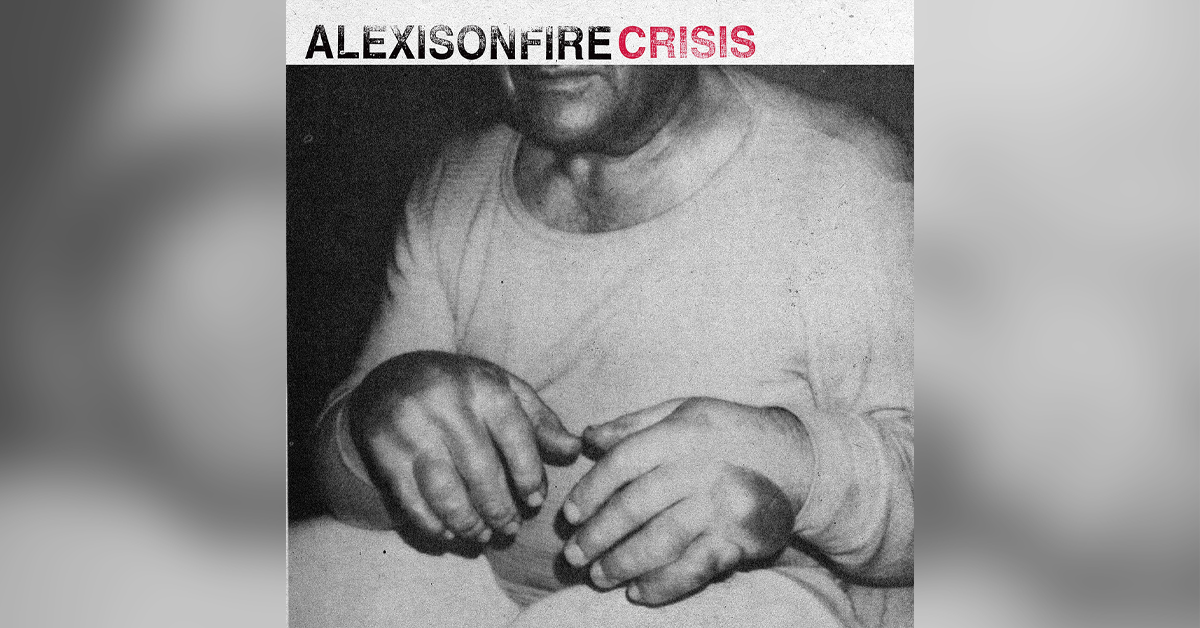
Mike Stringer was 12 years old the first time he heard Alexisonfire, catching “Pulmonary Archery” on the MuchMusic channel late one night and getting hooked on the spot. By the time Crisis, Alexisonfire’s third studio album, arrived in the summer of 2006, he was 15, and it became a liferaft. He recalls the record — which was inspired by the Great Lakes Blizzard of 1977 that engulfed Western NY and the Niagara Region — having a cold, wintry production that felt tailor-made for exactly who he was that year: “this confused, depressed, guitar-obsessed, ‘I don’t fit in’ kid” who was trying to figure out how to pursue music.
He started touring at 16. Today, he’s the guitarist in Spiritbox, one of the biggest heavy bands in the world, and he still credits Alexisonfire — and Crisis specifically — with proving that path was possible for a Canadian kid in a band in the first place. “I was really blown away by how much variety there is on the album,” he says. “It really opened my eyes to how important layering and ambience were within writing and creating an identifiable feel on an album. To this day, I don’t think there’s another album that sounds like Crisis, and it’s still an album I pull from for inspiration.”
Read more: 30 essential alternative albums turning 20 in 2026
That quote represents the significance of Crisis, 20 years later. It’s not just that it’s a “good” record — an entire generation of post-hardcore acts and fans alike credit it as a foundational LP. It debuted at No. 1 on the Canadian Albums Chart, an unheard-of feat for a post-hardcore band that contained equal parts clean vocals and screaming. The more interesting evidence is anecdotal: Ask almost any post-hardcore musician about Crisis, and 9 times out of 10, you get some version of Stringer’s story.

Thousands of miles separate St. Catharines, the hometown of Alexisonfire, and Glasgow, but even Stephen Christy, guitarist of alt-rock up-and-comers newshapes, sees himself in the band’s rise. Historically, the music industry has always heavily focused on acts from the U.S. and U.K., and Alexisonfire’s international breakthrough from what was, at the time, a fairly small Southern Ontario scene, was a sign that anyone could make it.
“Without Crisis, I don’t think an entire generation of post-hardcore bands would exist, including ourselves,” Christy says. “A lot of the bands we grew up listening to and looking up to were coming out of the U.S., so seeing a band like Alexisonfire break through internationally from a relatively small scene was really inspiring. I think what makes them such a useful reference point isn’t necessarily that they were from Canada, but that they proved you don’t have to come from one of the typical countries of the music industry to build something that reaches people everywhere. They developed their own identity, built a community around the band, and really quickly took that well beyond their local scene.”
The discussion around Alexisonfire, and specifically Crisis, always comes back to the voices: the way George Pettit screams alongside Dallas Green’s crooning and Wade MacNeil’s gritty vocals were arranged against each other. Michael Hamilton, bassist of newshapes, calls Alexisonfire “the kings of countermelody” — guitar parts that stay distinct from each other but interlock perfectly, a technique he points to directly in “Boiled Frogs” and tries to integrate in his own band’s arrangements. He hears the same logic in the vocals: On “Drunks, Lovers, Sinners and Saints” especially, three genuinely different voices bring something different to the same song without it ever feeling disjointed. It’s a lesson Hamilton says he’s chasing directly in newshapes’ newer material, trying to preserve the three distinct voices in their band instead of blending them into one or pushing one to the forefront.
“I think, creatively, we are also in quite a similar place to where they were when they were working on Crisis, with a similar ethos,” Hamilton says. “Taken with the albums before it, Crisis feels like a culmination of everything they’d done up to that point. That’s something I’m trying to take with me when I’m working on new music… I guess I’m just trying to make music that makes others feel the way Crisis made me feel.”

George Donoghue, one-half of the alt-rock duo WREX, took a local crew job on Alexisonfire’s 2018 Reading Festival reunion just so he could watch from the side of the stage. His read on the record’s vocal arrangement is the most concise version of Hamilton’s point: On Crisis, there doesn’t need to be one focal point. “The way they weave together three distinct vocal styles with those intertwining guitar parts is a masterclass,” he says. “If you break down the individual parts, they’re all doing something unique, but together they interweave and feel like one. That’s something I’ve always taken from Crisis — there doesn’t need to be one focal point. The song itself can be the front person. It’s heavy, melodic, and chaotic, but still incredibly considered. Twenty years on, it still hits just as hard.”
That interweaving isn’t only happening in the vocals and guitars. When Mike McKerracher, the drummer for Bearings and a touring member for a handful of bands like Crown the Empire, is asked about Crisis, the first thing he does is point out that Jordan Hasting’s drumming rarely comes up in conversations about the record.
“It’s a shame the drumming isn’t praised more,” McKerracher says. “Musical restraint is a great skill to have as a drummer, and it’s definitely the main thing I took away from this record. I appreciate when a drummer knows when to straighten a part out and let it drive, or when to get more syncopated and complex. The drum parts in ‘Mailbox Arson’ are a perfect example of that. Something as simple as a well-placed fill between two similar parts can have the same effect. Tasteful musical phrasing like that is something every drummer should use to tell a story through the instrument, regardless of genre.”
For McKerracher, who’s spent his career moving between pop punk, post-hardcore, and alternative rock, that sense of when not to play is the part of Crisis’ DNA that shows up least in tribute pieces and most in his actual playing. He credits the LP more broadly with normalizing genre-blending in heavy music before it was common practice. “Alexisonfire played a big part in showing musicians that kind of thing was possible in the first place, and they’ve definitely influenced a lot of bands in the space today,” he says. “The bands I play with are never strict about sticking to one genre, and I think that same mentality comes through in my playing. When you’re open to pulling ideas from different genres, it can take you somewhere unique and original, which honestly is just what good songwriting looks like these days. For myself and many other musicians, AOF was one of the first examples of that.”
Crisis didn’t just represent Alexisonfire getting heavier. Jake Hughes, guitarist of Free Throw, frames the record as a “perfect balance between a breath and a cough.” Back in 2006, Hughes was listening to a mix of bands, from Thrice and Thursday to Death Cab for Cutie and Dashboard Confessional. “Crisis sits somewhere in the middle of all the music I was listening to in the mid-’00s,” he says. “In hindsight, it is unsurprising how my music tastes formed over time. There has always been something so beautiful to me when two extremes exist in the same space.”
What Free Throw have taken from those two opposites isn’t a sound so much as an ethos: that vulnerability, not just volume, is what makes a heavy record land. “I think Free Throw has always been a band that thrives off energy,” he reflects. “Whether it be from the music or the crowd, it’s always present. Albums like Crisis have a way of giving the listener a front-row seat to that energy and tension. Above all, there is an honesty and desperation to Alexisonfire. When writing songs, we always strive to find that kind of vulnerability. Crisis has stood tall for 20 years and will remain there for many more to come.”
When performing over the weekend in Toronto for their Crisis anniversary shows, the band told the crowd that the effect they’ve had is a direct reflection of what happens when people support independent music. Twenty years ago, they likely couldn’t have anticipated the impact Crisis would have on the genre, but it’s proof that a specific, uncompromising band from Canada could find an audience. Although the album sits alongside influential records from 2006, including AFI’s DECEMBERUNDERGROUND, Saosin’s self-titled, and Bring Me the Horizon’s Count Your Blessings, Stringer says there’s still nothing else that sounds like it.

“Alexisonfire’s discography really is a great example of doing whatever feels right, and not worrying about genre labeling,” he explains. “That’s always been my band’s mission statement, and they instilled that in me from a young age. If you listen to their albums, you hear so many melodic hooks within the ambient guitar melodies, and that’s ingrained within my writing at this point. That, combined with how they’ve authentically balanced the heavy side and melodic side, really shows you can do whatever you want, and it can resonate and find such a massive audience.”
Two decades on, the clearest evidence of Crisis’ legacy isn’t how many records they sold or what chart position it achieved. Instead, it’s how consistently bands that followed them describe it as a formative, defining turning point. Christy’s claim that an entire generation of post-hardcore bands, his own included, might not exist without it is a literal account of how this record moved through the scene.
Looking out into the crowd during their anniversary run of shows, it was physical proof of what they created back in 2006. Crisis was an album made by a handful of misfit kids that gave a generation of fellow outcasts somewhere to belong. Now, that ethos is being carried forward by the bands who grew up listening to it, building the next scene. It’s a sentiment Stringer believes wholeheartedly. “Alexisonfire showed what could be possible for a heavier Canadian band,” he says. “They are the reason I started touring at 16 years old. Without them, I don’t think I would still be pursuing music all these years later.”