
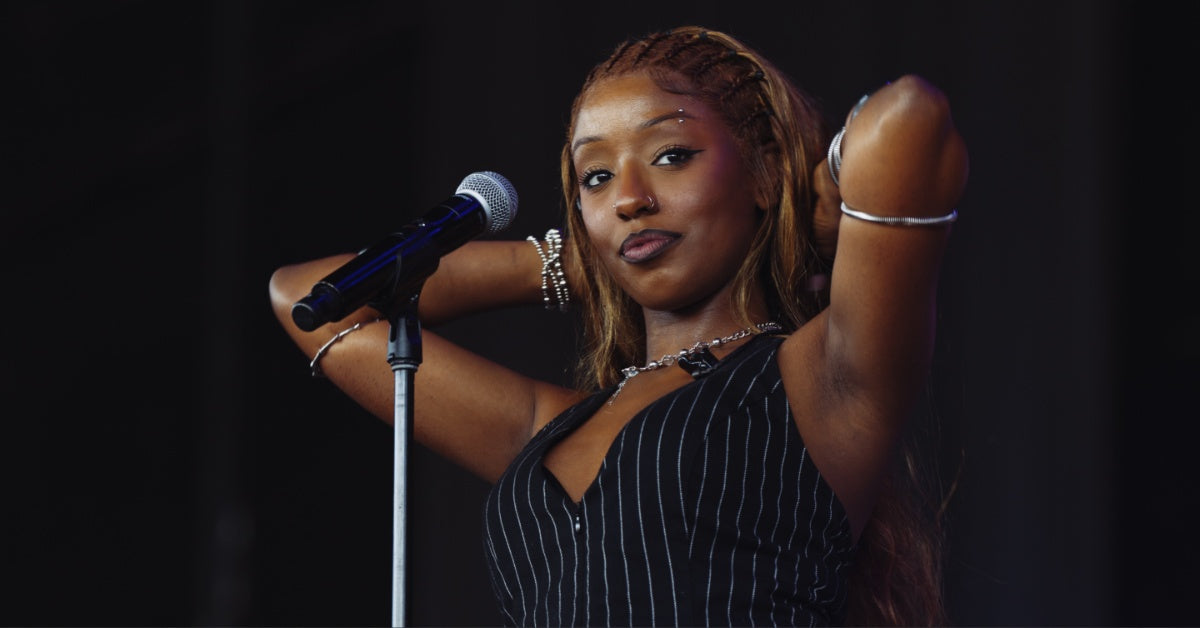
There was a point in her life where Alemeda thought she knew everything. But somewhere between the growing pains of her 20s and the sobering clarity that arrives when you make mistakes, the Ethiopian-Sudanese artist has realized there’s beauty in feeling uncertain. That gray area is exactly where But What The Hell Do I Know, her latest EP, exists.
“With maturity, you realize you actually know less and that you have so much more to learn,” Alemeda says, following her set at the inaugural edition of All Things Go in Toronto. “When approaching this project, But What The Hell Do I Know came from a place of acknowledging that I don’t know everything. It’s humbling. You feel kind of stupid, like you’re starting from scratch again.”
Read more: Fan poll: 5 best 2000s music videos
Where last year’s FK IT EP was assured, But What The Hell Do I Know is Alemeda letting herself be grounded by the mistakes she’s made and what she doesn’t know. The internet jokes that the human brain isn’t fully developed until the age of 25 and all choices before then should be warranted, but it’s something Alemeda, now 25, explores fully on the EP. But What The Hell Do I Know sees Alemeda touching on everything from heartbreak to fractured friendships, like on the stripped-down “I’m Over It,” where she’s at her most vulnerable, singing “You broke me down, I picked you up/I held your hair and flushed your drugs.”
Alemeda opened up about creating But What The Hell Do I Know, collaborating with Doechii, and becoming the Black rock star she needed when she was growing up.
How would you say you’ve grown since the release of FK IT last year?
I’ve been more open to collaboration. From the beginning, I’ve always been hands-on with production, but for But What The Hell Do I Know, I was even more hands-on than before.
The EP sounds like it captures a tension you were experiencing, teetering between feeling confident and uncertain. How do you balance those energies when you’re creating or performing?
There’s always uncertainty in general. And with maturity, you realize you actually know less and that you have so much more to learn. When approaching this project, But What the Hell Do I Know came from a place of acknowledging that I don’t know everything. It’s humbling. You feel kind of stupid, like you’re starting from scratch again.
Does that feel like returning to a childlike sense of wonder and joy when you uncover something new?
100%. Yeah, I think so.

Robbie Serrano
You weren’t allowed to listen to pop music growing up, but you could watch Hannah Montana and Camp Rock. What was it about them that made you feel like, “Oh, this is something I could eventually do”?
Yeah, I sneaked it. As an artist myself, I don’t think I viewed it that way. The journey of me starting music was very… I was pulled into it. It’s not like I saw it and said, “I’m gonna be that when I grow up.” It was more like, “That would be cool, but that’s not happening.”
But watching those things and being an early 2000s kid shaped my dream of being an artist — what kind of music I’d want to make if I were an artist, before I even thought it was possible.
You talk about wanting to be the rock artist you didn’t have as a kid. Why is that important to you, to be someone other kids can look to?
I think it’s about reclaiming it, because rock came from Black people. Soul, all the music in that category — it comes from Black people. I feel like they got wiped out completely. It was crazy growing up watching nothing but white people doing that music. I was still bumping Paramore and Avril Lavigne, but it was crazy that there were no Black people doing it. Then I did my research and found out that two generations before, there were so many Black rock artists. For me, especially being Ethiopian — and not a lot of Ethiopian people make music, let alone rock — it’s about reclaiming that energy, that power.
You talk about shedding old patterns and losing your old self on “Losing Myself.” What parts of your old self did you find hardest to let go of? Or is it more about being accepting of those old parts?
Being more accepting, for sure. Going back to the whole “I don’t know it all” and being open to learning. And environment, too, like letting go of people I probably shouldn’t hold onto just because I love them or like them.

Robbie Serrano
My favorite song on the EP is “I’m Over It.” Friendship breakups are rarely talked about, and they can be even more gutting than romantic ones. Why was it important for you to give that experience the same emotional weight?
I grew up with not a lot of family. All my family is in Ethiopia. I just have my three siblings here and my mom, and she didn’t really raise me completely. I always looked for family in my friends. I don’t think that was good — I think that it was horrible. But I held those relationships way higher than my family sometimes, so that was a fuck-up within itself. That was the perspective I was writing from.
“Beat a B!tch Up” features Doechii. Can you tell me a bit about working together and how it came to fruition?
We’re signed to the same label, same manager. She came around, and I immediately loved her. She’s so confident. It rubbed off on me because I didn’t know what the fuck I was doing. She came in like, “I know who I am.” We were out at a producer friend’s birthday, and I was being stupid, like, “Oh, somebody came to you? I’ll fight you right now.” And she was like, “Oh, thank you,” because we’re both on that crash-out timing.
I made the song inspired by her, but the song was actually about a breakup I was going through. It was just inspired by that feeling of “I would do anything for you, including fight people.” I sent it to her, and she did her verse. It’s like a four-year-old song.
Yeah, it’s an old song. Has it gone through a lot of versions?
Yeah, 100%. I reproduced the final version like four months ago.

Robbie Serrano
Why do you think it took all these iterations?
I just love it. Straight up, my manager and I were beefing about putting the song out, and he was like, “It’s a good song. Just put your best work out.” And I was like, “No, this is my favorite song I’ve ever made. I want to wait.” I honestly was gonna wait for the album. But I thought, “You know what? I’ll just put it on this EP.” The timing felt right.
I wanted to ask about visuals. Do you think about visuals when writing or recording?
I used to, but recently my creativity with music videos has depleted. I did everything I wanted to do, so now I bank on directors. Before, I was like, “I want this video to be this and this.” Now I’m like, “I don’t know, guys. Just figure it out.” But I do give my ideas and feelings — what the song makes me feel or the scenery — and they create a treatment from that.
Lastly, if But What The Hell Do I Know is about questioning everything you thought you knew, what’s one truth you feel certain about now?
Pertaining to the EP: how people feel about you is how they treat you, not what they say. That was a big lesson for me. I’m constantly making excuses for people, like, “They’re horrible, but it’s because they went through this.” Seeing shit for what it is, not fueling yourself with excuses. That’s the one I’m sure of.